
Olympic Pipeline officials describe Nov. 11 Milepost 78 release, recovery and remaining emergency response
Get AI-powered insights, summaries, and transcripts
Subscribe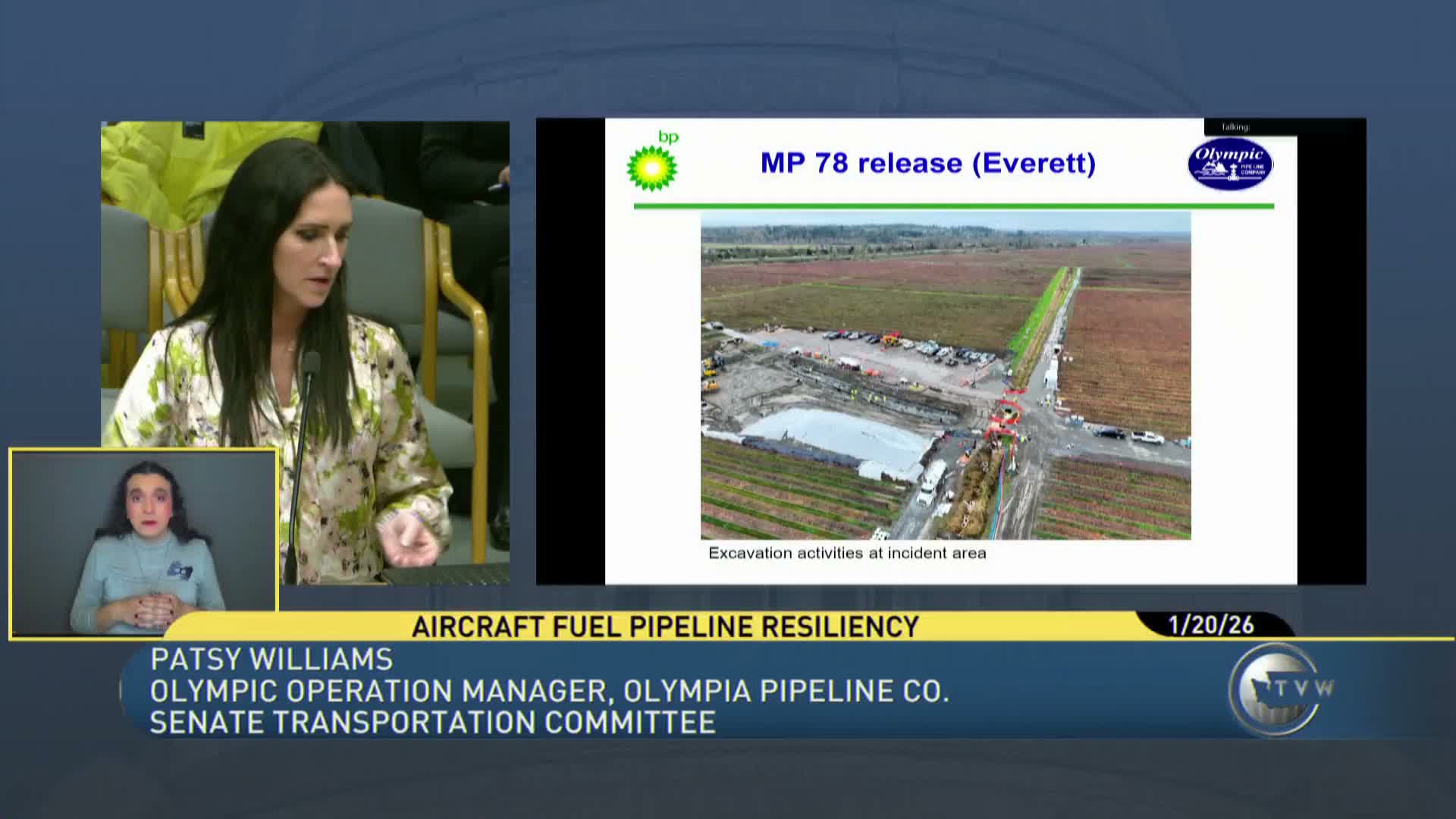
Summary
Olympic Pipeline and BP told the Senate Transportation Committee the Nov. 11 Milepost 78 release was small, discovered by a farm worker, and prompted an immediate shutdown and cleanup that removed 124 truckloads of contaminated soil and recovered 2,630 gallons; response remains active after December flooding washed away access roads.
Patsy Williams, Olympic Pipeline president and operations manager, told the Senate Transportation Committee on Jan. 20 that crews shut the system down immediately when a farm worker reported a sheen near Milepost 78 on Nov. 11 and that response teams later identified the leak on the 20‑inch line.
"We shut down the pipelines immediately," Williams said, describing on‑site excavation, construction of temporary access roads and coordination with oil‑spill response organizations and incident‑management teams. She said the 16‑inch pipeline segment was restarted Nov. 16 after testing confirmed its integrity; crews completed repairs on the 20‑inch line and removed 124 truckloads of contaminated soils. "The gallons of fuel that were recovered so far are 2,630 gallons of fuel," Williams added.
Williams reviewed Olympic's integrity programs, noting the system is subject to federal and state oversight: rate regulation by the Federal Energy Regulatory Commission, emergency‑response oversight by the Washington Department of Ecology, and safety regulation by the U.S. Department of Transportation's Pipeline and Hazardous Materials Safety Administration (PHMSA). She described in‑line 'smart pig' inspections (regulatory minimum every five years), external inspections, geotechnical assessments and cathodic‑protection surveys.
Committee members pressed on why the leak was first reported by a farm worker rather than by automated systems. Senator Christian said, "why did it take a farmer to find this with all of the technology that we have?" Williams answered that the release was smaller than the system's detection threshold and "it leaked for an amount of time that it accumulated," placing it below automated detection.
Senator McKeown pressed on pressure monitoring in the control center; Williams said normal operating pressure is "800 pounds or below," and emphasized that very small pinhole leaks may not immediately register a pressure anomaly on a large, high‑pressure system.
Williams said the company remains in emergency‑response mode following historic flooding on Dec. 11, which washed away temporary access built to reach the site; Olympic is monitoring the location daily with overflights and drones and is rebuilding access with rail and contractor coordination before resuming full field operations.
Why this matters: the pipeline supplies jet fuel regionally, including SeaTac Airport. Committee members asked for a post‑incident report on total release volume and a failure analysis; Williams said that calculation will follow laboratory analysis of removed soils and the failure‑mechanism determination.
Next steps: Williams said Olympic will remain in emergency mode until Washington Department of Ecology and UTC thresholds are met and that the company will provide follow‑up reporting to the committee once they complete their volume calculations and failure analysis.