Get Full Government Meeting Transcripts, Videos, & Alerts Forever!
Get email alerts on the Elections Administration topic
No spam. Unsubscribe anytime.
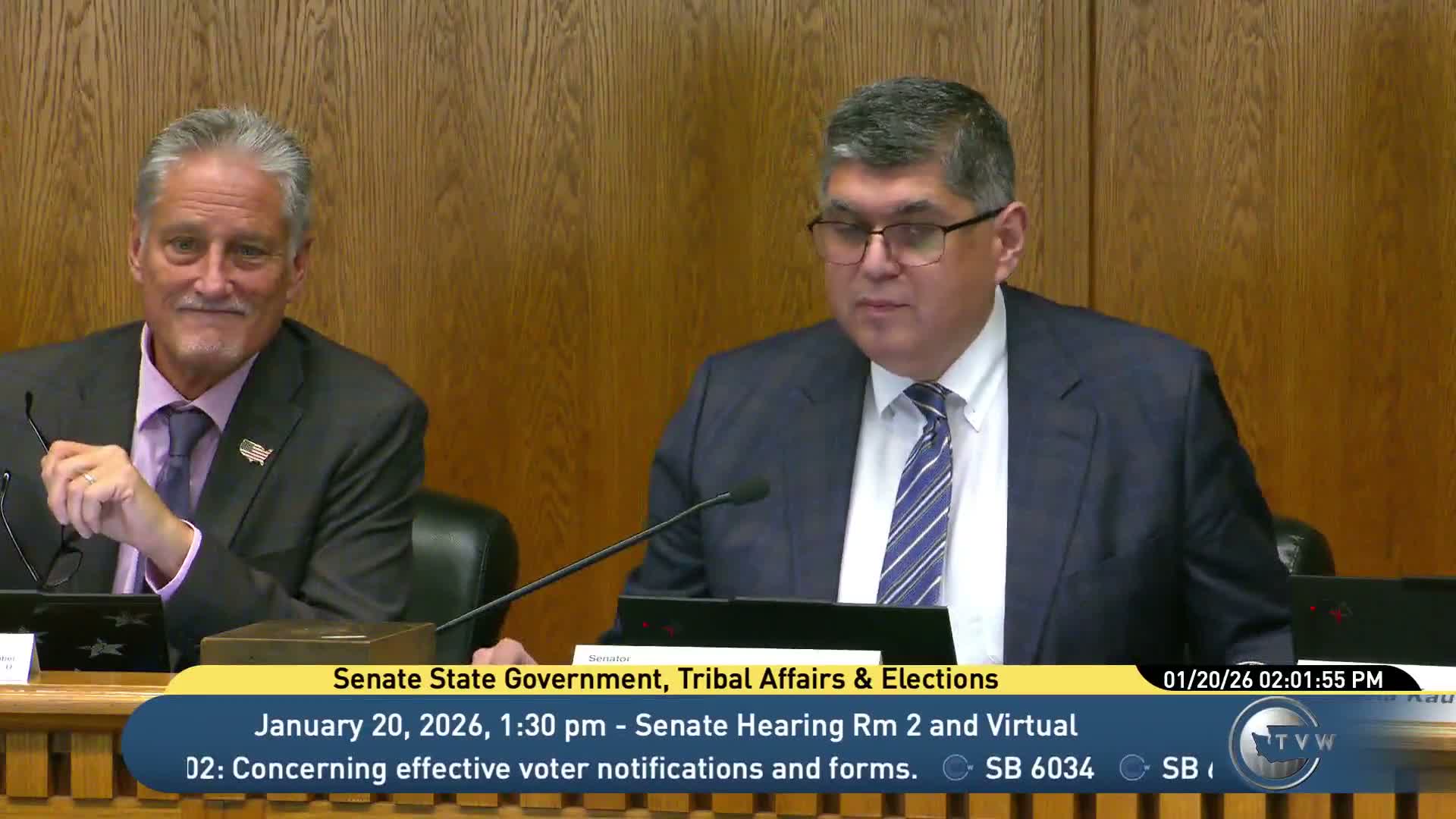
Committee considers SB 5902 to modernize voter notices and reduce mailing costs
Summary
Senators heard that SB 5902 would update voter‑notification procedures, allow in‑person address‑change forms and permit electronic acknowledgments to replace some mailed notices; county auditors estimated $1.9M–$3.8M in mailing cost savings. Testimony was broadly supportive; no vote was taken.
The committee received a briefing and public testimony on Senate Bill 5902, which would revise election notification procedures and forms to streamline automatic voter registration (AVR) communications and allow in‑person address‑change forms.
Committee staff said the bill requires standardized forms approved by the Secretary of State, allows county auditors to accept certain in‑person address changes without a full registration form, and lets mailed acknowledgement notices be skipped when voters respond electronically; a fiscal estimate said counties could save roughly $1.9 million to $3.8 million in mailing costs based on 2025 figures.
Sponsor Sen. Matt Behnke (8th) said the measure reduces barriers to participation with bipartisan intent and improves data quality. Michael Shaw, representing the Washington State Association of County Auditors, urged passage and cited the ~$1.8 million savings number from the fiscal analysis. County and Secretary of State witnesses discussed opt‑in text messaging and confirmed any text outreach would remain opt‑in per FCC rules.
Witnesses from county auditors’ offices described operational benefits, while the committee recorded the number of pro and con sign‑ins. The chair closed the hearing after limited questioning from members; no amendments or votes were recorded.