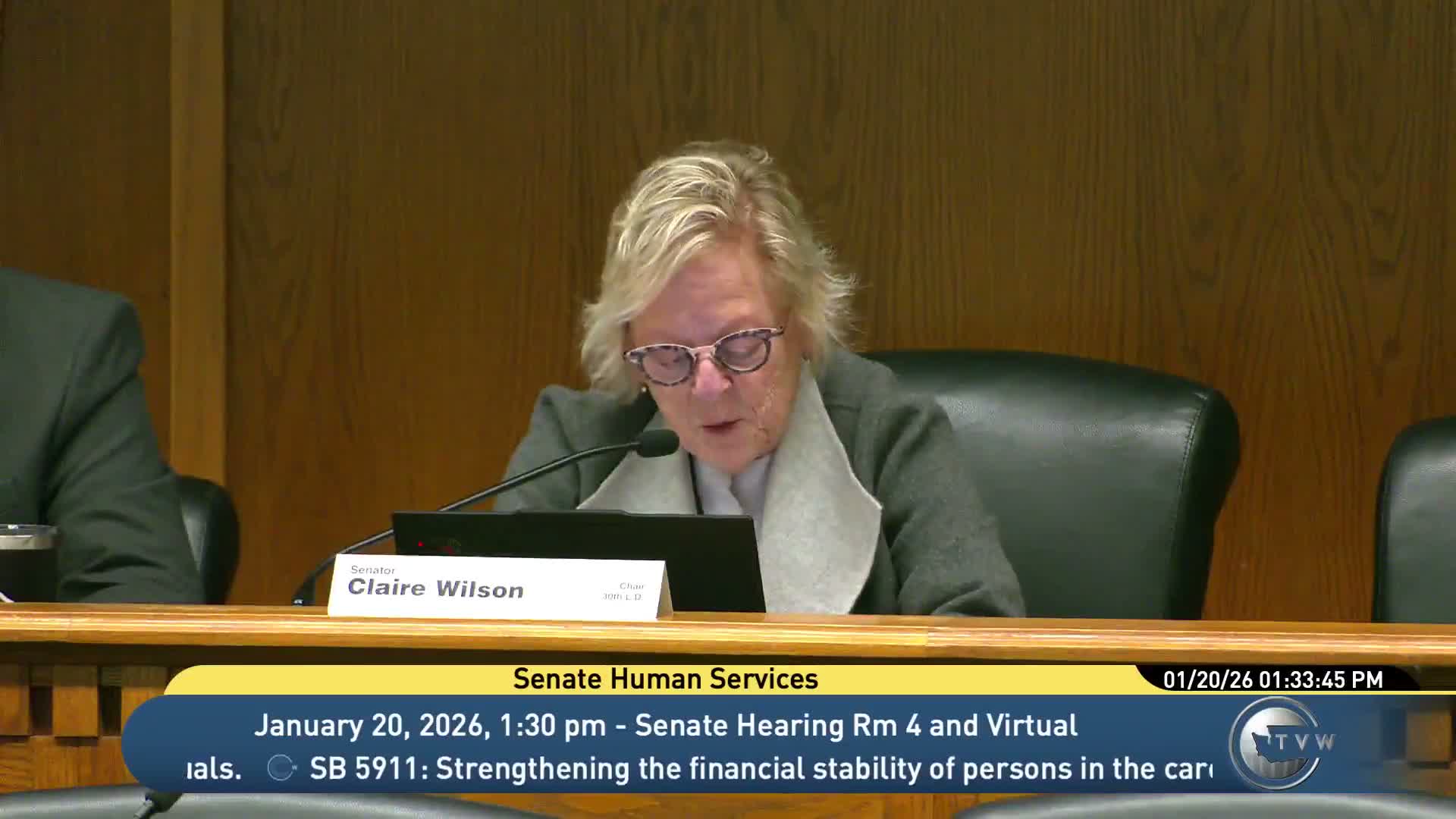
Senate committee advances escorted-leave bill after rejecting liability, monitoring and time-limit amendments
Loading...
Summary
The Senate Human Services Committee adopted a proposed substitute for SB 5,873 on escorted leaves for incarcerated individuals after rejecting a slate of amendments on monitoring, duration, staffing and liability. The bill now proceeds with a due-pass recommendation to Rules.
The Senate Human Services Committee advanced Senate Bill 5,873 on Jan. 20, approving a proposed substitute that would define escorted leaves of absence and expand eligibility in certain cases. The committee adopted a technical amendment to align the bill’s family-definition language with Department of Corrections (DOC) usage and rejected several amendments that would have narrowed or constrained escorted leaves.
The bill, introduced in committee briefing by staffer Will Thompson, would combine escorted leaves for funerals and bedside visits into a single category, define "immediate family," and expand escorted leave requests to include individuals participating in reentry programs aimed at preparing them for successful reentry. Thompson told members the Department of Corrections provided a fiscal estimate of less than $50,000 per year.
Why it matters: Supporters said escorted leaves can support rehabilitation and family relationships, while opponents warned of public-safety and fiscal risks. The committee’s decisions keep the bill’s access provisions broader than several senators sought to narrow.
Key debate and votes focused on Christian-sponsored amendments. Senator Christian offered measures that would have excluded people in close custody from eligibility; required electronic monitoring during leaves; limited leaves to Washington state; capped leaves at eight hours; made the state fully liable for criminal acts committed during a leave; required two corrections officers for each leave; and inserted a null-and-void funding condition. The committee rejected these amendments by voice votes after exchange of arguments.
Senator Christian argued for restrictions, saying, "If they're getting special privileges to leave, ... it has to be within Washington State," and urging limits to reduce risks to public safety and fiscal exposure. The chair and other supporters countered that DOC already applies risk-based determinations and needs flexibility to enable end-of-life and family visits that may cross state lines or require more time.
After the amendment votes, the chair moved to roll the adopted technical amendment into a proposed substitute and the committee gave the substitute a due-pass recommendation. The chair said the bill "passed subject to signatures" and indicated it will move to the Rules Committee for further consideration.
The committee did not produce a recorded roll-call tally in the transcript; votes were taken by voice. The next procedural step is Rules consideration and any subsequent floor action.
The committee recessed for caucus earlier in the meeting and reconvened to complete executive-session votes.