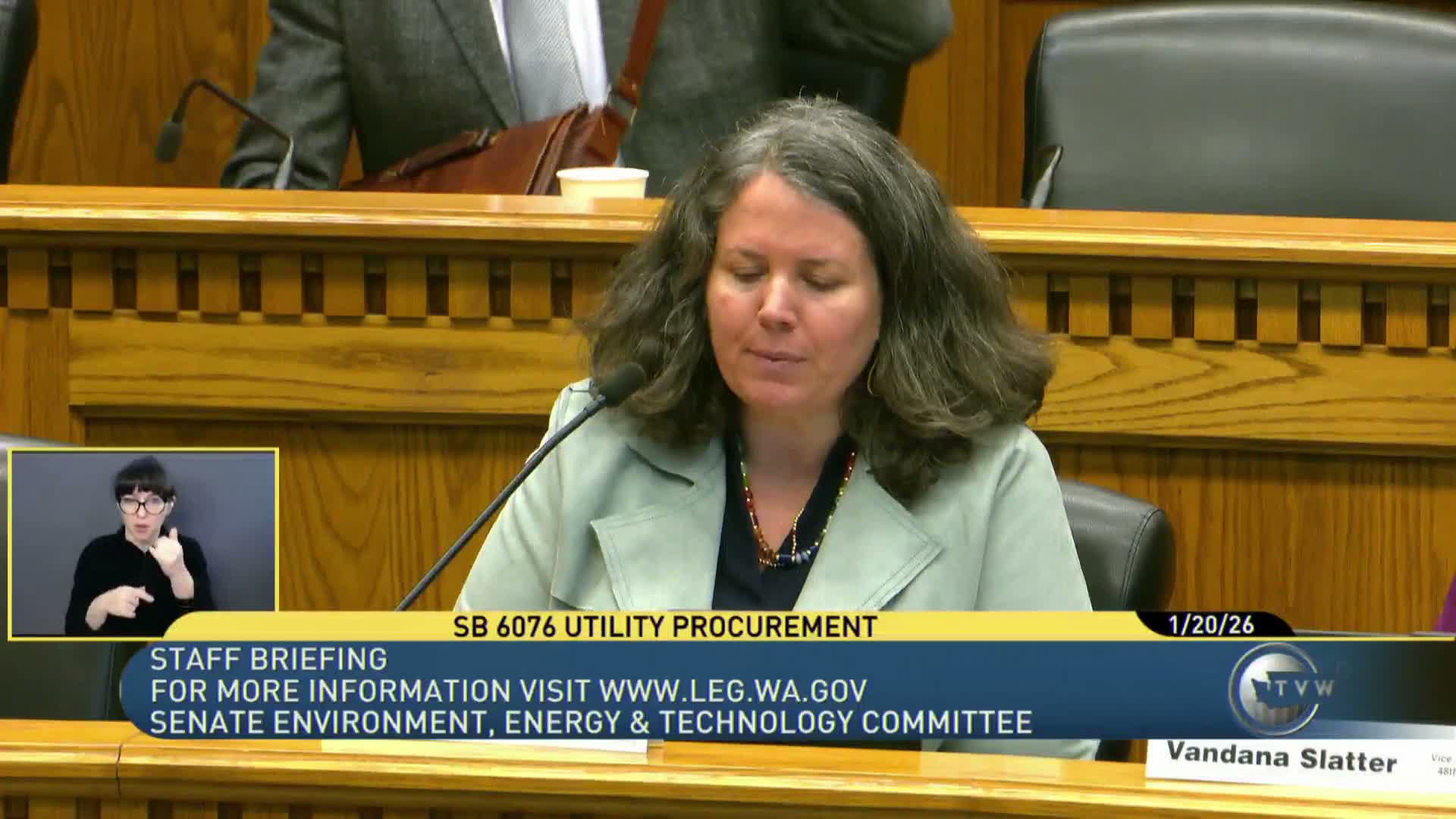
Committee hears bill to speed PUD procurement for energy projects
Loading...
Summary
A bill to raise public-works thresholds and expand procurement options for consumer-owned utilities (PUDs) drew support from utility associations and unions, who said the changes would speed projects and help address equipment shortages; staff said fiscal impacts to local governments are indeterminate.
The Washington State Senate Environment, Energy & Technology Committee on Tuesday heard Senate Bill 6076, legislation that would temporarily raise procurement dollar thresholds for public utility districts (PUDs) and streamline certain competitive-bidding rules for energy-generation, storage and transmission projects through Jan. 1, 2045.
Kim Cushing, staff to the committee, told members the bill has two main parts: it increases the dollar caps that allow PUDs to perform public-works projects without formal contracts and expands the use of preapproved vendor lists for purchases tied to specified energy projects. The measure would also permit electronic bid submissions, raise the share of a contract that may exceed estimated costs from 15% to 25%, and allow governing bodies to waive competitive bidding for narrowly defined proprietary or reliability-related procurement actions.
Sponsor Sen. Keith Gainer, identifying himself for the record as representing the 12th District, said the policy responds to rising equipment costs, supply-chain constraints and an aging electric grid that require faster, more flexible project delivery. He said the changes would let PUDs “get the work done more cost effectively and in a more expeditious manner” and noted the work would be performed by union-represented personnel.
Utility and labor groups that testified in favor described the scale of the challenge. Nicholas Garcia, policy director for the Washington Public Utility District Association, said the region needs thousands of megawatts of new nameplate capacity and accompanying transmission and distribution assets over the coming decade and that the bill could shave roughly six months from the time it takes to place critical assets into service. Matthew Harris, senior policy analyst for Grant County PUD, and Jason Hudson, government affairs director for IBEW Local 77, said rising costs for crucial components — including transformers, which speakers said are currently difficult to procure — and a backlog of projects make greater procurement flexibility necessary.
Committee staff noted a local government fiscal note is available and that the bill’s effect on local government expenditures is indeterminate, mostly because it would require updates to procurement documents and staff training. No committee questions were recorded during the public hearing on this bill, and staff reported 63 people signed in (60 pro, 3 con).
The committee closed the public hearing on SB 6076 and moved on to other items on the agenda. Any further action, including amendments or votes, was not announced at the hearing’s close.