Get Full Government Meeting Transcripts, Videos, & Alerts Forever!
Get email alerts on the Tobacco Vapor Regulation topic
No spam. Unsubscribe anytime.
Committee hears contrasting testimony on sweeping vapor and tobacco bill that would raise fees, expand enforcement and remove preemption
Summary
House Bill 24 39 would raise licensing fees, increase penalties, ban certain products and remove state preemption to let localities adopt stricter rules; public health groups urged passage for youth prevention and to restore funding, while retailers and industry warned of enforcement gaps and economic harm.
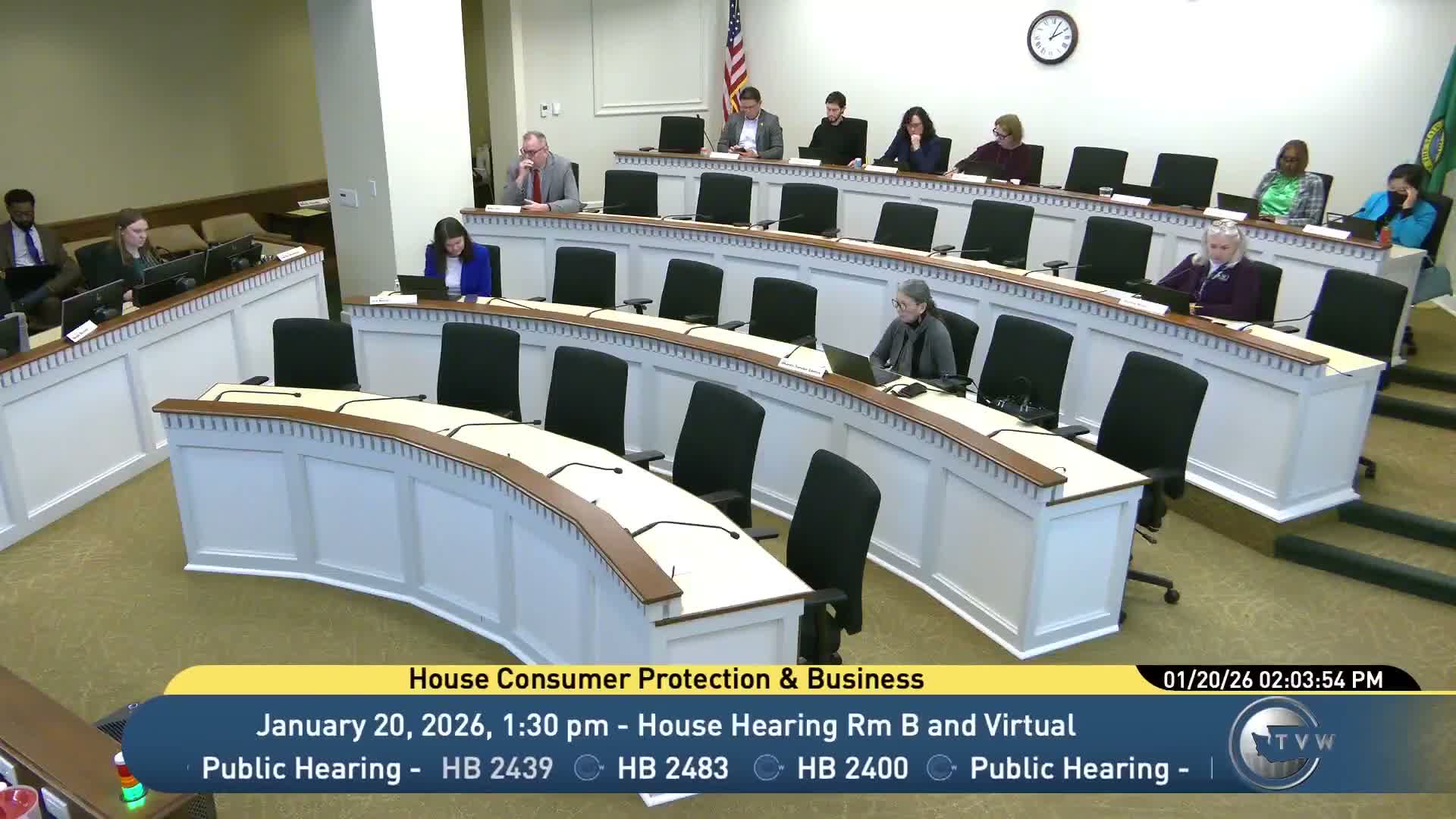
The Consumer Protection and Business Committee held an extended public hearing Jan. 20 on House Bill 24 39, a 14‑part omnibus bill that would change licensing, enforcement and revenue allocation for tobacco and vapor products in Washington.
Staff summarized multiple provisions: creation of a Liquor and Cannabis Board responsible "responsible vendor" program and training to reduce underage sales; increases in retailer, wholesaler and distributor license fees to approximately $1,000; stiffer penalties for violations of youth‑sales rules; certification and attestation requirements for manufacturers; prohibition on sales of products that imitate non‑vapor items or have interactive entertainment features; removal of state preemption to allow local governments to adopt stronger rules; a study of an extended producer responsibility program with a 2027 report date; and a redirection of portions of tobacco tax revenue to the Andy Hill Cancer Fund, foundational public health services, and a youth prevention account (each up to specified yearly caps).
Representative Christine Reeves, the prime sponsor, described the bill as an omnibus approach to prevent youth access, stabilize funding for foundational public health services and create greater parity in how tobacco and vapor products are regulated. She acknowledged substantial stakeholder disagreement about preemption, couponing and fee levels and asked the committee to consider the bill as a starting point for negotiation.
Public testimony split along predictable lines. Health‑sector witnesses — including the State Association of Local Public Health Officials, the Campaign for Tobacco‑Free Kids, the American Heart Association and medical professionals — supported the bill’s prevention focus and the proposals to dedicate tobacco revenue to youth prevention and public health services. Joe McDermott, representing King County Executive’s office, warned that cuts to the foundational public health services account would force jurisdictions to reduce core services like disease surveillance and homeless outreach without new revenue.
Industry and retail witnesses urged caution. Representatives of convenience stores, vape shops, national manufacturers and trade associations opposed key parts of the bill, citing three central concerns: the removal of state preemption could create a confusing patchwork of local rules; large increases in licensing fees (retailer fees from $175 to $1,000 in the draft) would disproportionately harm small businesses; and the state lacks the agency capacity to implement and audit new manufacturer certification and licensing requirements. Several retailers described recent revenue declines after tax changes and warned that overly burdensome rules could accelerate closures or push consumers to illicit or out‑of‑state sellers.
Law‑enforcement and public‑safety witnesses urged stronger enforcement against illicit imports and noted large recent seizures nationwide; they supported measures that would improve ability to seize untaxed or illegal products.
The hearing produced no votes. Multiple stakeholders asked the committee to pursue further negotiation on definitions, fee structures, enforcement capacity and preemption language before the bill advances.