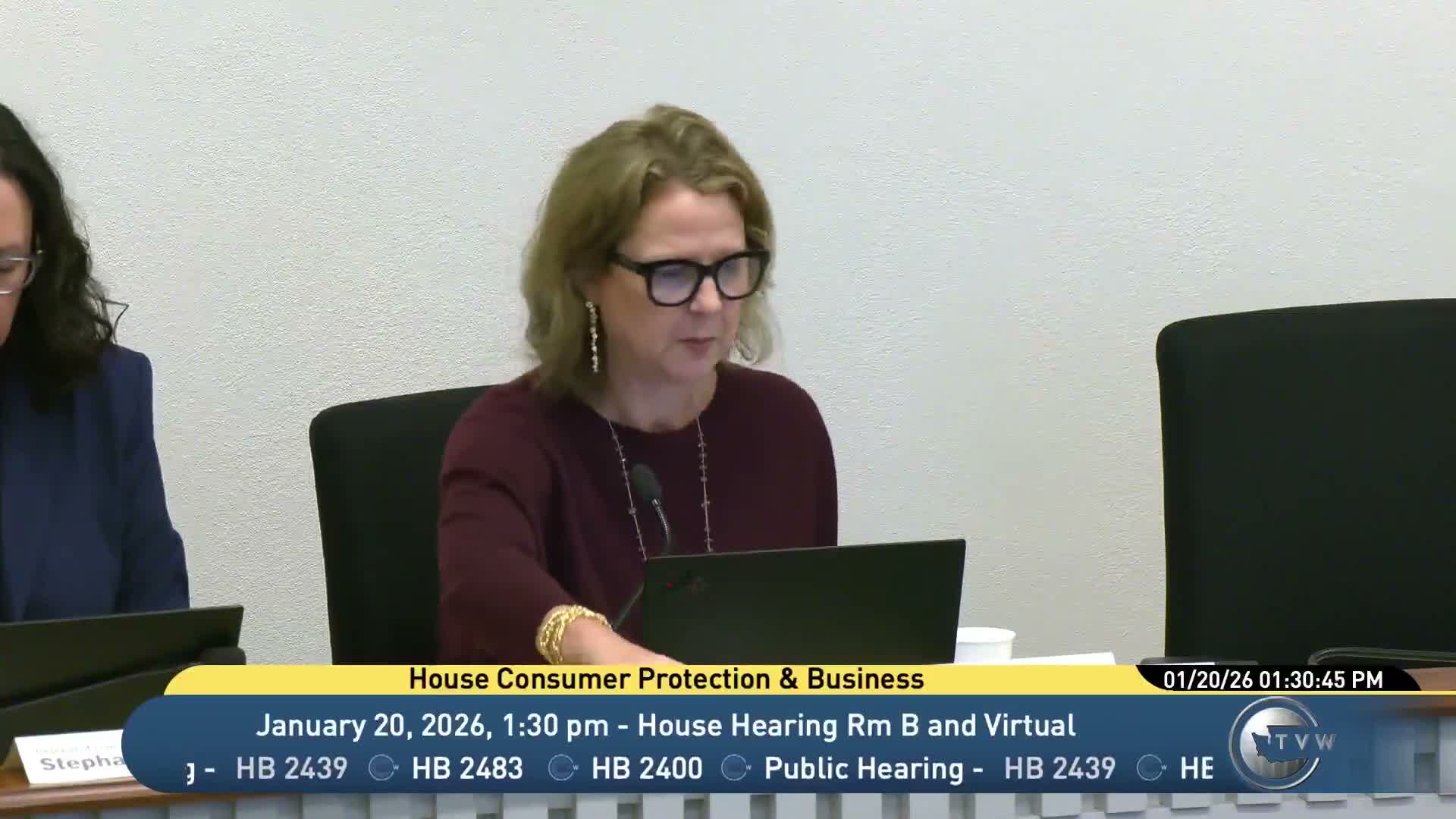
Washington committee hears bill to register data brokers, stakeholders warn definitions are broad
Loading...
Summary
Representative Shelly Kloba and staff summarized HB 24 83, which would require annual registration of data brokers and public disclosure of firm-level practices; industry groups said the bill’s definition is broader than Oregon/California and could sweep in non‑brokers, offering to work on clarifying amendments.
A Washington state committee heard staff and sponsor testimony Jan. 20 on House Bill 24 83, which would require businesses that collect and sell "brokered personal data" to register annually with the Department of Licensing and publish information about the data they collect, how they process it, who they sell it to and for what purposes.
Megan Mulvihill, staff to the Consumer Protection and Business Committee, told members the bill defines a data broker as any business entity that collects and sells or licenses brokered personal data irrespective of its relationship with the data subject and would require registrants beginning Jan. 1, 2027, to submit contact information, a fee and a declaration describing types of data collected, processing and security measures, whether precise geolocation or consumer health data are collected, and whether individuals can opt out.
Representative Shelly Kloba, the bill’s prime sponsor, said the registry is intended to make largely invisible data‑broker activity visible to consumers and regulators. "We want companies to register, supply a little bit of information, pay a small fee … and then have a fine if they do not register as they are supposed to," Kloba said, arguing the registration would help limit harms from activity such as targeted scams and surveillance.
Stakeholders at the hearing urged changes to the bill’s drafting. Rose Feliciano of TechNet said HB 24 83 "as introduced … will actually capture companies that are not data brokers," creating confusion and potential noncompliance for firms that do not operate as brokers. Max Martin of the Association of Washington Business and Crystal Leatherman of the Washington Retail Association echoed concerns that the definition is overly broad compared with existing registries in Oregon and California and asked for language aligned with other states to provide clarity for multi‑state companies.
Committee members pressed the sponsor on carve‑outs and on whether publicly available data scraped under the Public Records Act or assessor websites would be treated as brokered data; Kloba said the bill retains a carve‑out for publicly accessible data but acknowledged the difficulty of balancing public‑access purposes against harms from mass scraping.
No formal amendments were proposed at the hearing. Witnesses from industry offered to work with the sponsor and committee staff on drafting changes to narrow or clarify the definition before the bill moves forward.
The hearing record includes a staff briefing describing the statutory carve‑outs and an explicit reference to the Washington My Health My Data Act as an existing law that governs certain consumer health data practices. The committee closed the public hearing on HB 24 83 and moved on to other agenda items.