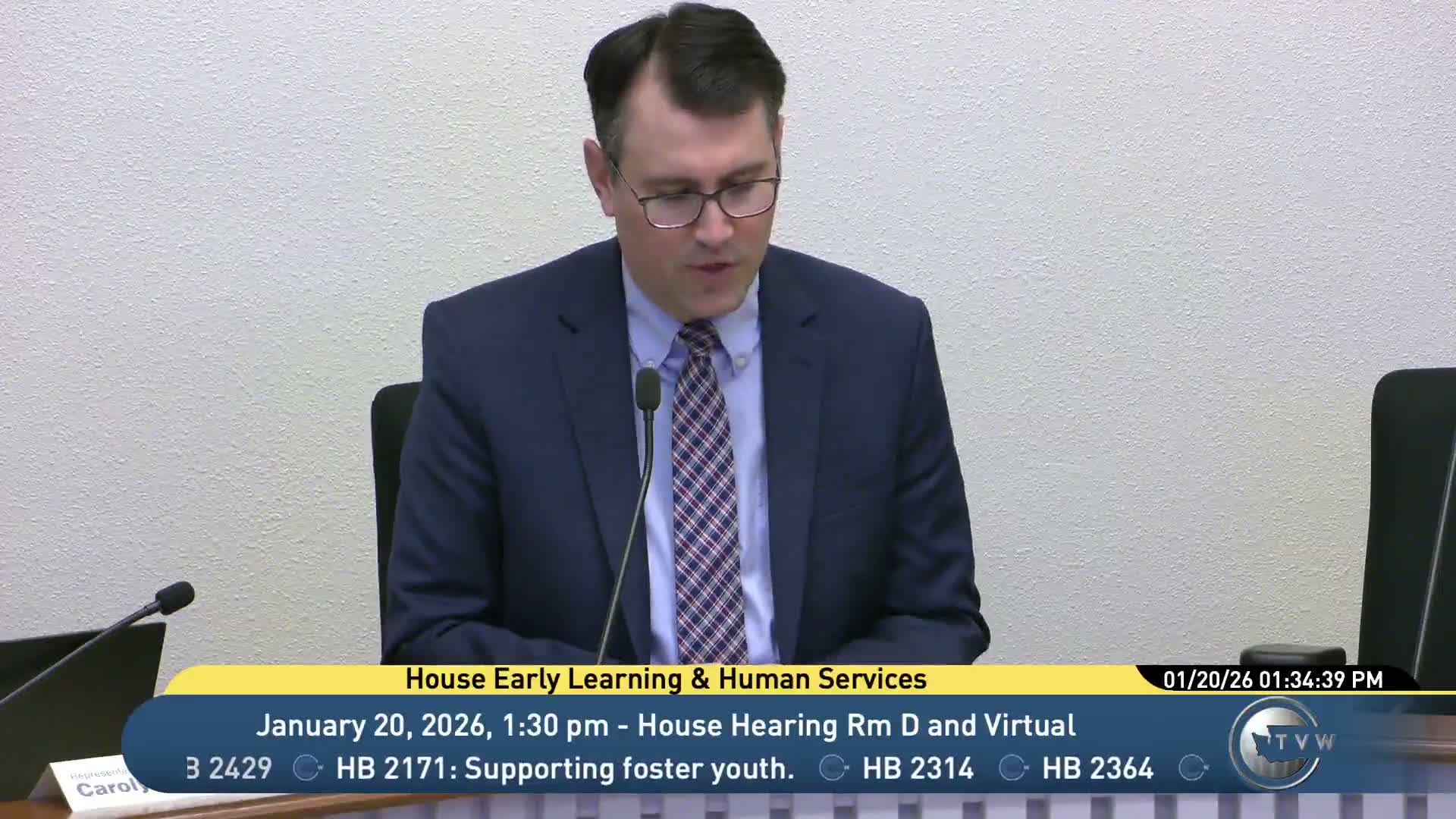
Committee hears testimony on HB 2429 to implement 'Washington Thriving' system for children and youth behavioral health
Loading...
Summary
House Early Learning & Human Services Committee heard a work session and public testimony on HB 2429, which would require the governor to coordinate state agencies around the Washington Thriving strategic plan, create a leadership council and an executive coordination officer, and extend the Children and Youth Behavioral Health Work Group.
Rep. Lisa Kallen, prime sponsor of House Bill 2429, told the House Early Learning & Human Services Committee that the bill seeks to put the Washington Thriving strategic plan into practice by improving coordination across state agencies.
"The System of Care with a capital S really means that we have a very well coordinated system that covers the full range of everything a child needs for wellness," Rep. Lisa Kallen said, describing the bill's aim to simplify families' experience of state services.
The bill, as summarized by committee counsel Luke Wickham, would require the governor, to the extent possible within existing resources, to support and facilitate cross-agency coordination following the Washington Thriving framework; maintain an executive coordination officer to monitor implementation; establish a leadership council to align state, tribal and local efforts; permit the governor to accept private funding for plan implementation; and extend the statutory life of the Children and Youth Behavioral Health Work Group to Dec. 30, 2031.
Tisha Kirschbaum, director of the Division of Behavioral Health and Recovery and co-chair of the Children and Youth Behavioral Health Work Group, presented the strategic plan to the committee. Kirschbaum said the plan grew over three years with broad participation and centers on a "system of care" model that prioritizes early intervention, coordination with schools, culturally responsive services, and workforce supports. She described the work group's membership and the broader stakeholder engagement that produced the recommendations.
Supporters at the public hearing included the governor's special advisor, providers and advocacy groups. Taku Minechita read a statement that "Governor Ferguson's strong support for House Bill 2429" and framed the bill as grounded in work by more than 300 stakeholders. Health systems and child advocacy representatives urged adoption to reduce emergency boarding, expand outpatient and crisis services, and increase accountability for children's behavioral health.
Some witnesses raised concerns about scope and cost. Sharon Henick urged a "no" vote, arguing the bill expands government responsibilities and could overlook families who are not prioritized by service models. Other testifiers asked the committee to ensure that the work group and any leadership council include a range of lived-experience and community-based voices.
The committee closed public testimony after a broad set of supporting and cautious witnesses had spoken. The bill's primary provisions are administrative and coordinative: they set a statewide framework for implementation rather than prescribing new direct services in statute. The committee did not take a vote in the hearing; the next procedural steps were not announced at the close of testimony.