
Committee hears support, fiscal questions for bill shifting digital equity duties to Broadband Office
Get AI-powered insights, summaries, and transcripts
Subscribe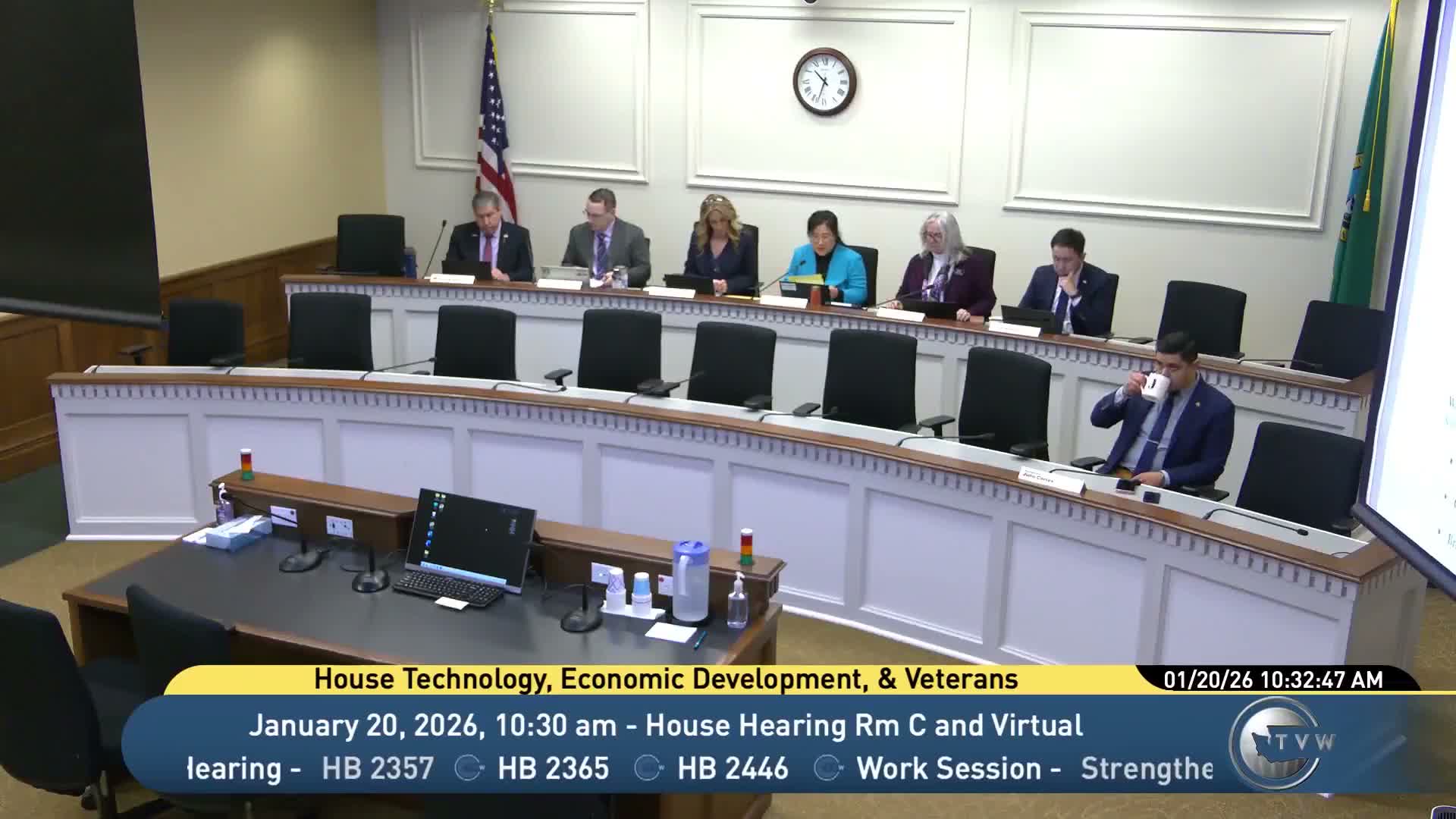
Summary
The Technology, Economic Development and Veterans Committee heard testimony for House Bill 2365, which shifts digital equity leadership to the State Broadband Office, requires provider cost reporting, and updates the state digital equity planning process. Advocates urged passage; Commerce warned of new costs.
The Technology, Economic Development and Veterans Committee heard testimony on House Bill 2365 on digital equity, which would move primary statutory responsibilities from the Office of Equity to the State Broadband Office and require regular reporting and a biennial state digital equity plan.
Emily Poole, committee staff, told lawmakers the bill expands the Broadband Office’s role to include promoting broadband adoption and digital equity, asks providers to report retail cost information, requires a two-year report on plan implementation, and updates the Digital Equity Forum’s duties and appointment process. Poole said the bill also renames the current program and clarifies grant criteria.
Prime sponsor Representative Mia Gregerson said HB 2365 is largely a governance bill that ‘‘just updates definitions, provides more guidance for the forum around grants’’ and does not itself fund the devices, connections or training that many advocates say are needed. Gregerson said the measure is ‘‘a trailer bill’’ to prior digital equity legislation and that her goal was to adopt the state plan and improve coordination across agencies.
Community groups and nonprofit witnesses urged passage. Will Booth, executive director of Creating Pathways, said the loss of prior federal funding has strained community training programs and argued HB 2365 ‘‘will continue to establish a pathway for equal oversight and access to these highly needed services for generations to come.’’ Dr. Sean Glaze (Black Brilliance Research) and Nancy Chang (Goodwill) described delivering digital skills training and device distribution across urban and rural counties and urged the committee to adopt the state plan. Tori Emerson, president of the Washington State PTA, said schools and libraries should be treated as anchor institutions and stressed the bill’s potential benefit to students and families.
Agency witnesses and fiscal questions. Dave Pringle of the Washington State Broadband Office, testifying for the Department of Commerce, said the office supports the intent but flagged technical and fiscal concerns because the expanded outreach and coordination will create new costs for the Broadband Office. Pringle noted the bill does not affect federal BEAD implementation but reminded the committee the state lost $15,000,000 in a previous federal grant that had supported digital literacy and security work. Commerce asked to work with the sponsor to align intent and budget impacts.
What’s next. Committee staff asked sponsors and interested members to provide amendment language ahead of exec session; staff noted a proposed amendment timeline for amendment drafting and said they expected to consider changes before the exec session. The hearing was closed with members indicating a willingness to work on fiscal adjustments before further action.