Get Full Government Meeting Transcripts, Videos, & Alerts Forever!
Get email alerts on the Land Use Shrub Steppe topic
No spam. Unsubscribe anytime.
Bill to limit shrub‑steppe protections inside urban growth areas draws split testimony
Summary
House Bill 2316 would prevent vegetation associated with shrub steppe inside urban growth areas from automatically triggering habitat or critical‑area restrictions, aiming to reduce housing delays; proponents cited housing costs and mitigation ratios, while tribes and conservation groups warned of broad ecological loss.
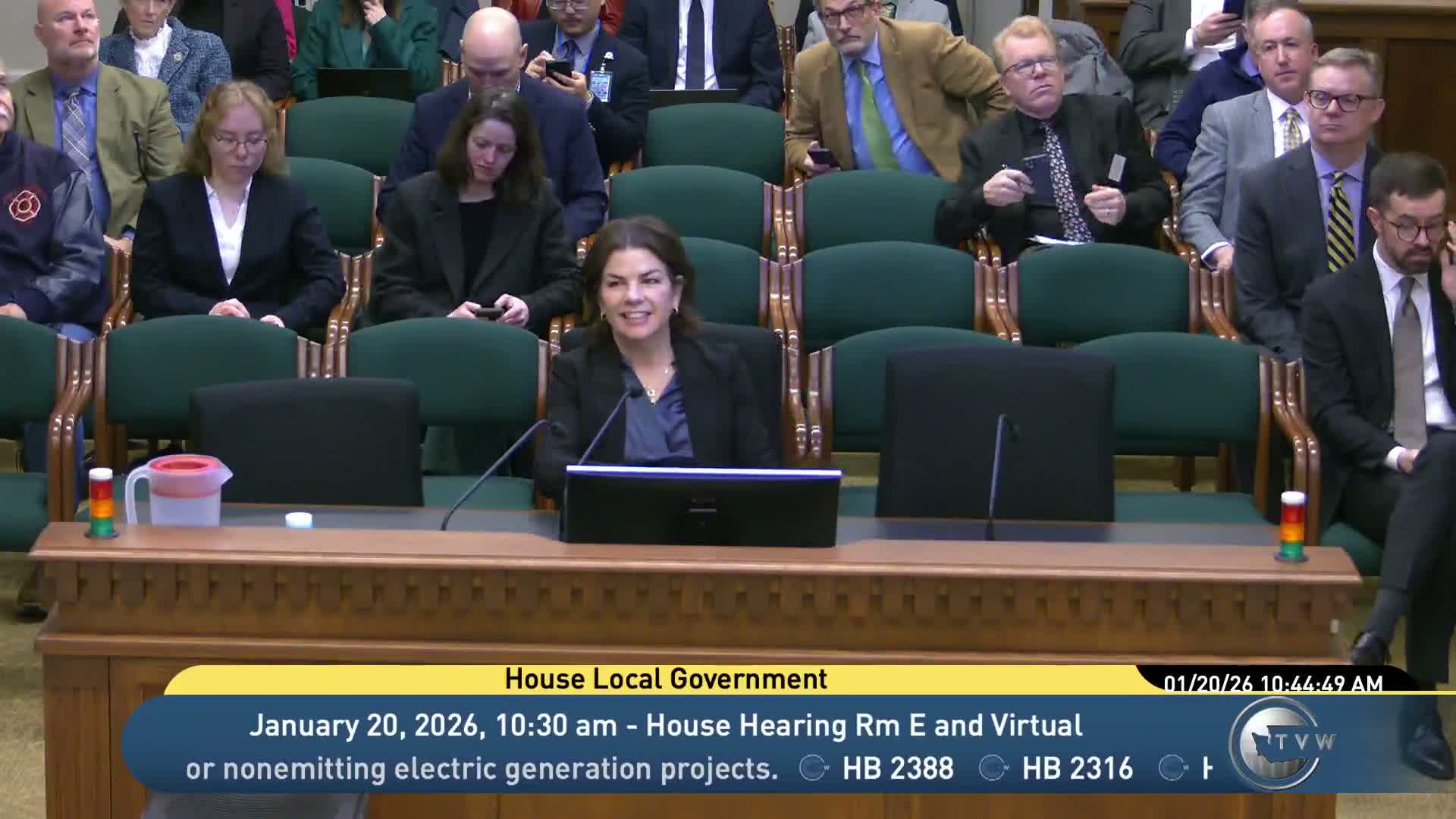
Representative April Connors, sponsor of House Bill 2316, told the Local Government Committee that the measure aims to clear regulatory uncertainty that delays housing projects and raises costs in fast‑growing regions such as the Tri‑Cities. "We only have, like, 20% of native shrub steppe left in Washington state," Connors said while emphasizing the bill is intended to focus protections on truly valuable habitat and not to remove protections for parks and designated preserves.
The bill would provide that vegetation associated with shrub steppe inside an urban growth area (UGA) cannot by itself be treated as wildlife habitat, a wildlife corridor, a critical area or a conservation area that would restrict development. Sponsor testimony and multiple witnesses from home‑building and economic‑development groups argued that isolated or degraded patches inside UGAs have caused projects to be delayed or canceled and that mitigation ratios (for example, 2:1 or higher) increase land costs and reduce feasible housing supply.
Proponents included the Building Industry Association and regional economic development groups, which said mitigation requirements applied parcel‑by‑parcel inside UGAs can push development outward and exacerbate housing shortages. "Treating planned urban land like conservation land creates a fundamental contradiction within our state policies," Andrea Smiley of the Building Industry Association said in support.
Conservation organizations, tribal representatives and local ecologists urged caution. Jeremy Takala, counsel for the Yakama Nation, said the bill would "fundamentally undermine science‑based land use planning" by precluding site‑specific review and mitigation inside UGAs. Audubon Washington submitted testimony estimating the changes could affect tens of thousands of acres and warned that small patches of shrub‑steppe can provide important ecological and cultural functions.
Committee members and witnesses flagged several technical issues that may require amendment, including how the bill defines ‘‘shrub steppe’’ (common names vs. scientific identification), whether the proposal would inadvertently exempt shrub‑covered steep slopes where erosion risk exists, and whether changes should be made to the statutory intent language in the GMA rather than to critical‑area definitions. Several stakeholders urged improved mapping and a clearer standard to distinguish degraded patches from intact habitat.
The committee closed the public hearing after receiving both detailed local examples of delayed affordable‑housing projects and sustained opposition from conservation and tribal interests. No committee action or vote was recorded during the hearing; sponsors and stakeholders left open the possibility of technical amendments to refine definitions and carve‑outs for high‑value habitat.