Get Full Government Meeting Transcripts, Videos, & Alerts Forever!
Get email alerts on the Reh Payments topic
No spam. Unsubscribe anytime.
Committee considers bill to make rural emergency hospital payments subject to appropriation
Summary
Proponents said SB 6,103 provides a state payment bridge for hospitals converting to the REH model so they can remain financially viable; East Adams Rural Healthcare and hospital association witnesses described the bill as necessary to preserve rural access along critical corridors.
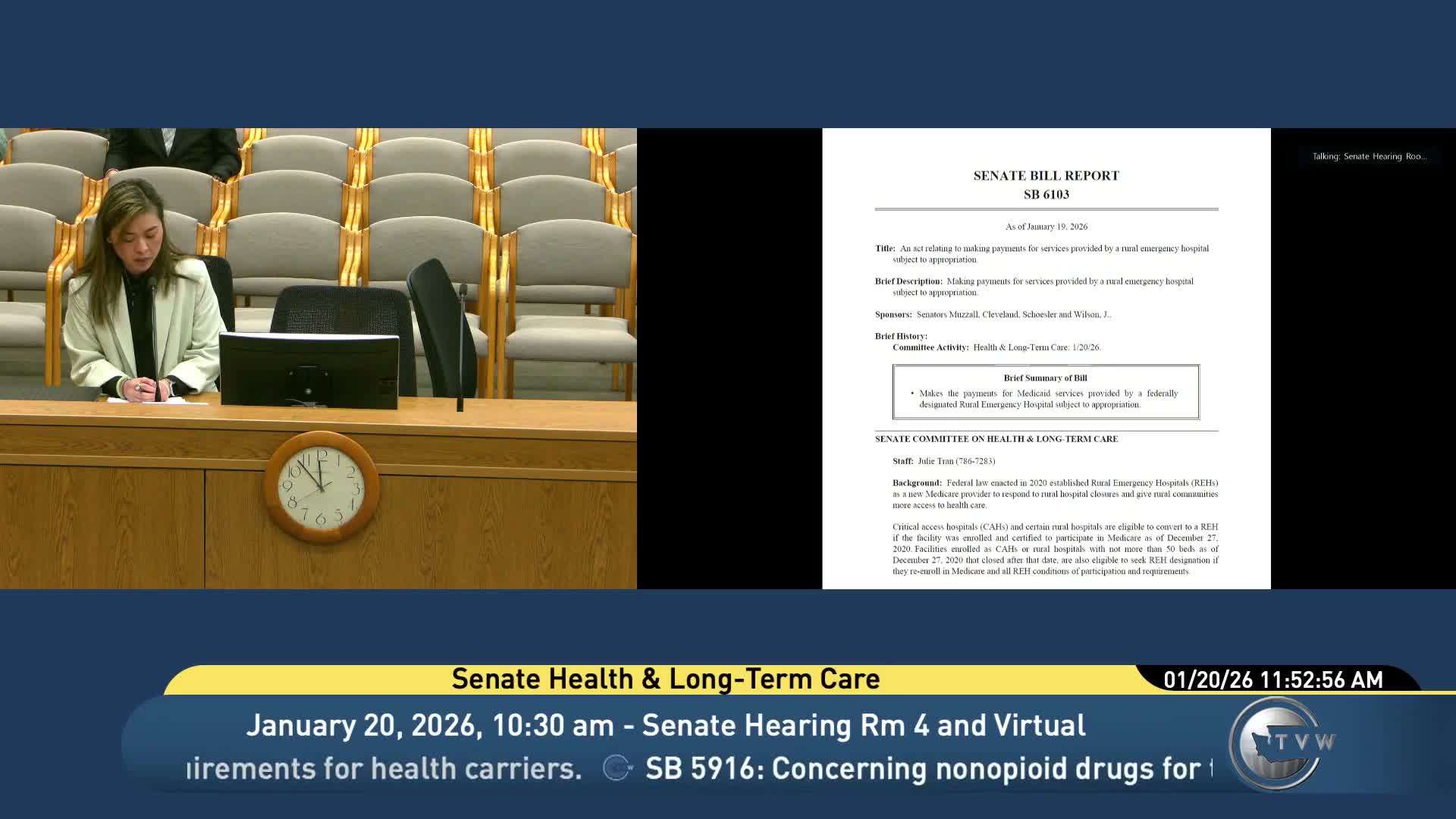
Senate Bill 6,103 would make state payments for services provided by a Rural Emergency Hospital (REH) subject to appropriation and preserve cost‑based Medicaid reimbursement so that hospitals converting to an REH can remain financially viable. Staff noted that the REH federal provider type was created in late 2020 and that federal rules pay REHs at 105% of the Medicare outpatient prospective payment system rate for Medicare patients; states choose how to reimburse Medicaid patients.
Todd Nida, CEO of East Adams Rural Healthcare, described East Adams’ plan to convert to an REH and said the bill would prevent a reduction in reimbursement that could make the conversion financially unsustainable. He said the bill was worked closely with Department of Health, HCA and stakeholders. Lisa Thatcher (Washington State Hospital Association) commended the interagency negotiation and endorsed the bill as targeted and necessary to keep rural facilities open.
Committee members asked whether the bill sets a framework that would handle future REH conversions without separate legislation; witnesses said the bill would address East Adams and provided a path forward while noting broader payment questions may be handled in larger budget or “snap” bills later.
What happens next: The bill received supportive testimony and sign‑in counts favored the proposal; staff and stakeholders plan follow‑up on implementation details and interaction with broader Medicaid payment policy.