
Committee weighs codifying farm-to-food-pantry program; supporters cite pilots, critics warn of restrictive language
Get AI-powered insights, summaries, and transcripts
Subscribe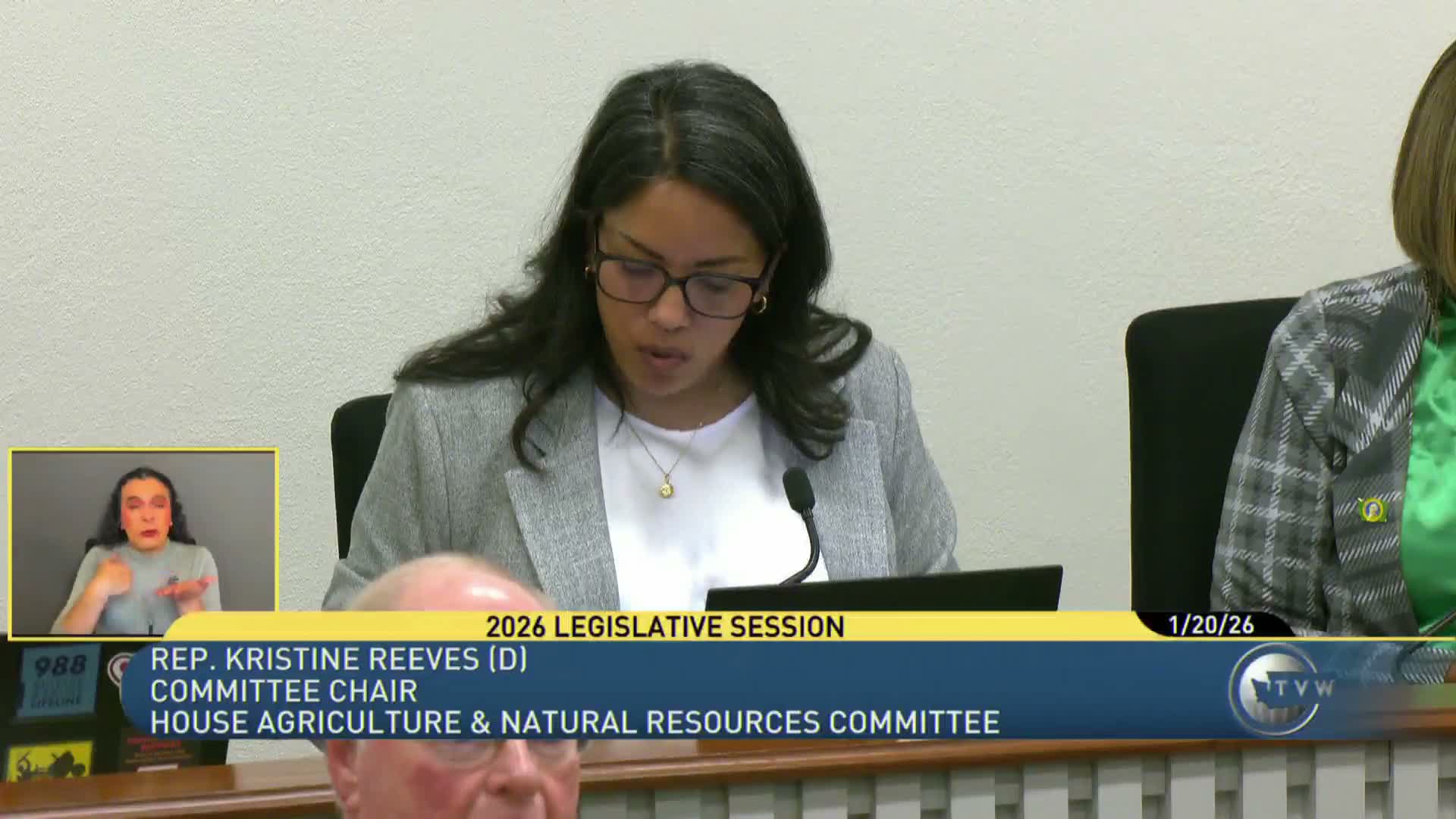
Summary
HB 24-63 would expand and codify commodity-donation and farm-to-food-pantry grants to connect local farmers with hunger-relief organizations; testimony praised pilot results but multiple witnesses warned that the bill’s 'solely' language could narrow eligible partners and reduce distribution resilience.
Representative Christine Reeves opened the committee’s public hearing on HB 24-63 by saying the bill is intended to shore up Washington’s food-security system as federal resources shrink and to codify pilot programs that connect farms and food banks. "This portion really makes sure that we are getting local food from farms into our food bank system in a meaningful way," she said.
Staff summarized the bill as amending the Washington Commodity Donation Program to expand procured commodities (including dairy) and setting up a Farm-to-Food-Pantry program that would authorize WSDA to issue grants, in partnership with a nonprofit, to help hunger-relief organizations build wholesale purchasing contracts with small-scale farmers.
Multiple hunger-relief organizations and distributors described successful pilots and urged passage. Rod Weaver of Feeding Washington said that, in a recent five-month rollout, his organization sourced and shipped more than 10 million pounds of Washington-grown produce, protein and dairy to nearly 500 distribution partners and said the program amplified reach to more than 500 food pantries, meal programs and senior sites. Michael Moran (Second Harvest) emphasized the program’s role in addressing food deserts and rural distribution gaps.
At the same time, several witnesses urged changes to avoid concentrating procurement authority. Anna Nepomisseno (Northwest Harvest) said that new language in Section 1 would "limit the WSDA to work with just 3 organizations" because the bill currently prioritizes organizations that 'solely function' for sourcing. She warned that limiting the state to a small set of sourcing organizations could reduce resilience and exclude many organizations that already serve local communities.
Aaron Chazewski (Food Lifeline), who helped design aspects of the program, said the intent was to leverage organizations whose sole focus is sourcing and logistics so that distributed product can flow efficiently into the statewide distribution system. "The design of the program was to take advantage of the specialty, experience that food sourcing organizations have," he told lawmakers.
Other witnesses added implementation details and suggested clarifications: tribal representatives asked for explicit inclusion of tribally owned small-scale farms, distributors and food hubs asked to be eligible partners, and farming representatives asked for a clearer statutory definition of "small-scale farmer." Food banks and advocates urged safeguards to ensure equitable distribution to smaller pantries and BIPOC communities.
Chair Reeves closed the public hearing after staff reported 89 pro and 2 con written submissions on HB 24-63. Committee members signaled interest in continuing stakeholder work and potential draft amendments to address eligibility, distribution equitability and definitions before the bill moves forward.