Get Full Government Meeting Transcripts, Videos, & Alerts Forever!
Get email alerts on the Environmental Health topic
No spam. Unsubscribe anytime.
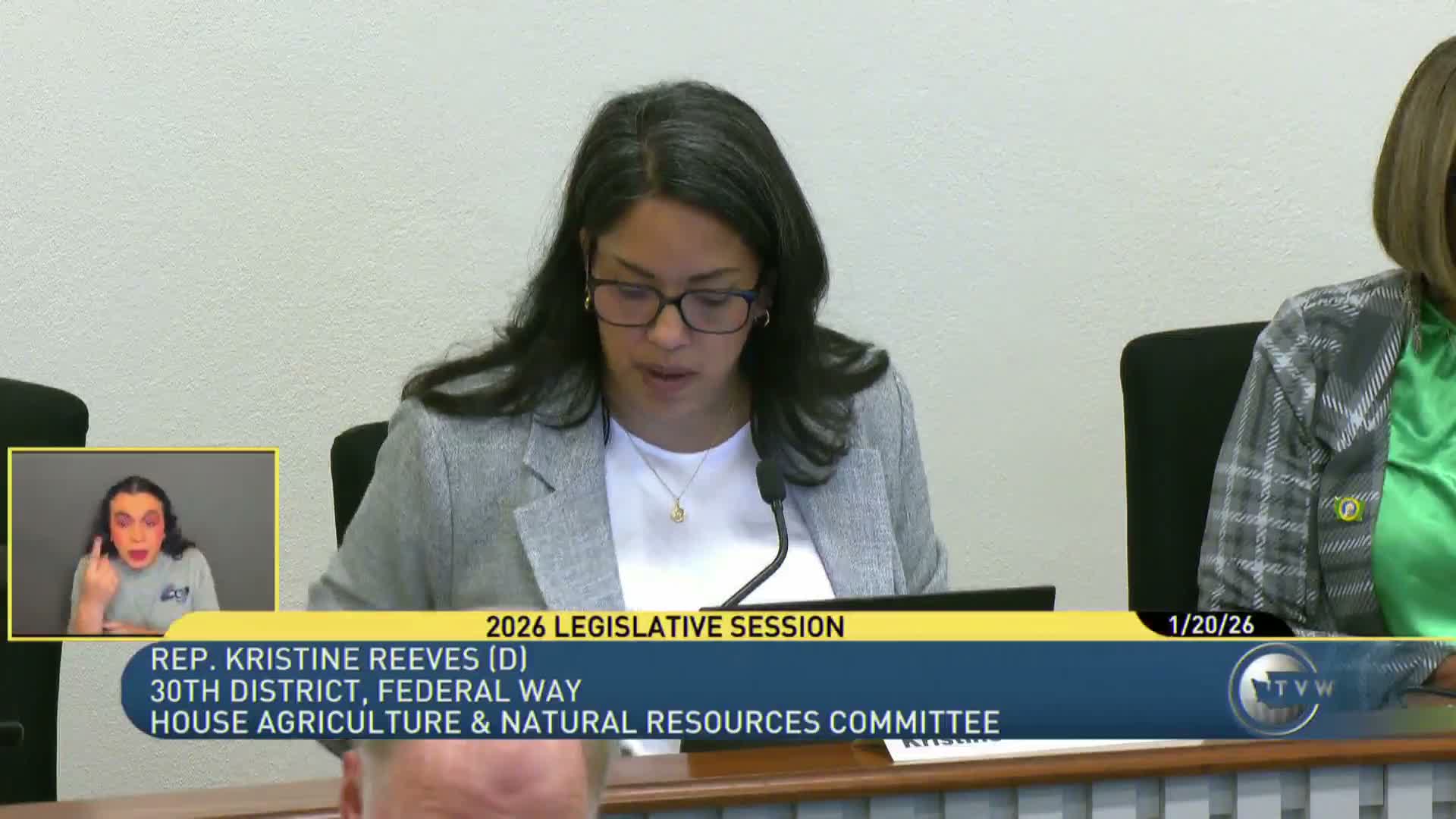
House committee hears experts split over state review of PFAS in pesticides and fertilizers
Summary
A House Agriculture committee heard testimony for and against HB 22-279, which would direct WSDA to create criteria to evaluate PFAS in pesticides and fertilizers; supporters called PFAS a persistent public-health risk while industry witnesses warned of duplication with EPA and potential market harms for Washington farmers.
Representative Parsley, the bill’s sponsor, told the House Agriculture and Natural Resources Committee on Jan. 20 that PFAS are a long-lived class of chemicals with widespread environmental and human-health effects and that state action is warranted. "PFAS causes a lot of problems … It's the problem with it is it's a forever chemical," she said, arguing that states should begin evaluations now rather than wait for federal regulation.
The bill, summarized to the committee by staffer Rebecca Lewis, would require the Washington State Department of Agriculture to establish criteria for reviewing PFAS in fertilizers and pesticides, allow WSDA to refuse or cancel product registrations under those criteria, and phase implementation so that new registrations are reviewed beginning Dec. 31, 2027. Lewis told members a fiscal note had been requested and that the agency would likely need rulemaking and ongoing staff resources to implement the work.
Kelly McClain, assistant director in WSDA’s Agricultural Environmental Services Division, said the agency can carry out the review but asked the committee to extend the bill’s deadlines by 12 months to permit fuller stakeholder engagement and rulemaking. "We would like to request an extension of 12 months in order to complete the work," she told the committee, adding that legal challenges were likely if criteria are adopted without a robust public process.
Industry witnesses urged caution. Ben Buckholtz, representing regional grain- and tree-fruit interests and his family farm, said PFAS encompasses thousands of chemistries and cautioned that state-level restrictions could put Washington growers at a disadvantage to producers in other countries. "We're not talking about apples to apples," Buckholtz said, arguing for narrowly targeted approaches focused on the chemistries used in agricultural products.
CropLife America’s Manojit Basu, speaking as a scientist for pesticide manufacturers, asked lawmakers to rely on existing federal review processes. Basu said the U.S. Environmental Protection Agency subjects fluorinated pesticide chemistries to extensive testing and multi-hundred-person reviews and characterized additional state registration requirements as duplicative.
Environmental and public-health advocates pushed the opposite direction. Heather Trim of Zero Waste Washington highlighted studies showing PFAS in some pesticides and described three pathways by which PFAS can enter agricultural products: as active ingredients, as inert surfactants, or by leaching from fluorinated packaging. She cited a 2024 study she summarized to the committee, saying, "14% of the pesticides they looked at across the U.S. had PFAS as an active ingredient."
Committee members asked whether state action would be redundant with EPA or could be tailored to speed protections. Sponsor Parsley answered that states have historically moved before federal action on similar issues and that state criteria could pressure regulators and manufacturers to accelerate safer alternatives.
The hearing closed after the committee recorded that 219 written submissions were pro and 188 were con. No formal vote was taken; the committee later recessed for caucus. Next steps for the bill were not announced at the end of the hearing.