Get email alerts on the Timely Payment topic
No spam. Unsubscribe anytime.
Committee hears data and debate on shifting timely‑payment rules to claim‑level deadlines
Summary
Hospitals and physician groups urged a move from percentage‑based standards to a 30‑day claim‑level rule, citing billions in late payments; insurers said the bill is one‑sided and raised concerns about high‑dollar claims and fraud prevention. Committee discussion highlighted potential technical fixes.
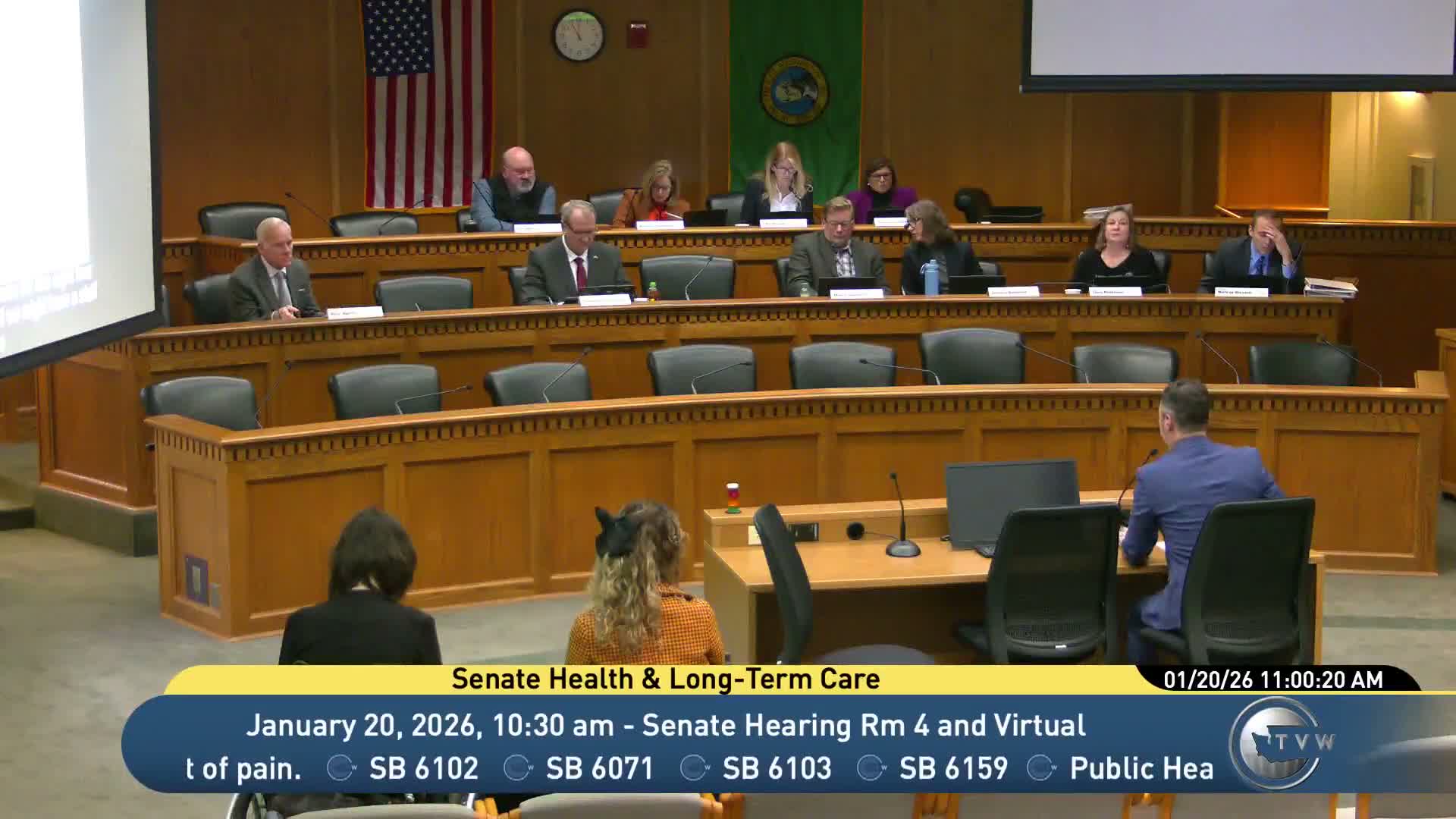
Senate Bill 5,845 would change Washington’s timely‑payment rules by requiring carriers to pay or deny clean claims within 30 calendar days, replacing the current percentage‑based standard that measures performance across claims. Greg Accinacio, committee staff, explained that beginning Jan. 1, 2027, carriers and plans for public employees would be required to pay or deny clean claims as soon as practicable and no later than 30 days after receipt. The bill also requires carriers to send written notice within 14 days for claims that are not clean, and to pay interest or penalties when timelines are missed, with exceptions for fraud, acts of God, bankruptcy, or labor disputes.
Hospital and physician groups provided data they say show systemic late payments. Adam Dittemore (Evergreen Health) cited Washington State Hospital Association data that 16% of the total dollar value of hospital claims that were clean were still paid more than 30 days after submission — roughly 320,000 claims — and argued that one‑third of the dollar value of clean claims is paid late, amounting to about $2 billion a year. Matthew Lund (UW Medicine) provided a hospital example of a billed claim totaling roughly $1,300,000 that remained unpaid more than a year after billing despite prior approvals, saying this demonstrates how the 95% average standard allows high‑dollar claims to be indefinitely delayed.
Supporters urged a claim‑level standard to provide predictability for providers operating on thin margins. Lisa Thatcher (Washington State Hospital Association) and Sean Graham (Washington State Medical Association) urged the committee to advance the bill. Several witnesses said they were open to technical edits around the timing of the initial information request and the enforcement mechanism (interest vs. a different late penalty).
Carriers expressed opposition or concern. Marissa Ingalls (Association of Washington Healthcare Plans) and Christine Brewer (Premera) said the bill as written is one‑sided, could limit the ability to investigate suspected fraud or abuse, and could have unintended fiscal consequences; Premera noted it meets 99% compliance with current rules and said the existing WAC allows pended claims when fraud is suspected. Insurers asked for clarifications on treatment of high‑dollar claims and for reciprocal timelines to ensure a practicable back‑and‑forth during claim review.
Committee members pressed witnesses on how prior authorizations and concurrent review interact with delayed billing and whether interest or holding‑cost compensation is equitable for hospitals. Sponsors and carriers indicated willingness to negotiate timeline mechanics, penalties, and exemptions during follow‑up work.
What happens next: The committee heard substantial empirical testimony from hospital systems and clinicians and pushback from carriers on implementation details and safeguards. The sponsor said technical edits and stakeholder negotiation are anticipated.
AI generated
The text on this page is AI generated. Summaries, highlights, analysis, and video transcripts are all produced from the original source material.
AI can make mistakes, so if you spot one, and we will fix it for everyone.
Note: the source content is unaltered by us. Any content source we link to, be it a video, an audio recording, or a document, is presented exactly as its publisher released it. That publisher is usually a government body, sometimes an individual official or another organisation.