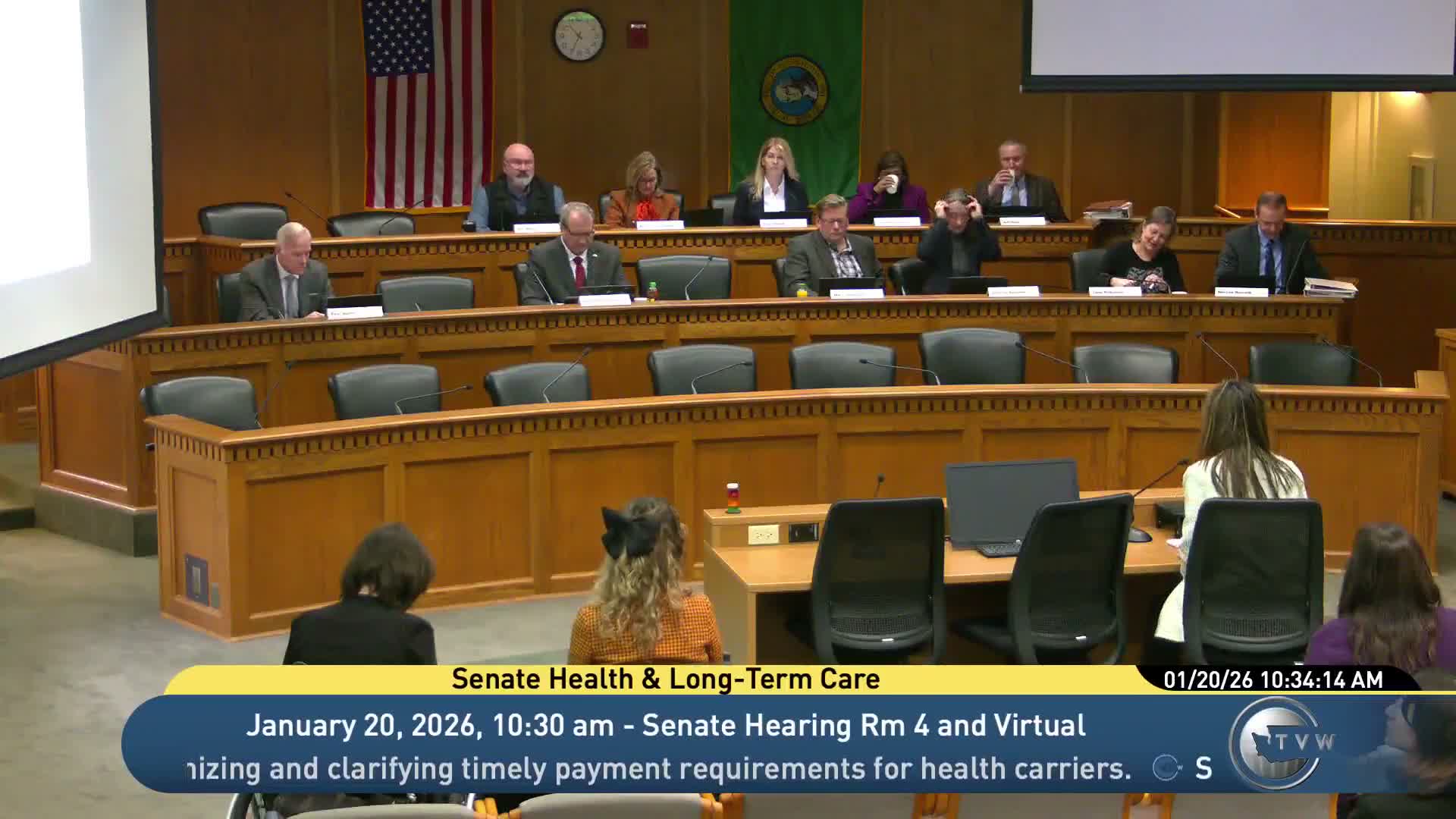
Senate panel hears debate over premium‑tax assessment to fund public hospital infrastructure
Loading...
Summary
Supporters say a small per‑member assessment and cooperative authority will help public hospitals modernize; insurers and mutual carriers warn the 75¢ per coverage‑month assessment could raise premiums and sweep in property/casualty mutuals. The committee heard extensive testimony and recorded heavy opposition on the sign‑in sheet.
Senate Health and Long Term Care received a briefing and public testimony on Senate Bill 6,159 on Jan. 20, 2026. Julie Tran, committee staff, said the bill would create a Public Hospital Infrastructure Account funded by an annual coverage assessment payable by entities subject to the insurance premium tax; the assessment would equal 75¢ per coverage month in the prior calendar year with initial assessments due on or before March 1, 2027. Funds would be deposited into the account, spent only after appropriation, and limited to funding assistance for public hospital districts or publicly owned or operated health‑care entities undertaking major new construction or modernization projects. The proposal caps account funding assistance at 20% of an approved project’s cost and uses Medicaid‑revenue share to determine an assistance percentage.
Senator Manka Dhingra, the bill’s prime sponsor, told the committee the measure is permissive and intended to help public hospitals modernize and coordinate services. Dhingra said the measure allows public hospital districts to enter cooperative agreements and negotiate contracts to reduce costs and improve access, particularly for rural districts that lack scale and for hospitals serving high Medicaid shares.
UW Medicine’s Ian Goodhue described capital shortfalls at UW Medical Center and Harborview and supported a SCAP‑style funding model to help public hospitals modernize infrastructure. Patient‑access advocates urged guardrails: Emily Bryce of Northwest Health Law Advocates said she had received multiple reports that a public hospital limited outpatient Medicaid appointments, and recommended clearer statutory requirements to protect affordability and access.
Insurers and industry representatives opposed the bill’s proposed assessment. Marissa Ingalls (Association of Washington Healthcare Plans) and Christine Brewer (Premera Blue Cross) argued that adding a per‑member monthly assessment would worsen affordability amid large recent premium increases and could be passed, directly or indirectly, into higher costs for consumers. Multiple witnesses representing property and casualty mutual insurers — including Katie Kolan and Dan McGrady of PEMCO — said the bill as drafted could sweep in mutuals and other non‑health carriers that do not participate in the health market, exposing them to retaliatory tax risks and solvency pressures. Kenton Brian of the Northwest Insurance Council said ambiguity in cross‑references to RCW provisions created confusion about which lines of insurance would be assessed.
Committee staff reported five pro sign‑ins, 74 con, and two other. Chair Cleveland closed the hearing and returned the committee to its agenda.
What happens next: The bill drew extensive opposition from payer groups and detailed technical questions about which carriers would be assessed and how affiliation rules affect access to the program. The sponsor said many implementation details can be refined in subsequent committee work and in collaboration with the Office of the Insurance Commissioner and stakeholders.