
House panel hears eight-part bill to expand local revenue tools for housing, utilities and services
Get AI-powered insights, summaries, and transcripts
Subscribe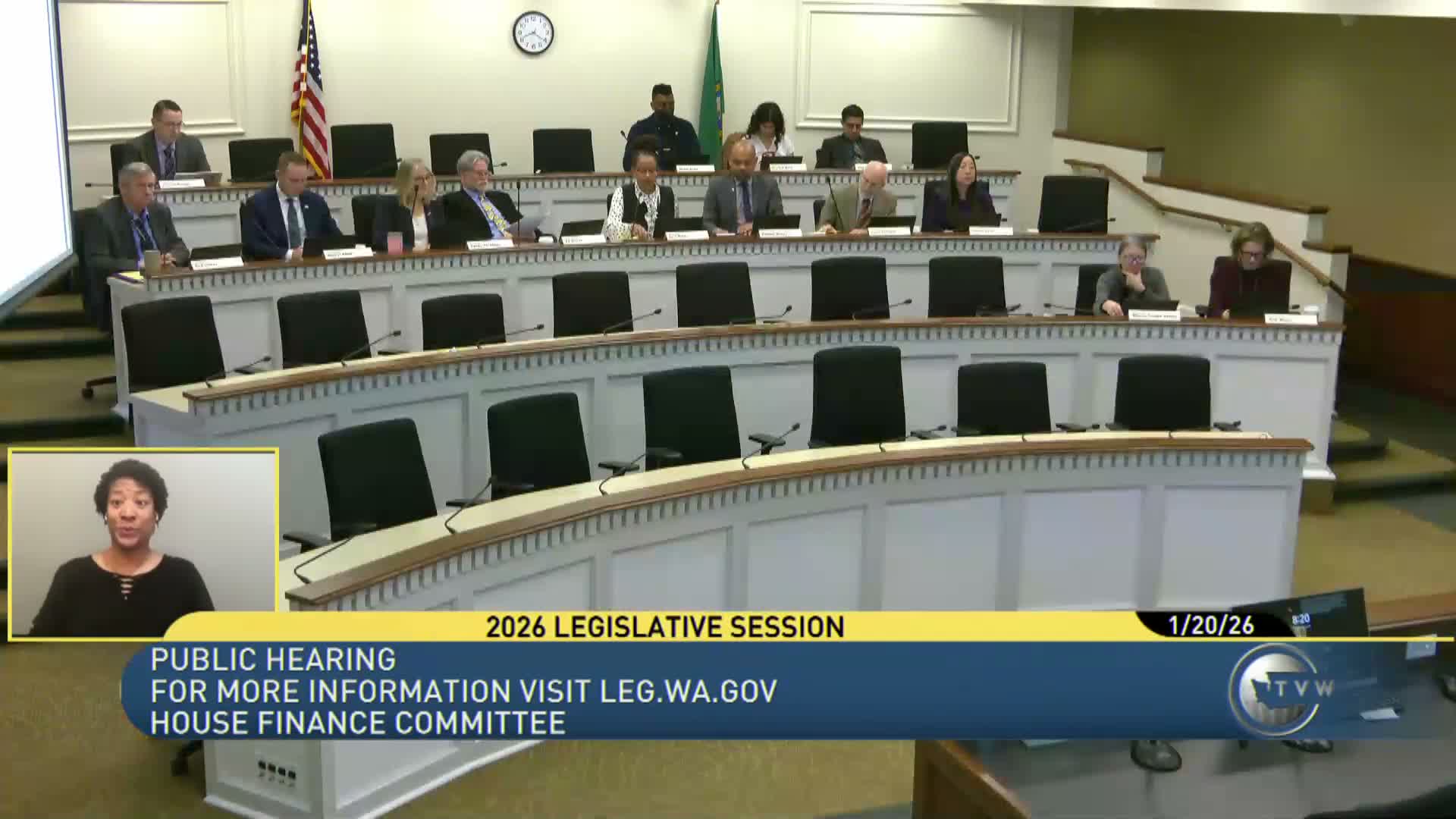
Summary
House Finance heard HB 24-42, an eight-part package that would expand local taxing and spending options—including county public utility taxes, REIT expansion for affordable housing, a 0.01% children/families sales tax option and longer levy lid lifts—drawing broad local-government support and industry opposition on the utility tax.
The Washington House Finance Committee on Jan. 20 heard HB 24-42, an eight-part measure that would give cities and counties new or expanded local taxing authority and greater flexibility in how certain local revenues are used. The bill’s sponsor and staff described it as a package of options for communities facing rising costs for housing, public safety, infrastructure and social services.
Tracy Taylor, staff to the committee, summarized the bill’s parts: Part 1 would expand uses for local real estate excise tax revenue to include nuisance-property abatement; Part 2 would allow cities to propose a 0.5% local REET (real estate excise tax) for affordable housing subject to voter approval; Part 3 would authorize counties to levy a local public utility tax (PUT) up to 3% on utility service in unincorporated areas, with 0.2% required for low-income assistance; Part 4 would permit a new 0.01% local sales-and-use tax for services to children and families; Part 5 would broaden allowable uses for existing housing sales taxes to include rehabilitation and rental assistance; Parts 6–7 would change levy and levy-lid rules for veterans and mental-health levies and for exceeding regular levy limitations; Part A would allow additional flexibility in rental-car taxes for criminal-justice purposes. Taylor also summarized fiscal notes and administrative costs estimated by the Department of Revenue.
Local officials and housing advocates told the committee the package would supply urgently needed, locally controlled options. Josh Weise of Snohomish County said counties face structural revenue shortfalls and that “75% of the budget that Snohomish County spends is on public safety,” urging both new revenue and flexibility in uses. Paul Jewell of the Washington State Association of Counties called the bill “the single most important thing you can implement this year to provide real immediate help” to county finances.
Housing advocates highlighted Parts 2 and 5. Michelle Thomas of the Low Income Housing Alliance said the bill “provides much needed local new flexibility for critical affordable housing fund sources” and would help preserve existing housing investments and fund rehabilitation and rental assistance. Candace Bach of the Association of Washington Cities said REET expansion would give communities the option to ask voters whether to fund local affordable housing.
Industry groups and utilities raised objections to specific provisions. Bill Clark of the Washington PUD Association opposed the proposed county PUT in Part 3, calling a 3% utility tax “regressive” for low-income rural customers and saying the 0.2% set-aside for assistance was inadequate. Charles Brown of Northwest Natural told the committee that adding a county utility tax would compound rising utility costs already driven by other state policies and asked that natural-gas utilities be exempted from the new authority. Jeff Gumbowski of CTIA argued the change would worsen the state’s already-high taxation of wireless consumers.
Committee members pressed on details: how local voter approval and county crediting would work for REETs, which taxes count toward statutory caps, and what the expected local revenue patterns might be. Taylor referenced fiscal estimates: administrative department costs of about $1.25 million in FY27 and ~$759,000 in FY28 for certain parts, and an estimated local revenue increase of roughly $30.1 million in FY27 and $56.3 million in FY28 tied primarily to levy changes in Part 6.
There were also localized requests for additions: Pierce County urged broader flexibility to use flood-control and other local revenues for disaster recovery and transitional housing after recent floods. Members representing smaller and tourism-dependent communities emphasized that not every part of the bill fits every locality and asked for guardrails and options to direct dollars where they’re most needed.
The committee did not take final action. Sponsors and supporters said they intend to work with stakeholders to refine nexus questions and administrative details as the bill moves forward.
The committee will determine next steps as HB 24-42 is considered in subsequent Finance work sessions.