Debate over waiving state rules for individual schools exposes split between districts and state regulators
Loading...
Summary
Senate Bill 6051 would let local boards grant waivers of many state requirements to individual schools; supporters say it relieves unfunded mandates, while OSPI and the State Board warn it could weaken uniform basic‑education standards and harm special‑education protections.
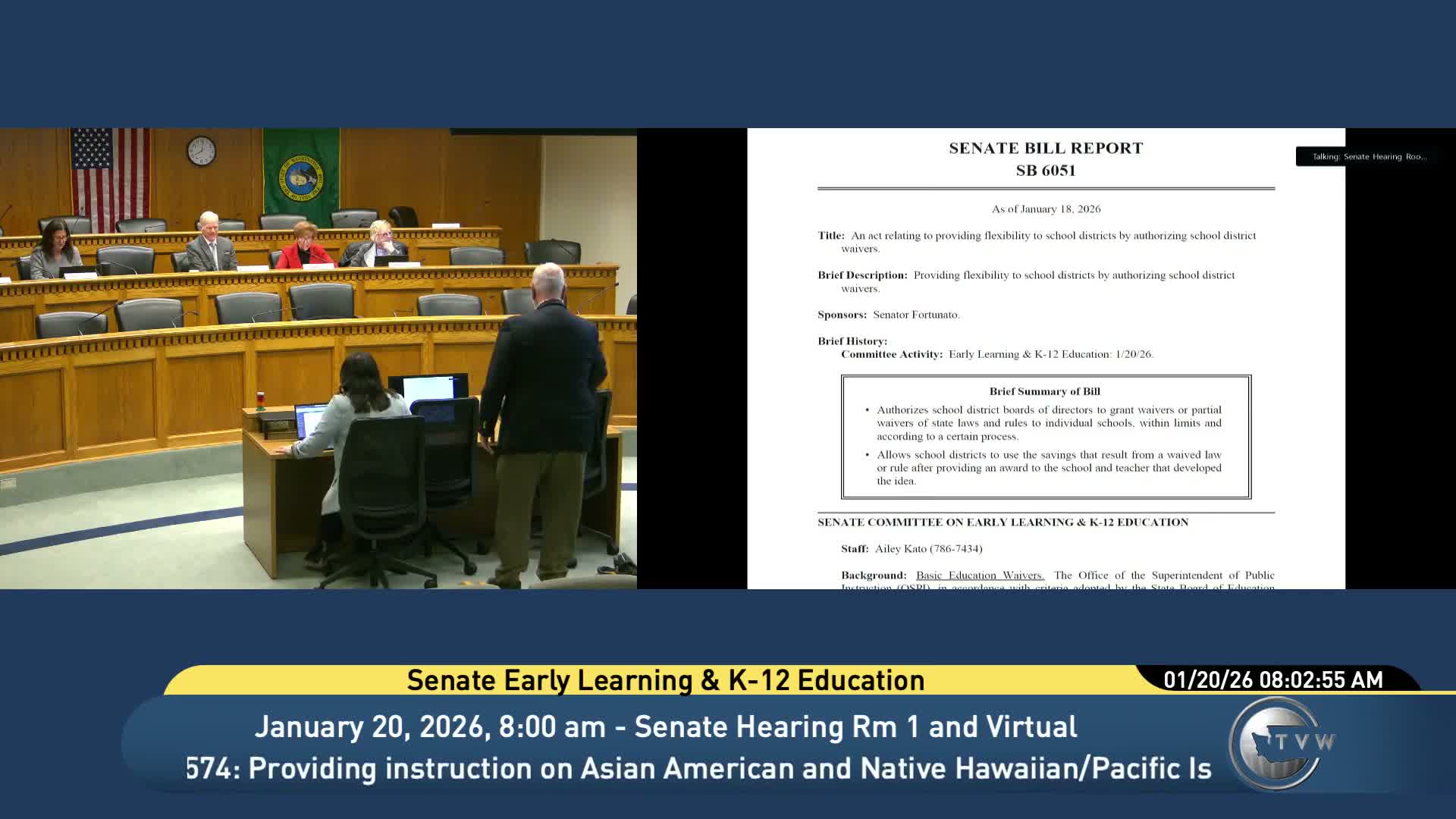
Olympia — Lawmakers and education stakeholders clashed over Senate Bill 6051 on Jan. 20, as school leaders urged flexibility to relieve unfunded mandates and state officials warned the bill grants sweeping local waiver authority that could undermine statewide basic‑education standards.
The bill, summarized by committee staff, would allow local school boards to grant waivers or partial waivers of certain state laws and rules to individual schools within a district. The measure lists explicit prohibitions on waiver authority for some categories — including health and safety, nondiscrimination, basic education, employment checks, open public meetings and public‑records compliance — but staff and witnesses noted ambiguity in how some terms, like "basic education," are defined in the bill text.
Julie Salvy of the Washington Education Association testified in opposition, saying the measure permits districts to waive broad portions of Chapter 28A and warned that prior waiver frameworks have typically involved state agencies to ensure consistent oversight. Randy Spalding, executive director of the State Board of Education, said the bill "provides sweeping waiver authority to local districts" and that managing a patchwork of waivers would complicate the State Board’s role in certifying compliance with the program of basic education.
Proponents, including school‑district representatives and associations from rural and small districts, said the state has accumulated many underfunded mandates and that a tool to permit targeted flexibility could help districts focus on core student needs. Senator Fortunato, the bill’s sponsor, described the measure as a diagnostic tool that would surface recurring local burdens — he gave an example of a composting requirement a district said cost "a couple of $100,000" and argued waivers could free resources for special education or classroom use.
Why it matters: Opponents warned the bill could lead to inconsistent student protections depending on the district. OSPI staff expressed particular concern about special education, saying differential protections would create unequal outcomes for students with disabilities. Several witnesses asked for a clearer crosswalk enumerating which statutory provisions could be waived and for stronger state oversight or clearer definitions of non‑waivable categories.
What’s next: Committee discussion did not result in a final vote that day. Members said they may pursue bill refinements, and staff offered to help clarify whether waivers are granted at the local board level (staff read the bill as authorizing local boards to grant waivers, with required reporting to OSPI and the State Board of Education).