
House committee signals support for bill to criminalize interference with voters and election officials
Get AI-powered insights, summaries, and transcripts
Sign Up Free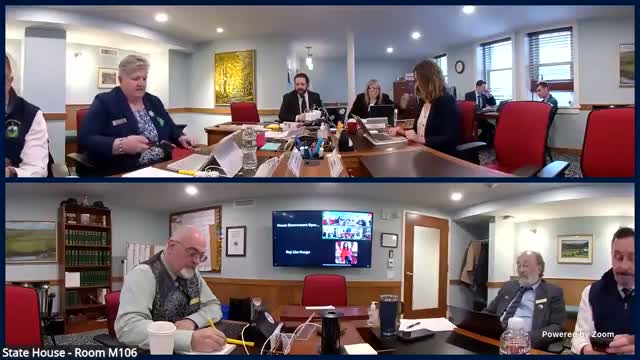
Summary
On Jan. 29 the House Government Operations & Military Affairs committee reviewed H 541, which would create a state criminal offense for intimidating or coercing voters or election officials; presenters said Judiciary narrowed the bill to an "intentionally or recklessly" standard, removed civil investigatory provisions, and proposed penalties of up to two years in prison or a $2,000 fine. The committee held an informal straw poll finding the bill favorable.
The House Government Operations & Military Affairs committee reviewed H 541 on Jan. 29, a bill that would create a state criminal offense for "intentionally or recklessly" intimidating, threatening or coercing voters or election officials.
Representative Ian Goodnow (Brattleboro), a member of House Judiciary, told the committee the measure was intended to fill a gap between federal election statutes and Vermont law so prosecutors "have a criminal penalty for interference with voters and election officials around the time of an election and at the polls." He said Judiciary substantially narrowed the original draft and removed broad civil investigatory provisions to focus the bill on criminal conduct.
Goodnow said Judiciary adopted language informed by First Amendment guidance and case law. Quoting advice the committee received, he summarized the operative standard: "no person shall intentionally or recklessly intimidate, threaten, or coerce or attempt to intimidate, threaten, or coerce." He cited Counterman v. Colorado (2023) as an influential U.S. Supreme Court decision that guided the decision to require an "intentionally or recklessly" mental state rather than broader language that could sweep in protected expression.
Legislative counsel Tim Devlin told members where the new provision would sit in state law: the amendment would add a new section to chapter 17 of Title 17 (purity of elections), to be titled "interference with voters and election officials." Devlin read the proposed penalty for violating the new subsection: a person "shall be in prison not more than 2 years or fined not more than $2,000 or both." He also noted the drafting is informed by 18 U.S.C. §594, a federal statute on voter intimidation.
Goodnow said Judiciary solicited input from the Secretary of State's office, the ACLU and the defender general's office, among others. He told the committee the Secretary of State's election team and at least one town clerk reported threatening behavior around elections that prompted the effort to draft a state-specific criminal tool; he cautioned that not every concerning incident will necessarily meet criminal thresholds.
Members asked for clarifications about scope and enforcement. Representative Hoover of Burlington asked whether the bill addresses escalation such as the use or display of a weapon. Goodnow and counsel said the proposed section does not itself add weapon-specific charges but may overlap with existing criminal threatening statutes (13 V.S.A.) and other statutes prosecutors already use; they acknowledged that fact-specific situations (for example, a firearm brandished near a polling place) could be litigated and that prosecutorial discretion will shape outcomes.
Committee members also asked about the bill's coverage of ballot initiatives and town-meeting votes; Goodnow said the draft explicitly covers a "public question" so coercion related to noncandidate votes would be captured. He noted Judiciary removed broader civil investigatory material (addressed separately in S.23) to keep H 541 focused on criminal liability.
After the briefing, member Straubel moved "to find it favorable." Committee members indicated support by a thumbs-up/thumbs-raising signal in person and via Zoom; the chair described the result as an informal straw poll (the transcript contains no formal roll call or recorded tally). The committee recessed for lunch and planned to reconvene at 1:00 p.m. for other agenda items.
What happens next: Goodnow said Judiciary planned to vote on the revised draft later the same day. If passed out of Judiciary, the measure would return to the full House for further consideration and potential amendment.