Get Full Government Meeting Transcripts, Videos, & Alerts Forever!
Get email alerts on the Land Use Zoning topic
No spam. Unsubscribe anytime.
Senate panel hears debate on bill to allow housing in commercial zones, with cities and small towns seeking carve‑outs
Summary
The Senate Housing Committee heard hours of public testimony on SB 6,026, a governor‑requested bill that would require cities and counties planning under the Growth Management Act to allow residential uses in many commercial and mixed‑use zones while prohibiting mandated ground‑floor retail outside transit‑oriented station areas; supporters say it unlocks underused land, opponents seek targeted exemptions for small towns and key retail corridors.
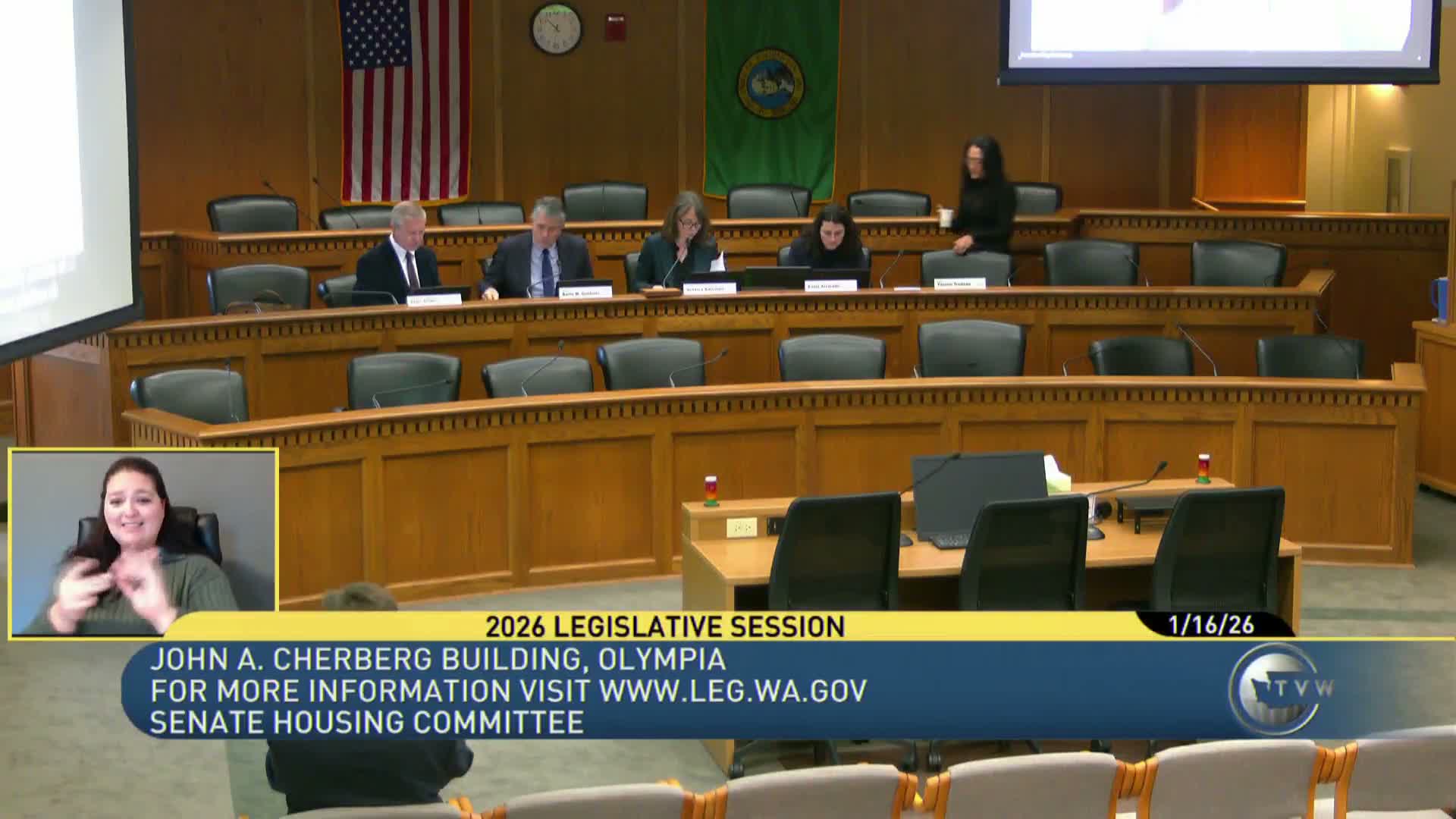
Senators heard competing views Jan. 16 on SB 6,026, a governor‑requested bill that would legalize residential development in many commercial and mixed‑use zones across Washington.
Senator Tana Alvarado, the bill’s prime sponsor, said the measure is designed to open underused commercial properties — “a lot of unused, underutilized land right now” — to housing and to remove requirements that can make housing projects financially infeasible. “It’s about legalizing residential development in commercial zones,” Alvarado said.
Administration witnesses and developers urged the committee to act quickly. Em Stone, the governor’s housing policy adviser, described the bill as an important step to increase housing supply and praised a proposed substitute that exempts transit‑oriented development (TOD) station areas. Dave Anderson of the state Growth Management Program told the panel that roughly 20% of affected commercial land currently prohibits residential uses and that enabling residential uses could add substantial developable acreage.
Local officials, small‑town leaders and planning groups urged narrower language to protect Main Street corridors and the small businesses that rely on them. Mindy Brooks, Lewis County director of community development, told the committee that many of her county’s small towns “do not have TODs” and that “a high percentage of ground‑floor residential and commercial will erode the commercial corridor and reduce job opportunities in these small towns.” Association of Washington Cities representative Carl Schrader voiced concern about tax‑base stability if retail is lost.
Housing advocates, affordable‑housing developers and some economists said the bill would free sites for new homes where infrastructure already exists. Dan Berdelet of Sightline Institute cited an analysis he said would “increase the amount of land we have available for multifamily housing by 62%” in affected areas and warned that requiring money‑losing ground‑floor retail discourages housing investment.
Several committee members pressed for technical clarifications, including whether cities could still allow ground‑floor commercial standards or apply commercial building codes to mixed‑use buildings; staff and the sponsor said the bill prohibits requiring ground‑floor retail but does not prevent cities from allowing or designing for commercial uses where market demand exists.
The bill contains multiple carve‑outs — for TOD station areas, shoreline and critical areas, industrial zones outside urban growth areas, and parcels near active refineries — and would require jurisdictions that do not update local ordinances within one year of the bill’s effective date to be preempted on conflicting rules. A fiscal note was requested and was not yet available at the hearing.
The committee closed the public hearing after receiving dozens of in‑person and remote statements and indicated it would continue to work with sponsors and local governments on amendments and implementation details.