Get Full Government Meeting Transcripts, Videos, & Alerts Forever!
Get email alerts on the Contracting Non Emitting topic
No spam. Unsubscribe anytime.
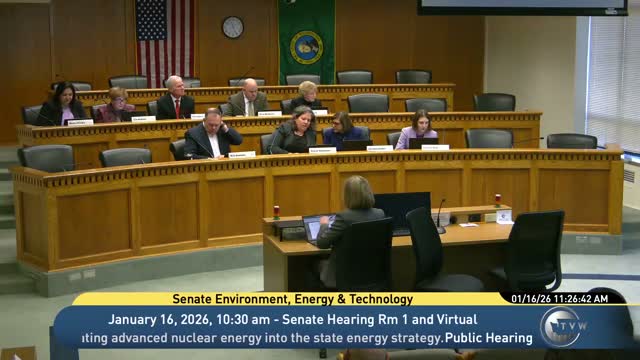
Debate over liability and consumer risk as committee hears bill expanding contracting authority for non‑emitting resources
Summary
Senate Bill 60-04 would let cities, PUDs and joint operating agencies contract for CETA‑eligible renewable and non‑emitting generation, including potential early‑stage financial commitments. Supporters say it modernizes contracting; opponents say it shifts construction and financial risk to ratepayers and favors large nuclear projects.
Senate Bill 60-04 would broaden public entities’ authority to contract for renewable and non‑emitting electric generation projects consistent with the Clean Energy Transformation Act (CETA). Committee staff described the bill as aligning older contracting statutes with CETA’s expanded definition of eligible resources, including renewable hydrogen and other technologies.
Senator Matt Behnke described the change as a "corrective update" that modernizes definitions to allow public utilities and joint operating agencies to engage in projects under CETA-eligible resources. Energy Northwest and the Washington Public Utility District Association supported the bill as providing contracting flexibility to meet clean energy goals.
Numerous opponents — including representatives of the Sierra Club, labor unions skeptical of construction‑work‑in‑progress charges, consumer commenters and former regulators — warned the bill could allow municipalities or utilities to lock ratepayers into payments for projects that fail to complete or perform. Kathleen Saul of the Sierra Club said the bill “shifts the financial risk of unproven and expansion of energy projects onto the ratepayers of Washington State.” Roger Lippman and others cited historical examples of large nuclear cost overruns and urged consumer‑protecting timelines or prohibitions on shifting nonperformance risk to ratepayers.
The committee received mixed testimony and recorded sign‑in tallies (pro and con) but took no final action during this session; committee members asked proponents about possible timeline and consumer‑protection language.