Lifetime Citizen Portal Access — AI Briefings, Alerts & Unlimited Follows
Senate committee hears broad testimony on bill to study advanced nuclear options
Loading...
Summary
Supporters call Senate Bill 58-21 a preparatory framework to assess small modular reactors for reliability and decarbonization; tribal and environmental groups warn the bill narrows public process by relying on outside funding, raises waste and treaty concerns, and lacks firm guardrails. WSIPP presented a state policy review of SMRs.
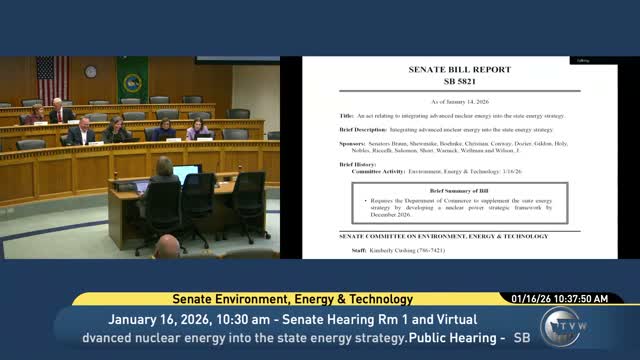
The Washington Senate Environment, Energy and Technology Committee heard hours of testimony on Senate Bill 58-21, which would direct the Department of Commerce to develop a nuclear power strategic framework — contingent on sufficient outside funding and with a required publication target in 2026. Kim Cutching, staff to the committee, summarized the bill as requiring Commerce to outline processes for financing, siting, permitting, tribal consultation and workforce needs and to integrate the framework into the state energy strategy.
Senator Matt Behnke, speaking for Senator Braun, described the bill as “a preparation bill” meant to keep nuclear options on the table as the state plans for rising electricity demand and electrification while seeking to avoid placing costs on ratepayers. “We want to make sure it’s not on the backs of the rate payers in the state,” Behnke said.
In a legislatively requested work session, researchers from the Washington State Institute for Public Policy presented a policy review of small modular reactors (SMRs). Colin Gibson summarized the study’s findings: states have enacted 79 policies across 35 states focusing mainly on preliminary groundwork, siting studies, workforce inputs and select financial mechanisms. Gibson noted federal preeminence in safety regulation via the Nuclear Regulatory Commission and emphasized state roles in interagency coordination, workforce development, and some financial supports such as tax preferences or matching grants.
Tribal leaders were among the earliest and most forceful voices in opposition. Lisa Gunuelas, a member of the Confederated Tribes of the Umatilla Indian Reservation Board of Trustees, said the tribe had signed in opposition and urged that “any development that may impact those first foods must be done with respect and acknowledgment of the CTUIR sovereign rights and resources.” Lindsay Watchman, a tribal chair and general counsel, asked for three conditions to gain tribal support: a transparent third‑party study funded by state revenues (not private developers), mandatory tribal consultation built into the study and funding for tribal technical participation, and firm study deliverables and deadlines.
Other testimony split broadly. Energy Northwest, local public utility leaders and nuclear advocacy groups urged the committee to authorize a framework to examine advanced nuclear as a way to provide non‑emitting, firm capacity and to protect against hydropower variability and large seasonal shortfalls. Greg Cullen of Energy Northwest described the planned Cascade Advanced Energy Facility and said Energy Northwest is “committed to continuing outreach and engagement” with tribes.
Opponents — including the Sierra Club, Columbia Riverkeeper, 350 Washington and numerous ratepayer commenters — argued the bill risks industry influence, lacks adequate waste‑management safeguards, and could shift financial risk to customers. The Sierra Club’s testimony raised ethics concerns about directing Commerce to seek gifts and contributions to fund the work and cited published levelized‑cost estimates showing SMRs are not currently cost‑competitive. Multiple speakers warned that Hanford is an inappropriate site for new nuclear development and that private funding of the framework could bias outcomes.
No formal action or vote on SB 58-21 occurred in the committee during this session. The hearing record shows extensive public sign‑in lists and both detailed technical and value‑based arguments; committee members asked for additional information on water use, environmental impacts, and life‑cycle analysis. The committee adjourned the hearing after collecting testimony and moved on with other agenda items.