Get Full Government Meeting Transcripts, Videos, & Alerts Forever!
Get email alerts on the Policy Conflict topic
No spam. Unsubscribe anytime.
Industry and small landowners warn NP buffer rule could harm rural economies; call for renewed consensus
Summary
Stakeholders told the House Agriculture and Natural Resources Committee that the recently adopted Type NP buffer rule — which some agencies interpreted as allowing no measurable temperature change — constrains adaptive-management alternatives, risks large economic costs for rural counties and small landowners, and has fractured consensus; several witnesses urged reconvening principals to restore trust.
At a House Agriculture and Natural Resources Committee work session, representatives of small forest landowners and large forest landowners warned that recent implementation of the so-called "Type NP" rule has strained the adaptive-management consensus and could impose significant costs on rural communities.
Elaine O'Neil, executive director of the Washington Farm Forestry Association, told the committee that small landowners supported the original Forest and Fish agreement "with the expectation that all those promises...about landowner assistance, financial support, and alternate plans would come to fruition." She argued the adaptive-management program has sidelined human use and urged policy makers to "revisit the four core principles with an emphasis on integrating people into the system."
Jason Spadaro, executive director of the Washington Forest Protection Association, said the NP rule was implemented after the Department of Ecology applied an anti‑degradation interpretation that, in his view, allowed "no measurable temperature change" rather than permitting evaluation of meaningful biological effect. "It results in a one‑size‑fits‑all approach at enormous cost and without corresponding environmental benefit," Spadaro said.
Both organizations said they have conducted county‑level and small‑landowner analyses that show concentrated impacts in already‑stressed counties. Spadaro and O'Neil said the groups are prepared to share their analyses with the committee; O'Neil said earlier work suggested excise‑tax revenue impacts on the order of tens of millions of dollars (Spadaro cited a $90 million figure in aggregated excise tax impact under current inventories).
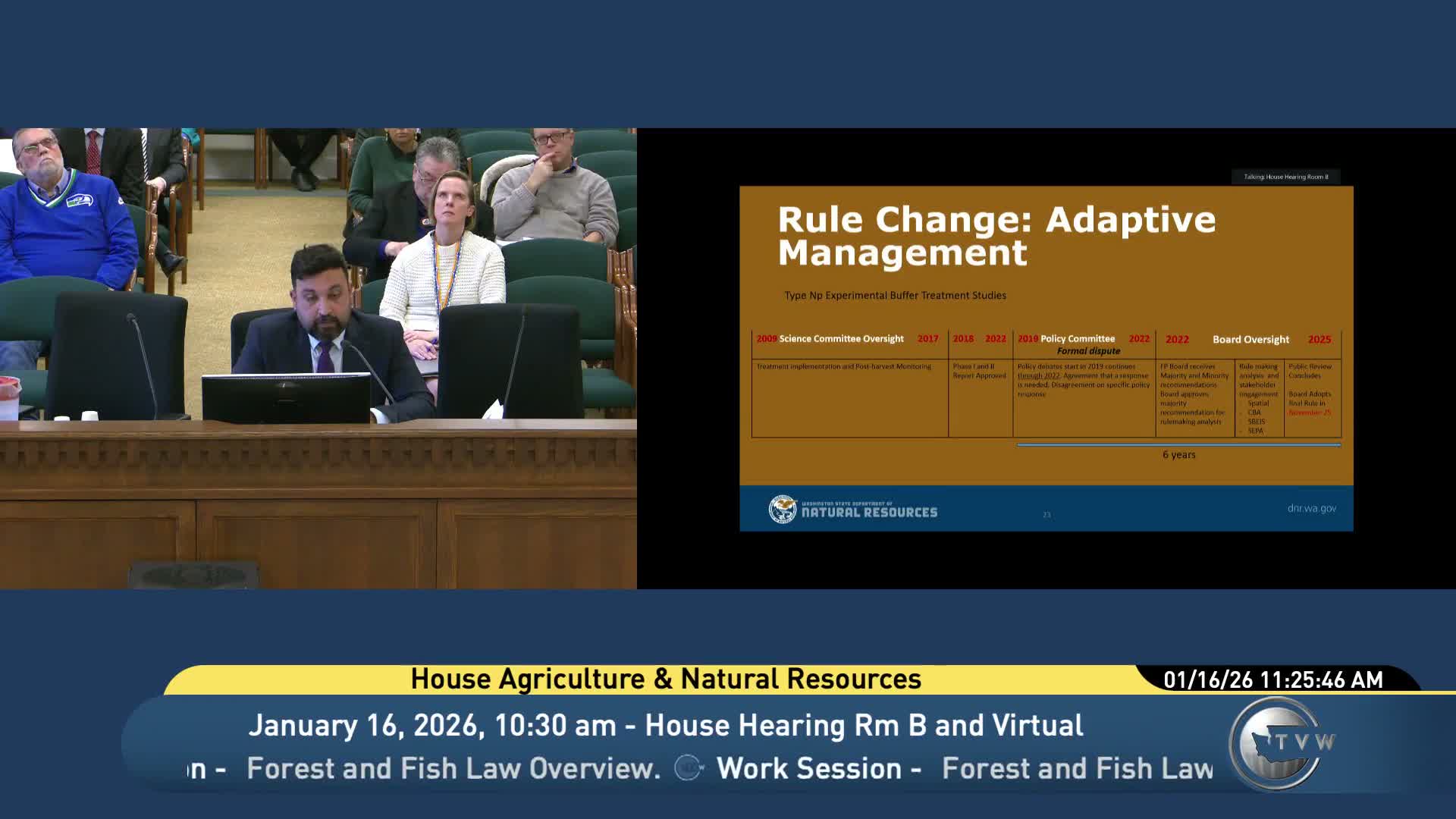
DNR witnesses and tribal representatives framed the dispute as primarily one of interpretation rather than science. Saboor Jawad told the committee the Type NP experimental studies were consensus‑driven but that policy disagreement emerged later in the process and moved to formal dispute resolution. "We had full consensus at the science level...and then at that point consensus fell apart," Jawad said.
Mediator Tim Thompson urged convening negotiation sessions with principals and key stakeholders to restore confidence and rebuild consensus. "Call a 90 negotiation. Bring some of the principles in. Get them centered in on the issue," Thompson said.
Why it matters: Witnesses told lawmakers that the NP rule dispute has eroded long-standing collaborative structures that undergird the Forest and Fish framework, and they urged legislative attention to the consequences for rural economies, the structure of the Forest Practices Board and the integrity of adaptive management.
Next steps: Presenters agreed to share county-level analyses with the committee; the chair said staff would circulate contact information and that legislators will follow up on HEAL Act and agency obligations.