Get Full Government Meeting Transcripts, Videos, & Alerts Forever!
Get email alerts on the History topic
No spam. Unsubscribe anytime.
Lawmakers, tribal leaders and mediators recall origins of Forest and Fish agreement
Summary
Former lawmakers, tribal officials and the mediator who brokered the original deal told the House Agriculture and Natural Resources Committee that the Forest and Fish agreement was the product of decades of negotiation and remains a rare multi-party consensus designed to meet federal Endangered Species Act requirements while keeping the timber industry viable.
Chair of the House Agriculture and Natural Resources Committee convened a work session on the Forest and Fish agreement, hearing historical testimony from original negotiators, tribal leaders and the mediator who helped forge the deal.
Former state Representative Jim Buck, who co‑sponsored the legislation that codified the negotiated agreement into state law, told the committee the law was adopted to provide the federal assurances required under the Endangered Species Act. "Setting the agreement in state law provides that assurance," Buck said, adding that the bill was brought as governor-request legislation and that the legislature acted in special session to pass it.
Tim Thompson, the independent mediator for the original Timber, Fish and Wildlife negotiations, described an unusually collaborative process. "One hundred and forty separate individuals...came together for the first time, arguably in the United States, and achieved a first-of-its-kind collaborative agreement," Thompson said. He emphasized adaptive management and consensus as the deal's core features and urged renewed commitment to those principles.
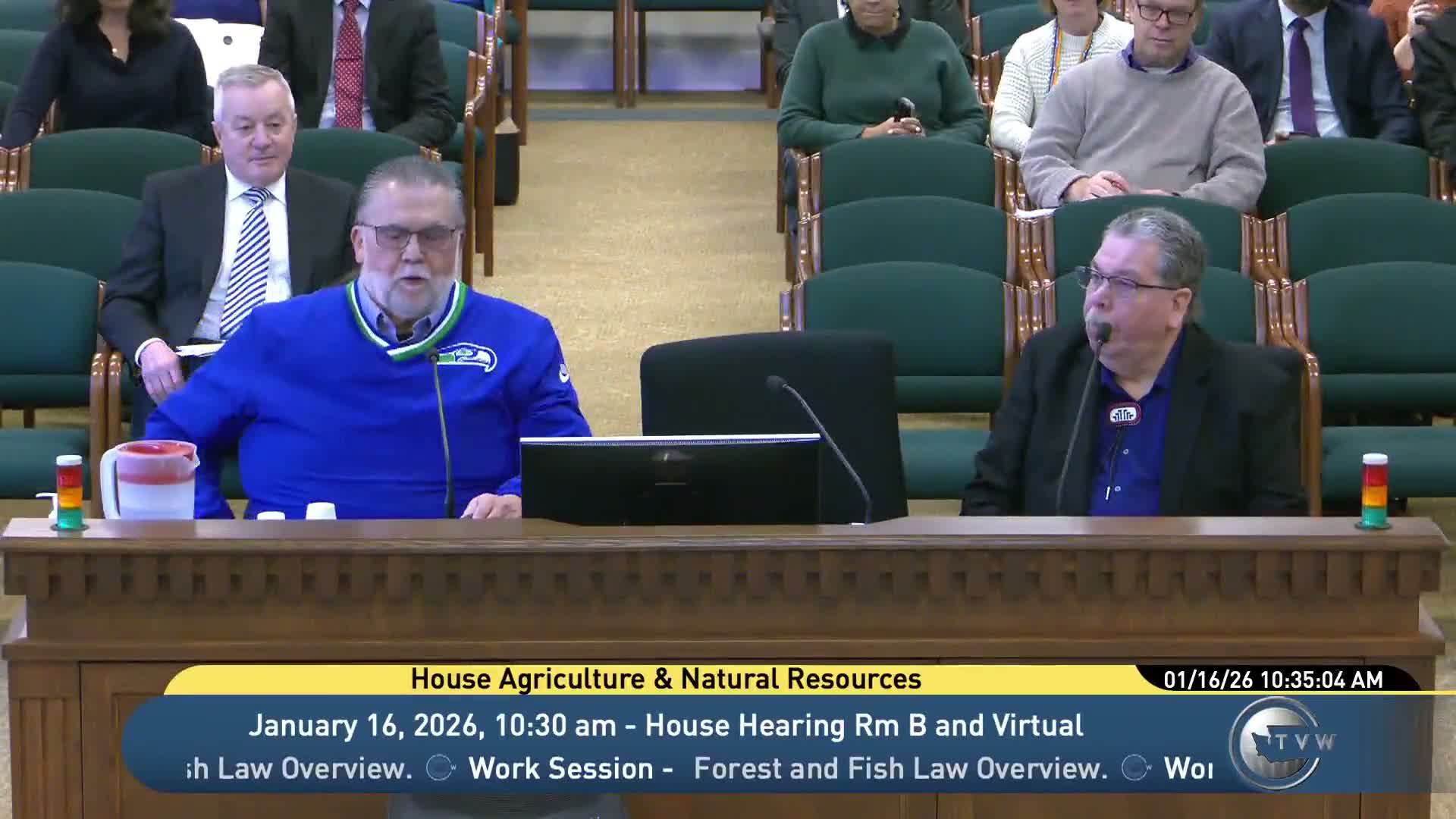
Jim Peters of the Squaxin Island Tribal Council and David Herrera, a Squaxin fisheries representative, said tribal participation hinged on a credible adaptive management program. Peters recalled that the program and its science-driven adaptive management were what secured tribal buy‑in: "What really brought everybody back in was the adaptive management program," he said.
Nut graf: Committee members were given a narrative of how the Forest and Fish agreement developed — from contentious environmental and economic pressures in the 1990s through long-term scientific study and negotiation — and why signatories still consider the adaptive management framework central to the deal.
Why it matters: The historical account underlines that the agreement was intended to provide legal and scientific certainty to landowners and tribes while satisfying federal ESA and Clean Water Act requirements. Several presenters warned that changes made without renewing multi-party consensus risk undermining the assurances that underpin the program.
The committee closed this segment by noting that historical context will inform later discussion about whether and how to adjust implementation, and that several witnesses will remain available for follow-up questions.