Get Full Government Meeting Transcripts, Videos, & Alerts Forever!
Get email alerts on the Early Achievers Awards topic
No spam. Unsubscribe anytime.
Bill Would Let Providers Count ECAP, Head Start Children Toward Early Achievers Award Thresholds
Summary
House Bill 23-18 would allow Early Achievers participants to count ECAP and Head Start enrolled children toward the 5% qualifying threshold for quality improvement awards, removing a disincentive subcontracted providers face when enrolling ECAP children; providers and association representatives called the change small but important for program viability.
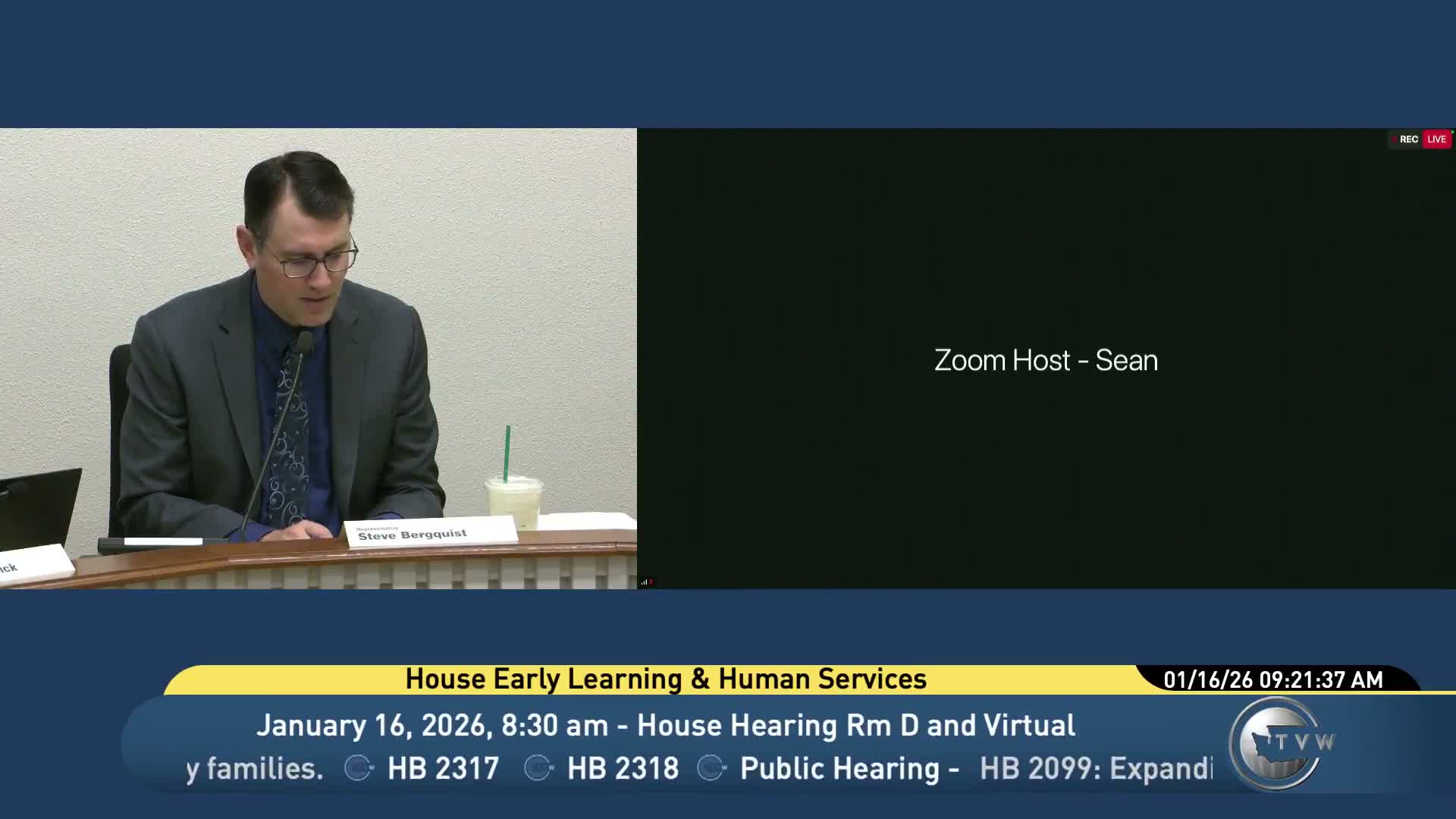
Committee counsel Omera Harrington explained that House Bill 23-18 would modify the Early Achievers quality improvement award qualifying rule so that providers may count enrolled children participating in ECAP or Head Start, in addition to children receiving a qualifying childcare subsidy such as Working Connections, when determining the 5% enrollment threshold to be eligible for an award.
Supporters said the current rule unintentionally penalizes subcontracted providers and geographic‑isolate programs when ECAP enrollment grows, because ECAP children were excluded from the 5% calculation even though ECAP participation requires Early Achievers engagement. Amber Paulson, director of Kaleidoscope on Orcas Island, said her program relies heavily on ECAP and Working Connections and that one child changing funding sources can jeopardize an award that represents critical funding. "I have found myself discouraging families from accessing the comprehensive and critical services provided by ECAP in order to keep our award, and that's not right," Paulson said.
Katie Warren of the Washington State Association of Head Start and ECAP urged support and noted the bill addresses a small anomaly that disincentivizes subcontracted providers without intending a fiscal impact; she said language tweaks may be needed to confirm fiscal neutrality and keep the award targeted to providers serving high‑need children.
Representative Esselick, who presented the bill, said the measure is intended to provide modest additional funding for programs operating on thin margins and framed it as another tool to help expand childcare capacity to serve the neediest families.
The committee closed the hearing on HB 23-18; staff and sponsors indicated they may return with language adjustments to ensure the bill does not unintentionally expand awards beyond the intended scope.