Get Full Government Meeting Transcripts, Videos, & Alerts Forever!
Get email alerts on the Sports Wagering topic
No spam. Unsubscribe anytime.
Committee hears testimony on expanding in‑state college sports wagering while banning prop bets on individual athletes
Summary
At a hearing on House Bill 2205, tribal leaders, casino operators and some universities urged bringing in‑state college wagers into tribal regulation to curb offshore markets, while Washington State University warned the expansion could increase harassment of student-athletes. Lawmakers pressed for athlete protections and integrity monitoring.
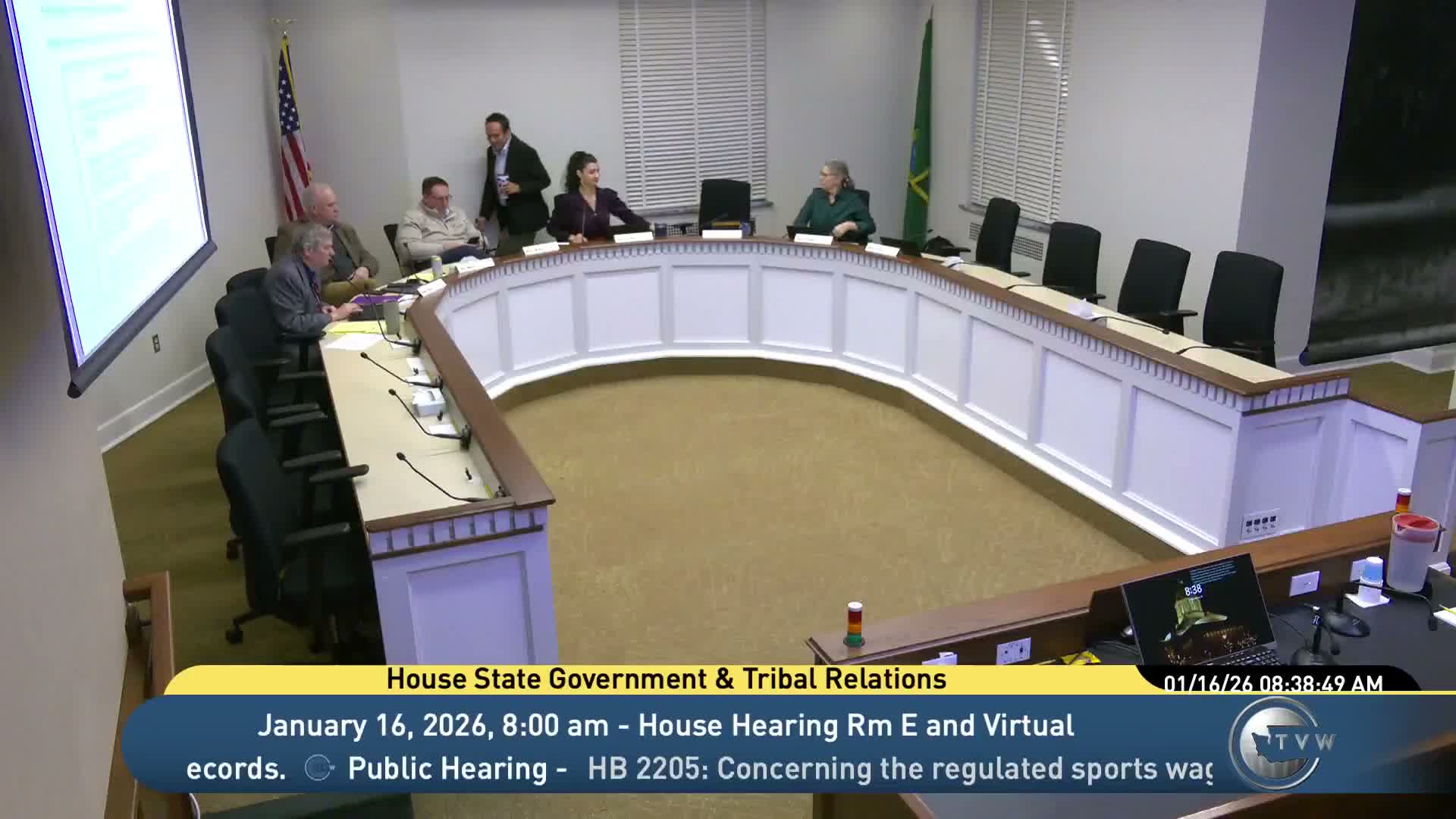
OLYMPIA — The state government tribal relations committee heard closely watched testimony on House Bill 2205 on the regulation of sports wagering, focusing on whether to allow wagers involving Washington post‑secondary athletic events while preserving safeguards for student athletes.
Representative Charlotte Mena, the bill’s sponsor, said the measure would expand the existing on‑premises tribal wagering framework to permit wagers on collegiate team outcomes for Washington schools while explicitly banning prop bets on the performance of individual in‑state athletes. "It protects these college athletes by prohibiting bets on individual performance," Mena said, and described the bill as a way to bring existing, out‑of‑state betting into a regulated, transparent system.
The bill would allow a tribe’s sportsbook to accept internet‑transmitted wagers so long as the bettor is physically present at any tribal gaming facility, rather than requiring the bettor to be on the premises of the accepting tribe. Counsel Connor Schiff told the committee that the change preserves tribal oversight because wagers must be placed and accepted on tribal premises and remain subject to the Indian Gaming Regulatory Act (IGRA).
Tribal leaders testified in strong support. Bill Stairood, identified in the record as chairman of the Puyallup tribal gaming operation, said the bill "builds on what is already working" and emphasized the three layers of tribal, state and federal oversight that apply to tribal gaming operations. Ron Allen, Jamestown S'Klallam tribal chair, told lawmakers the measure would let smaller tribal casinos participate through "hub and spoke" arrangements and would redirect wagering currently taking place on illicit platforms into regulated venues.
Operators echoed that message. Yale Rowe, general manager of the Emerald Queen Casinos, said in‑state collegiate wagering is already taking place through offshore sites and illegal apps and that the bill would not create new demand but instead "redirect it into a regulated and safe environment" with age verification and problem‑gambling safeguards.
Universities offered mixed views. Morgan Hickel of the University of Washington urged the committee to keep the ban on individual prop bets, stressing student safety and the university’s training and wellness supports for athletes. By contrast, Chris Mulek and Brad Corbin of Washington State University testified in opposition, saying the expansion "opens a very large market for sports betting on WSU athletic contests with all the ills that come with it" and arguing regulated venues would not eliminate illicit markets or online harassment they say student athletes already face.
Policy advocates urged the committee to weigh consumer choice and treatment of problem gambling. Johnny Campos of the Taxpayers Protection Alliance urged lawmakers to consider models that use tax revenue to fund addiction services, and he cited New Jersey as an example where revenues have been used to bolster problem‑gambling programs.
Committee members questioned witnesses about the scope of protections, monitoring tools tribal operators use to detect suspicious line movement and the degree to which the proposed approach would curb illegal wagering. Several witnesses cited recent media reports of game‑fixing and an ongoing federal‑level dispute over prediction platforms as context for legislative action.
The hearing closed after a broad set of testimony from tribal leaders, casino operators, higher‑education officials and policy groups. No committee vote on HB 2205 was taken at the hearing; the bill will return to the committee's calendar for later consideration.