Get Full Government Meeting Transcripts, Videos, & Alerts Forever!
Get email alerts on the Paid Family Medical Leave topic
No spam. Unsubscribe anytime.
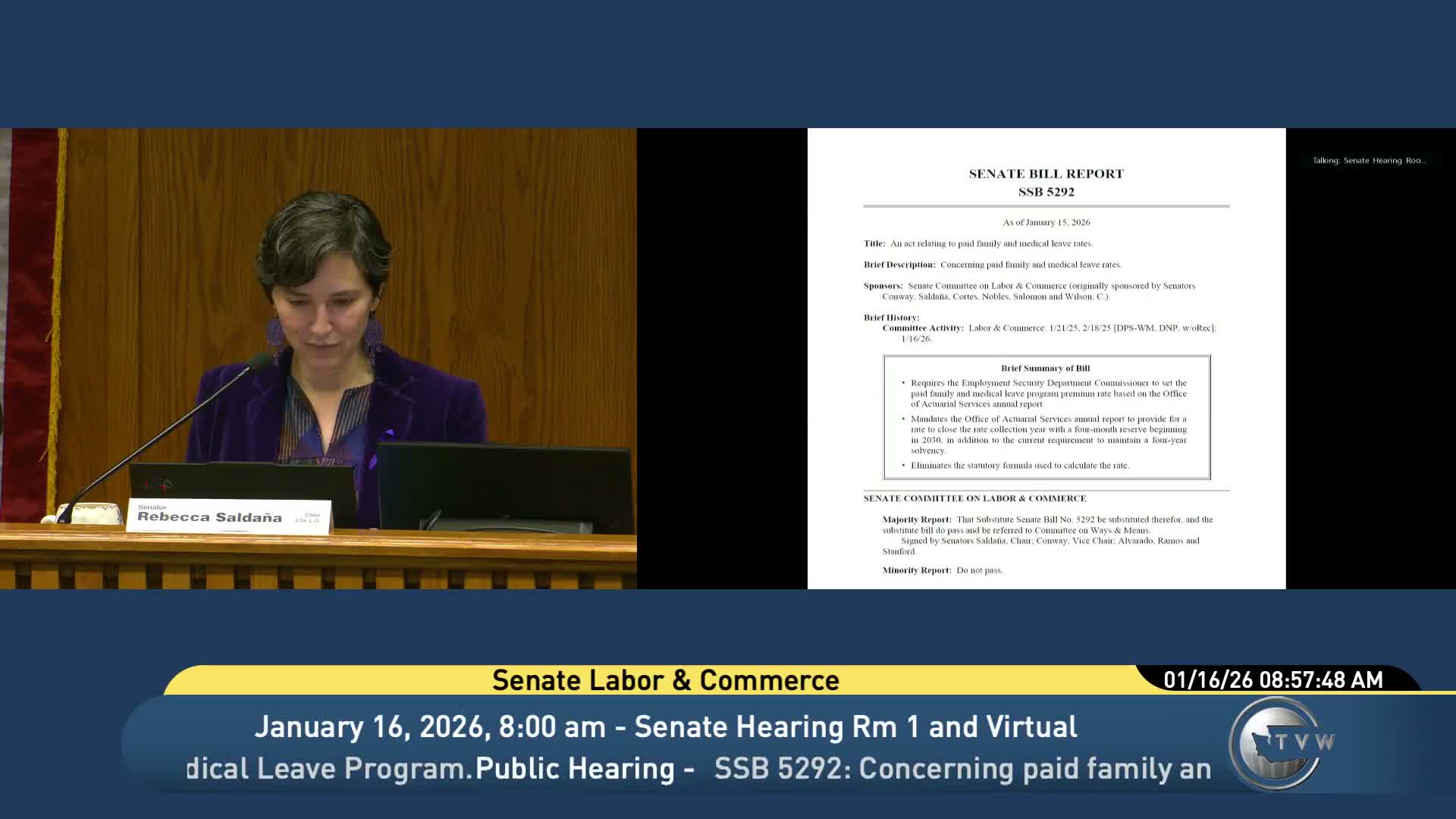
Senate committee hears bill to shift paid-leave premiums to actuarial rate setting
Summary
The Senate Labor & Commerce Committee heard testimony on Senate Substitute Bill 5292, which would require the Employment Security Department to set paid family and medical leave rates using a forward-looking actuarial method and increase target reserves; public testimony was mixed on affordability and solvency.
The Senate Labor & Commerce Committee on Wednesday heard Senate Substitute Bill 5292, a proposal to change how Washington sets premium rates for the state's paid family and medical leave (PFML) program.
Committee staff and the Employment Security Department described the bill as implementing a JLARC recommendation to move from a statutory formula to an actuarial, forward-looking rate. Susan Jones, committee staff, said the proposed substitute eliminates the statutory three-step formula and directs ESD to set the premium based on its annual actuarial report; beginning in 2030 the report must provide for a rate that achieves a four-month reserve.
Sponsor Sen. Steve Conway said the change would make PFML funding more predictable. "This is a great program," Conway said, adding the bill aims to "bring the funding of this program under a methodology that we use to really encourage us to know exactly where what we need to be doing." The department's Dan Zeitlin provided context: since launch PFML has paid more than $8.2 billion in benefits to roughly 723,000 Washingtonians and the separate WA Cares program has processed about 567,000 exemptions and collected roughly $3.2 billion in premiums.
Public testimony was split. Jeff Papp of Citizens Against Unfair Taxes opposed the measure on affordability grounds, saying the change could be used to justify higher payroll taxes. Supporters including Maggie Humphreys of MomsRising and business groups such as the Association of Washington Business said an actuarial approach would stabilize funding and reduce the need for ad hoc adjustments. James Crandall (Association of Washington Business) and Jan Heimbaugh (Building Industry Association of Washington) urged keeping the substitute narrow and forward-looking.
Committee members pressed ESD on operational details: how WA Cares and PFML calls will be handled, fraud detection and referral practices, and trust-fund solvency projections. ESD said WA Cares and paid-leave staffing and premium collection are managed together while DSHS will support benefit-side calls; unresolved fraud complaints are referred to enforcement agencies when appropriate. ESD projected trust-fund reserves at roughly seven months of benefits and noted a statutory 0.2% solvency surcharge triggers if reserves fall below seven months on Sept. 30.
The committee closed the hearing on SB 5292 and the chair said interim work will continue to refine PFML policy and funding.
Next steps: the committee may schedule follow-up briefings and deliberations during the interim before returning to the bill.