Get Full Government Meeting Transcripts, Videos, & Alerts Forever!
Get email alerts on the Age Verification topic
No spam. Unsubscribe anytime.
Washington committee hears emotional testimony on HB 2112, a bill to require age checks for online adult sites
Summary
Supporters said the bill would protect children and cited mental-health harms; opponents warned of privacy risks, enforcement limits for foreign sites, and potential censorship of LGBTQ and health resources. The committee held a public hearing but took no vote.
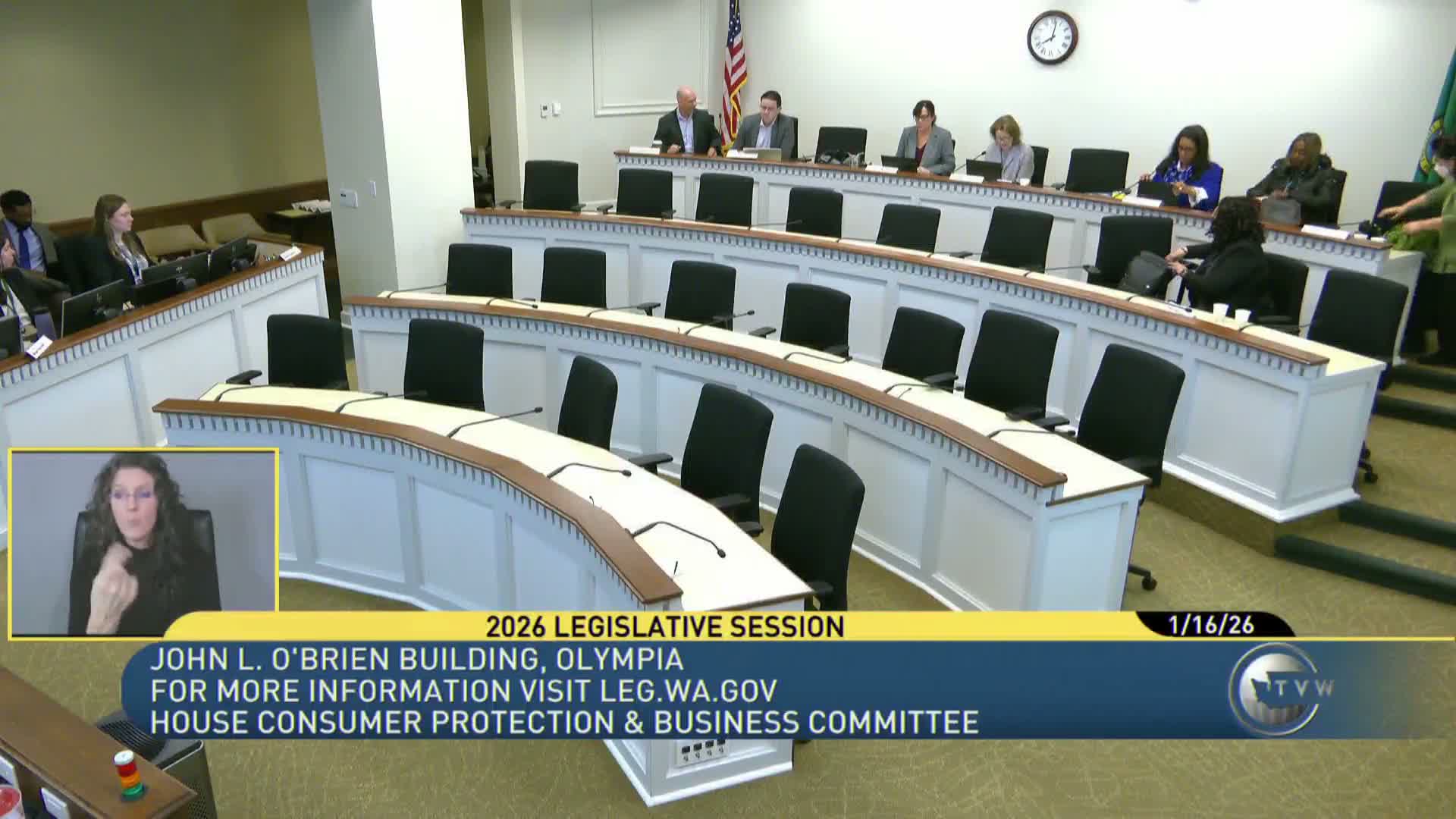
The House Consumer Protection and Business Committee held a public hearing Jan. 16 on House Bill 2112, a proposal that would require commercial websites with more than one-third ‘‘material harmful to minors’’ to implement age verification before granting access. The committee heard hours of testimony from the bill sponsor, technical experts, clinicians, industry representatives, civil-rights groups and dozens of public commenters.
Representative Marie Levitt, the bill—s prime sponsor, framed the measure as a child-protection step analogous to carding for alcohol and tobacco. "The bill before you is about keeping our children safe," Levitt said, citing pediatric concerns that early exposure to adult content correlates with higher rates of depression, anxiety and other harms. She said the bill narrowly targets commercial adult-content sites and includes a warning-label provision and a carve-out for bona fide news and public-interest material.
Megan Mulvihill, staff to the committee, summarized the bill—s mechanics: commercial entities would need to use reasonable age-verification methods (such as government-issued identification, commercially reasonable transactional-data methods, or third-party verification) and display Department of Health notices about youth health risks. The attorney general would enforce the law; civil penalties are described in the draft as up to $10,000 per day for violations, with statutory ceilings noted at amounts up to $250,000 in instances involving minor access.
Supporters urged the committee to act. Heather Grassman, who identified herself as the mother of Riley, a 17-year-old who died by suicide last year, told members her son—s struggles were "directly related to the time he spent in the dark places of the Internet" and asked lawmakers to "place the burden of age verification where it belongs with the companies that create and profit from it". Several clinicians and counselors testified that early exposure is linked to lasting mental-health consequences and framed the bill as a preventive measure.
Proponents including industry providers also described technical solutions intended to protect privacy. Ian Corby, executive director of the Age Verification Providers Association, said modern age checks can be "privacy preserving" and run as ‘‘zero-knowledge proofs—— that confirm age without disclosing identity. Corby proposed clarifying the 33 1/3 percent content threshold and suggested audited standards (he cited a 95% prevention benchmark used by regulators like Ofcom) to measure effectiveness and bias testing.
Opponents raised consistent concerns about data risk, scope and unintended consequences. Privacy experts and civil-rights groups, including the ACLU of Washington, pointed to documented breaches of age-verification systems and argued that even ephemeral or metadata collected during verification can create new vulnerabilities. "Requiring people to provide a government-issued or digital ID to access lawful online content creates serious privacy and security risks," an ACLU representative testified.
Civil-rights and LGBTQ advocates warned the bill—s definitions for "material harmful to minors" and the one-third threshold are vague, risking the inadvertent blocking of educational, health and peer-support resources. Gender Justice League and Lavender Rights Project representatives said they had seen similar laws in other states or localities restrict access to LGBTQ resources and urged clearer carve-outs and definitional fixes.
Industry witnesses and some opponents also questioned enforceability and effect. Representatives of the Free Speech Coalition and other adult-site actors said sites often relocate or shift traffic to noncompliant platforms outside U.S. jurisdiction, reducing the law—s protective effect and potentially driving users to riskier services. Technologists and civil-liberties witnesses warned that state-level rules cannot fully control content hosted abroad and that a compliance burden could force smaller, lawful providers offline.
Committee members asked technical and constitutional questions throughout the hearing, including whether the bill would require platform-wide verification (for example, whether a social platform would need age checks to access individual posts), how the measure would treat AI-driven chatbots or gaming environments, what audit standards would apply, and whether the bill—s non-retention language is sufficiently enforceable for third-party vendors. Sponsor Levitt and staff said the draft focuses on commercial adult-content sites and that staff would follow up on statutory scope and domiciliary questions.
The hearing closed with broad agreement among witnesses that child safety is an important goal but deep disagreement about whether this bill, in its current form, strikes the right balance. The committee did not take a vote and adjourned after the testimony.
What happens next: the committee may request amendments to tighten definitions, data-retention and vendor-audit language, or to add explicit carve-outs for educational and health resources; no formal action on the bill was recorded at the hearing.
(Reporting based on committee staff briefing, sponsor remarks and the committee hearing transcript.)