Get Full Government Meeting Transcripts, Videos, & Alerts Forever!
Get email alerts on the Abortion Medication Stockpile topic
No spam. Unsubscribe anytime.
Bill would let Washington donate or otherwise distribute state stockpile of abortion medications
Summary
HB 2182 would remove a statutory requirement that the Department of Corrections sell the state's mifepristone/misoprostol stockpile at cost-plus fee, allow donation or lower‑cost transfers coordinated with the Department of Health, and expand the definition to cover full-spectrum reproductive care; supporters say this prevents waste and preserves access, opponents object on moral and legal grounds.
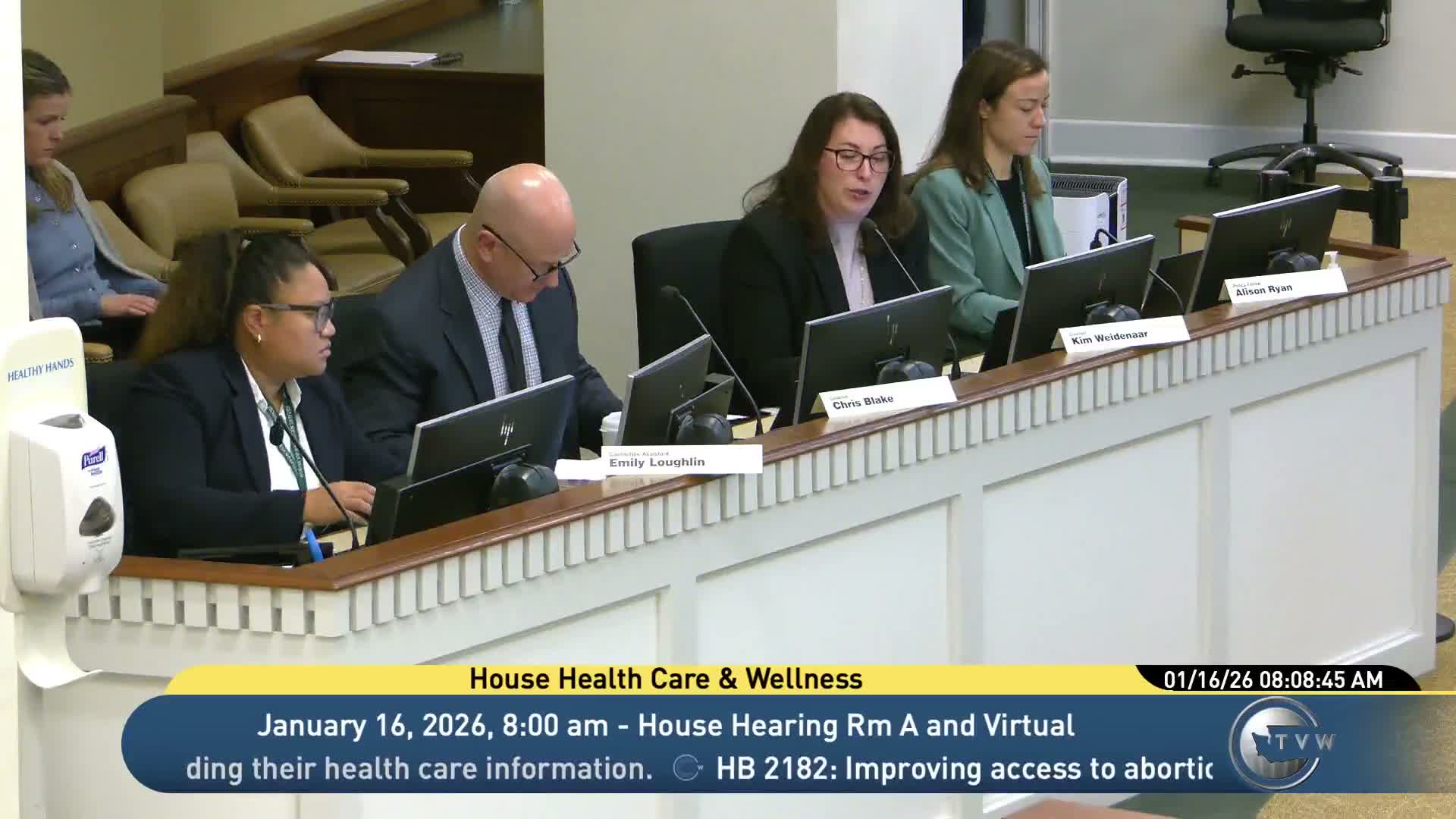
A bill to loosen state restrictions on the sale and distribution of Washington’s mifepristone and misoprostol stockpile drew vigorous public testimony at a House Health Care & Wellness Committee hearing on Jan. 16.
Committee staff summarized House Bill 2182 as removing the statutory requirement that the Department of Corrections sell or distribute abortion medications at cost (or cost plus $5 per dose) and instead authorizing — but not requiring — the DOC to seek payment. The bill would require DOC to coordinate with the Department of Health to identify appropriate recipients and prioritize bulk distribution, and it explicitly adds misoprostol and language covering the full spectrum of reproductive care.
Representative Brianna Thomas, the prime sponsor, said the statute was designed to protect access after Dobbs v. Jackson Women’s Health Organization and that the state has already purchased stockpiles. She said the $5 fee and sale‑at‑cost requirement limit DOC’s ability to distribute or donate medicines before they expire and leave Washington residents vulnerable if federal access is restricted. Caitlin Safford, the governor’s senior policy advisor, and other administration and public‑health officials told the committee that the purchase was a proactive step taken after the 2022 Dobbs decision and that recent federal litigation makes state flexibility important.
Proponents including Pro Choice Washington and reproductive‑health clinicians said the bill would prevent the medication from expiring unused, allow donations to providers that serve uninsured or rural patients, and preserve access in the face of legal uncertainty. Katie Eilers of the Department of Health said DOH will coordinate distribution to reputable clinical partners and noted misoprostol’s uses in miscarriage care and postpartum hemorrhage.
Opponents included faith‑based speakers and several public commenters who described moral objections, cited federal statutes concerning distribution by common carrier, and raised concerns about taxpayer liability if the state stops requiring cost recovery. One opposing speaker cited a study he said showed elevated adverse‑event rates associated with medication abortion; medical providers on the panel disputed that characterization and emphasized that medication abortion is commonly used and that the majority of abortions in Washington were medication abortions in 2024.
Witnesses also noted a pressing practical problem: the transcript shows an earlier DOC stockpile purchase is approaching expiration at month’s end, and staff said the state had purchased additional supplies. Supporters argued that removing the sale‑at‑cost / $5 requirement would allow the state to donate or otherwise distribute medications at a lower price so the stockpile is used rather than wasted.
Committee members heard both policy and moral arguments but no formal vote occurred during the hearing. Sponsors asked the committee to adopt clarifying technical language and to advance measures that ensure both appropriate distribution and stewardship of state resources.
The committee adjourned without taking final action on the measure.