Get Full Government Meeting Transcripts, Videos, & Alerts Forever!
Get email alerts on the Passenger Rail topic
No spam. Unsubscribe anytime.
Panel hears bill to create passenger rail advisory committee for Amtrak Cascades and statewide service
Summary
House Bill 2092 would create a statutory passenger rail advisory committee to advise WSDOT on Amtrak Cascades and broader passenger-rail issues; advocates, disability groups and rail coalitions supported the measure and asked for statewide scope and explicit disability representation.
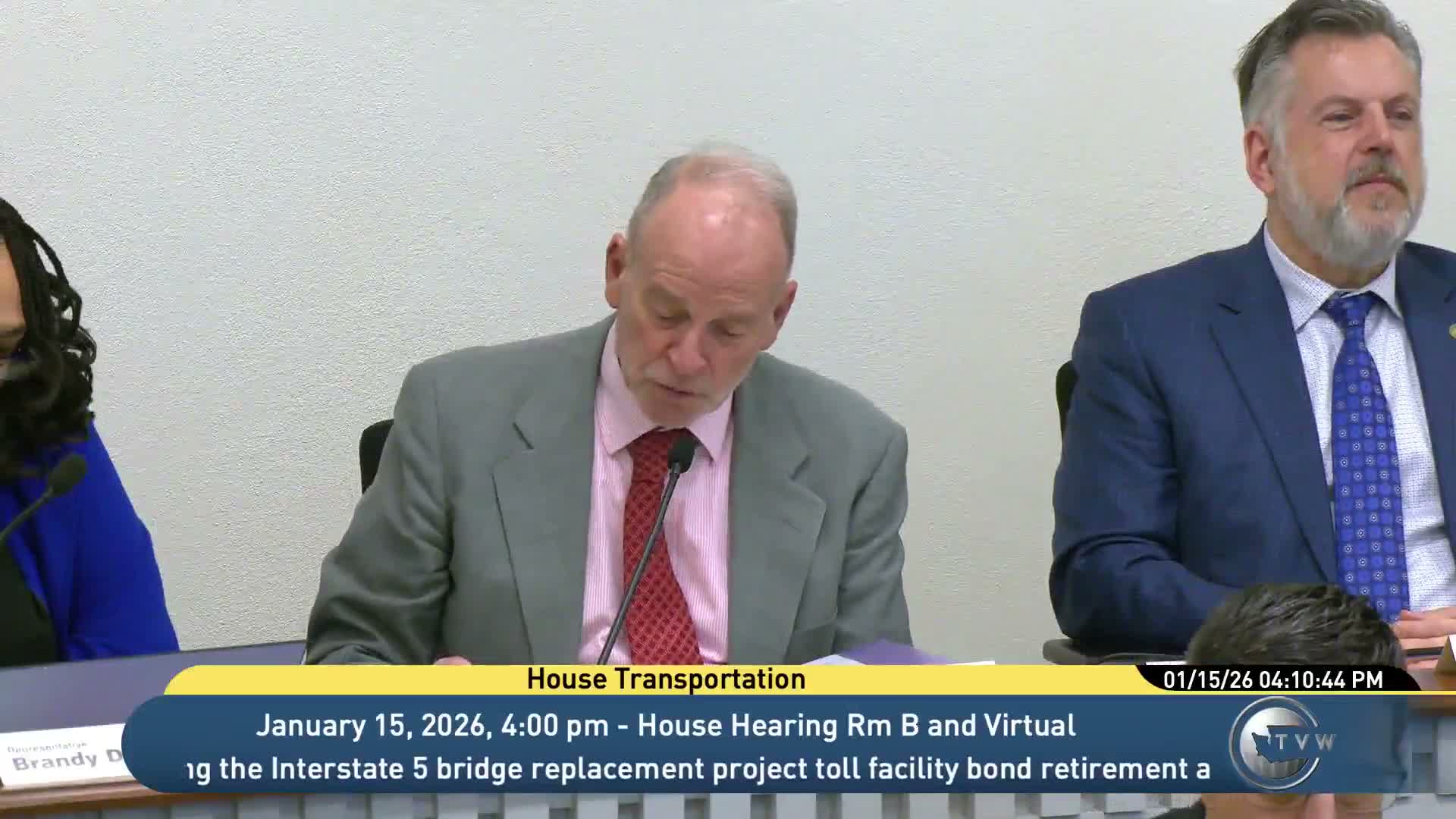
The House Transportation Committee heard House Bill 2092 on Jan. 15, which would establish a Washington State passenger rail advisory committee to provide formal, recurring user and stakeholder feedback to the Washington State Department of Transportation (WSDOT).
Jennifer Harris, staff to the committee, briefed the proposal and described WSDOT’s current passenger-rail responsibilities, the Amtrak Cascades service and federal grants that have supported service planning. Harris said the bill sets targets for 2035 – including a minimum on‑time performance goal and expanded round trips – and requires WSDOT reporting and independent review by a Joint Transportation Committee-led review process. WSDOT estimated a fiscal impact of $82,000 during the remainder of the biennium and an ongoing impact of $156,000 per biennium for roughly 0.5 FTE to staff the advisory effort.
Vice Chair and prime sponsor Representative Reed said the advisory body grew from community advocates who "didn't feel heard" by the agency and framed the committee as a statutory way to ensure regular, systemic input. Reed indicated possible amendments to add ex officio members and disability representation.
Rail advocates and coalition groups testified in strong support. Luis Saul Moscoso of All Aboard Washington called the bill "a long-sought direct advocacy forum for passenger-rail users." Charles Hamilton and Gary Wirt, also from rail advocacy organizations, urged the committee to make the body statewide and to include disability and planning representation. Members of the Rail Can't Wait coalition, environmental and public‑health advocates, and disability-advocacy groups recommended explicit seats for people with disabilities and broader geographic representation.
During questioning, Rep. Timmons asked whether affordability and fares could be within the advisory committee's remit; Reed said the group would primarily provide consumer feedback but could develop proposals for legislative action. Rep. Orcutt asked whether freight rail owners such as BNSF should be included; Reed said that could be resolved by adding ex officio appointments.
The committee concluded the public hearing on HB 2092 after an extended panel of advocates; no formal vote was taken during the hearing.