Get Full Government Meeting Transcripts, Videos, & Alerts Forever!
Get email alerts on the Capital Budget topic
No spam. Unsubscribe anytime.
Committee hears Governor Ferguson’s supplemental capital budget; housing pitch meets warnings about $75 million public-works sweep
Summary
At a House Capital Budget Committee hearing on HB 2295, OFM staff outlined Governor Ferguson’s supplemental capital budget — including roughly $237 million for housing and $225 million for the Housing Trust Fund — while local officials and advocacy groups urged the Legislature to preserve a $288M public‑works fund from a proposed additional $75M transfer that they say would jeopardize projects.
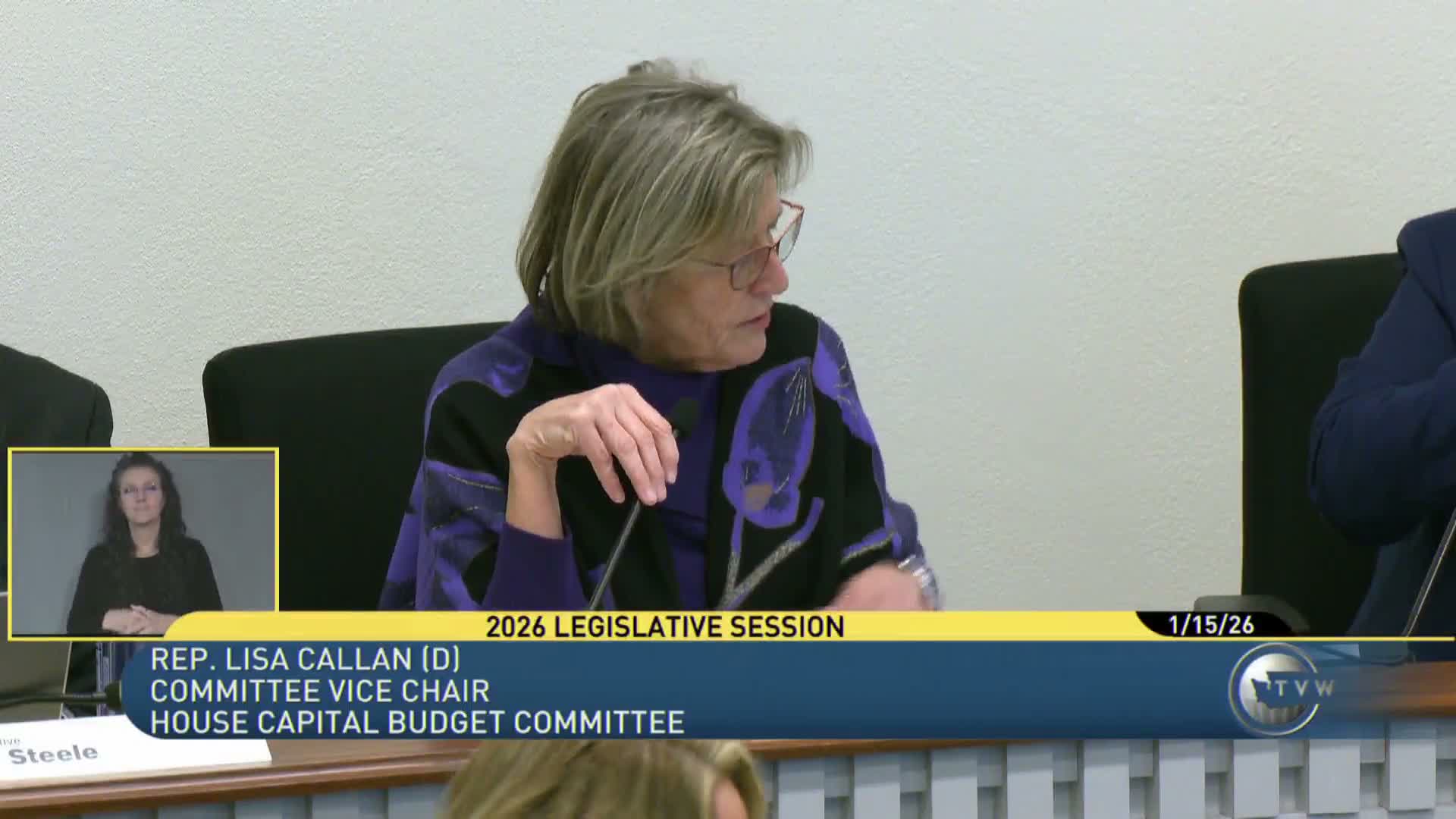
The House Capital Budget Committee on Thursday heard the governor's proposed supplemental capital budget in a public hearing for HB 2295, with Office of Financial Management Senior Budget Advisor Jen Masterson detailing the plan and dozens of local officials and advocates testifying for specific projects.
Jen Masterson, Senior Budget Advisor for the Capital Budget at the Office of Financial Management, told the committee the legislature left “just over $355,000,000 in available bond capacity” for the supplemental session and OFM identified “nearly $46,000,000 in savings,” bringing available bonds “to just over $400,000,000.” She said the governor’s new appropriations total about $396,000,000, leaving roughly $5,400,000 in bond authority, and noted the supplemental also draws $68,000,000 from the Common School Construction Account, $67,000,000 from the Climate Commitment Account and $13,000,000 in federal funds.
The governor’s proposal emphasizes housing, Masterson said, with a total capital housing investment of $237,000,000 and a $225,000,000 allocation to the Housing Trust Fund. OFM staff itemized parts of that package: $81,000,000 to develop approximately 1,900 affordable rental units; $73,000,000 for a homeownership program estimated to build over 650 units for first‑time buyers; $50,000,000 for preservation and repairs; and $20,000,000 to acquire and preserve manufactured‑home communities.
Supporters of the housing investments urged the committee to keep that funding in the final budget. Rachel Myers, Executive Director of the Washington Low Income Housing Alliance, said: “This level of funding would create or preserve over 4,000 affordable homes for low income households in Washington.” Michonne Preston of Habitat for Humanity of Washington State and other nonprofit and local government witnesses described shovel‑ready projects and urged urgency to address the housing shortage.
At the same time, multiple witnesses raised alarm about a proposed transfer in the governor’s operating budget that would move $75,000,000 out of the Public Works Assistance Account. Gary Roe, vice chair of the Washington State Public Works Board, warned the transfer “will again need an injection of state bond dollars to ensure that the cash balance for the public works assistance account stays in positive territory,” and asked the committee to evaluate options to avoid disrupting loans and grants. Scott Hazelgrove of the Washington Association of Sewer and Water Districts said the transfer “takes $75,000,000 away from dollars that you have already approved for this program and have already been awarded to recipients,” risking projects that are out to bid.
Local elected officials described immediate consequences. Ruth Clemens, city administrator for Aberdeen, said her city’s flood‑risk plan relies on low‑interest loans from the Public Works Assistance Account and warned higher‑cost market borrowing could make projects unattainable. Axel Swanson of the Association of Counties urged the committee to “find another way” and noted many projects are already obligated.
Other testimony highlighted priorities across the supplemental package: increased salmon‑recovery funding, natural‑climate solutions and community forests (tribal and nonprofit sponsors asked for additional RCO funds), school seismic safety and small‑district modernization, preservation projects at public universities and targeted investments in state facilities with urgent safety or financial risk.
University and research representatives urged additional decarbonization funding for campus projects; Kevin Chang of the University of Washington said the omitted decarbonization phase would reduce greenhouse gas emissions by an estimated 4,600 to 10,100 metric tons per year and aid compliance with the Climate Commitment Act and the Clean Building Performance Standard.
Committee members asked staff for follow‑up details on several requests; members did not vote on any measures during the hearing. The chair closed the hearing and said the committee will continue work on the capital budget in future sessions.
The hearing record includes detailed project requests from local governments, tribes and nonprofits; the committee did not take formal action on HB 2295 during this session.