Get Full Government Meeting Transcripts, Videos, & Alerts Forever!
Get email alerts on the Agriculture Policy topic
No spam. Unsubscribe anytime.
Washington Policy Center warns of farm financial stress and urges regulatory fixes for forests and salmon recovery
Summary
Washington Policy Center researchers told senators that farm take‑home pay has fallen sharply, leaving many operations financially strained, and recommended voluntary programs, tax review, labor‑cost adjustments and targeted forest‑health funding (including broadened Good Neighbor Authority and reduced permitting barriers) to accelerate on‑the‑ground work.
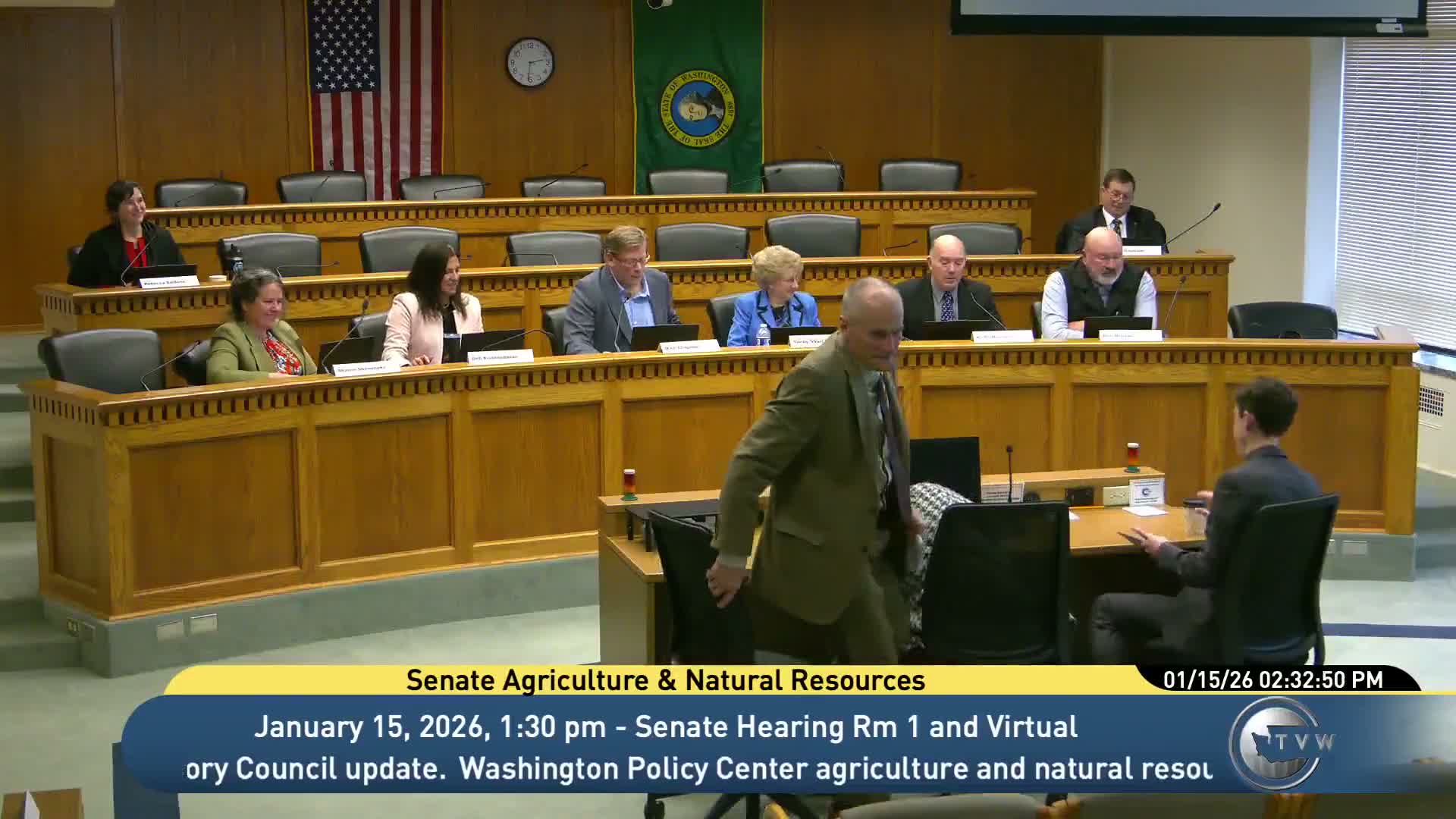
Todd Myers, vice president for research at the Washington Policy Center (WPC), and Pam Lewison, WPC’s agricultural director and a fourth‑generation farmer, briefed the Senate committee on agricultural viability, forest health and salmon recovery.
Lewison urged policies that preserve farm financial viability, citing USDA figures and WPC analysis that Washington farms experienced a steep decline in take‑home pay between 2023 and 2024 and now face production expenses that outpaced farm income. She recommended prioritizing voluntary stewardship programs, evaluating tax burdens on farms and pursuing labor‑cost adjustments and youth outreach to bolster the next generation of farmers.
Myers urged increased, accountable spending for forest health and described the Good Neighbor Authority as a useful tool for state–federal cooperation. He proposed moving some forest‑health funding to the capital budget (to support longer projects), reducing SEPA and NEPA barriers where appropriate, and ensuring grants for salmon recovery remain science‑based rather than diluted by unrelated program goals.
Committee members raised practical concerns: how to get surplus crops into donation channels without worsening farmers’ losses; competition with international producers; and processor disruptions. Witnesses suggested central food repositories and stronger partnerships with organizations such as Second Harvest to move marginally profitable produce into donation networks.
Myers said the legislature should set priorities locally, fund science‑based projects for salmon recovery, and remove permitting barriers so state funds can get projects on the ground more quickly. He said WPC will bring a bill next year to reduce regulatory barriers and that Good Neighbor Authority has succeeded in parts of Eastern Washington but needs acceleration.