Get Full Government Meeting Transcripts, Videos, & Alerts Forever!
Get email alerts on the Ocean Acidification topic
No spam. Unsubscribe anytime.
MRAC: Ocean acidification narrows favorable seasons for shellfish; state monitoring and adaptation investments urged
Summary
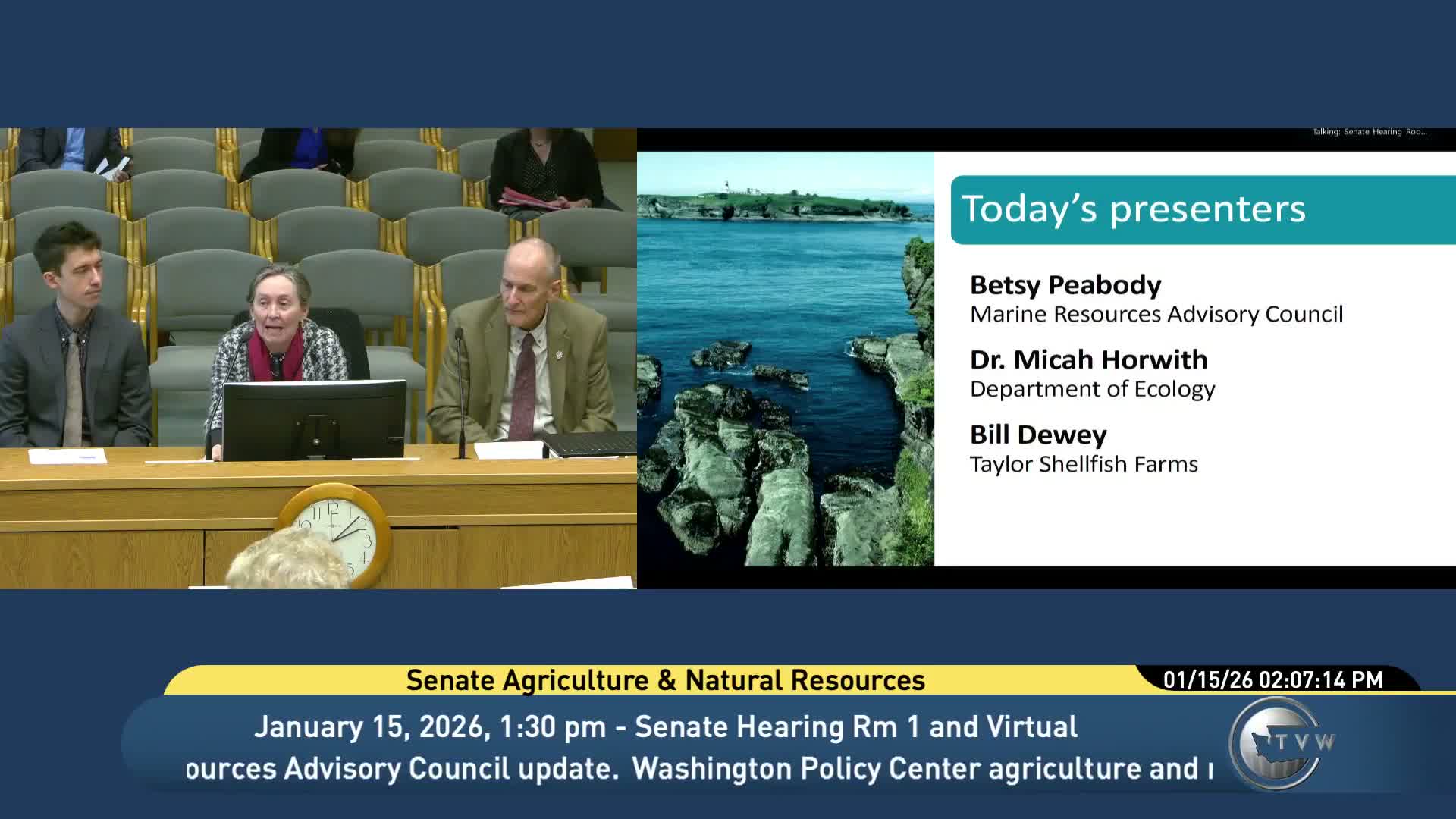
Marine Resources Advisory Council chair Betsy Peabody and scientists told the Senate committee that ocean acidification — compounded by coastal processes like upwelling — has shortened the season of 'favorable water' for shellfish in Puget Sound and that continued state investment in monitoring, mitigation (nutrient reduction) and adaptation (kelp co‑culture, hatchery buffering) is essential.
Betsy Peabody, chair of the Marine Resources Advisory Council, told the Senate Ag & Natural Resources Committee that Washington state has taken a leadership role in studying and responding to ocean acidification, which she described as already affecting local economies and marine species.
Micah Horwath, senior scientist on ocean acidification at the Washington Department of Ecology, explained that ocean acidification is driven by carbon dioxide absorbed from the atmosphere, which forms carbonic acid in seawater and reduces pH and carbonate ion availability. Horwath emphasized aragonite saturation state — a laboratory‑measured metric — as a key indicator, noting values near 1 mark the boundary where shell formation becomes difficult for animals such as Pacific oysters.
Bill Dewey of Taylor Shellfish described past hatchery losses in oyster larvae (70–80% mortality two decades ago) and credited scientific collaboration and hatchery chemistry treatments for resolving an acute seed crisis. He warned, however, that acidification continues to worsen and will increasingly threaten both farmed and wild animals. Dewey described on‑farm and hatchery adaptation strategies — buffered intake systems, selective breeding and potential species shifts — and said co‑culturing kelp near shellfish beds may locally improve water chemistry.
Committee members asked about monitoring capacity and thresholds for harm. Horwath said pH sensors are deployed across Greater Puget Sound and complementary lab measurements of aragonite saturation provide context; he noted Washington’s geography and seasonal upwelling make the state especially vulnerable. Dewey added that federal and philanthropic investments, plus a half‑million‑dollar federal purchase of real‑time chemistry monitoring equipment, helped the industry adapt.
Peabody urged continued state support for research, monitoring networks and mitigation strategies (including nutrient pollution reduction and carbon‑emissions controls) to protect shellfish, crab, razor clams and other resources that support coastal communities and jobs.