Get Full Government Meeting Transcripts, Videos, & Alerts Forever!
Get email alerts on the Water Supply topic
No spam. Unsubscribe anytime.
Office of Columbia River says basin projects have delivered 80% of 2030 goal; Springwood Ranch reservoir remains years away
Summary
Office of Columbia River Director Larry Mattson told the Senate Ag & Natural Resources Committee that projects since 2006 have developed about 800,000 acre‑feet — roughly 80% of the office’s 1,000,000 acre‑foot target for 2030 — while major storage and conveyance projects (including the Springwood Ranch site) still face geotechnical, permitting and funding timelines.
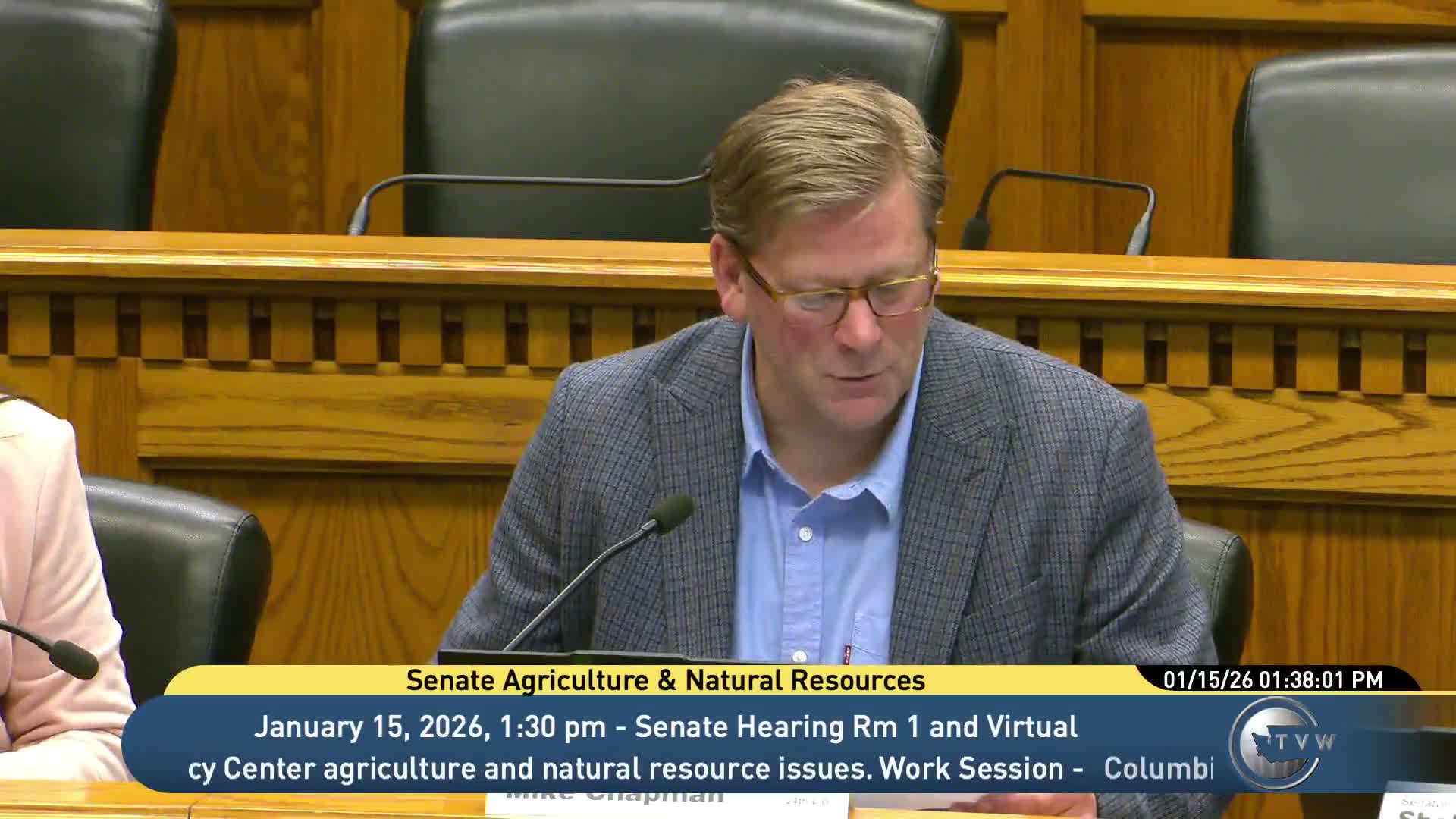
Larry Mattson, director of the Office of Columbia River, told the Washington State Senate Agriculture and Natural Resources Committee that projects funded through the Columbia River water account have developed just over 800,000 acre‑feet of water supply, about 80% of the office’s 1,000,000 acre‑foot target for 2030.
Mattson said the office’s five‑year water supply and demand forecast — led by Washington State University — will be published this spring and delivered to legislators this summer. He described the office’s mission as “to aggressively pursue new water supplies for both in‑stream and out‑of‑stream needs,” and said the office functions as a conduit that leverages state funds to attract federal and nongovernmental matching dollars.
On details, Mattson reviewed the Odessa groundwater replacement program established after a final environmental impact statement and said the program aims to convert temporary groundwater permits to Columbia Basin surface water for roughly 88,000 acres of irrigated farmland. He described three main stages: securing surface water allocations, canal enlargement (East Low Canal upgrades and bridge modifications), and on‑farm distribution and pumping plant construction. Mattson noted the U.S. Department of Agriculture’s Natural Resources Conservation Service has contributed nearly $40 million for several canal projects.
Mattson also summarized the Yakima Basin Integrated Plan and recent accomplishments, including the purchase of the 3,600‑acre Springwood Ranch (a potential reservoir site) and work on the Cle Elum juvenile fish‑passage facility and the Yakima River gap‑to‑gap restoration. He said Bateman Island causeway removal had progressed with a recent levy breach to allow the river to flow around the island.
Senators asked whether Springwood Ranch reservoir work could be accelerated. Mattson said geotechnical studies limit how quickly some tasks can proceed but that staff are identifying tasks to run concurrently rather than sequentially to shorten timelines. On capacity, estimates discussed ranged from tens of thousands up to 200,000 acre‑feet, and Mattson characterized the range under consideration as roughly 40,000–100,000 acre‑feet for feasible designs.
Mattson reviewed the account established in 2006 that originally used $200 million in general obligation bonds and said those funds were largely exhausted by 2019, leaving a pay‑as‑you‑go model with biennial capital requests. He described a recovery account that recoups development fees from permittees to fund future supply projects.
The committee did not take formal action on the Office of Columbia River update; the presentation closed and the committee moved to the next item on the agenda.