Get Full Government Meeting Transcripts, Videos, & Alerts Forever!
Get email alerts on the Face Coverings topic
No spam. Unsubscribe anytime.
Senate panel backs substitute for bill restricting law‑enforcement face coverings after lengthy debate
Summary
After extended debate over multiple amendments, the Senate Law and Justice Committee adopted a proposed substitute to SB 5,855 (face coverings) and sent it to the Rules Committee with a due‑pass recommendation. Debate focused on exceptions for medical and weather protection, federal agents, and whether discipline should be through the Criminal Justice Training Commission.
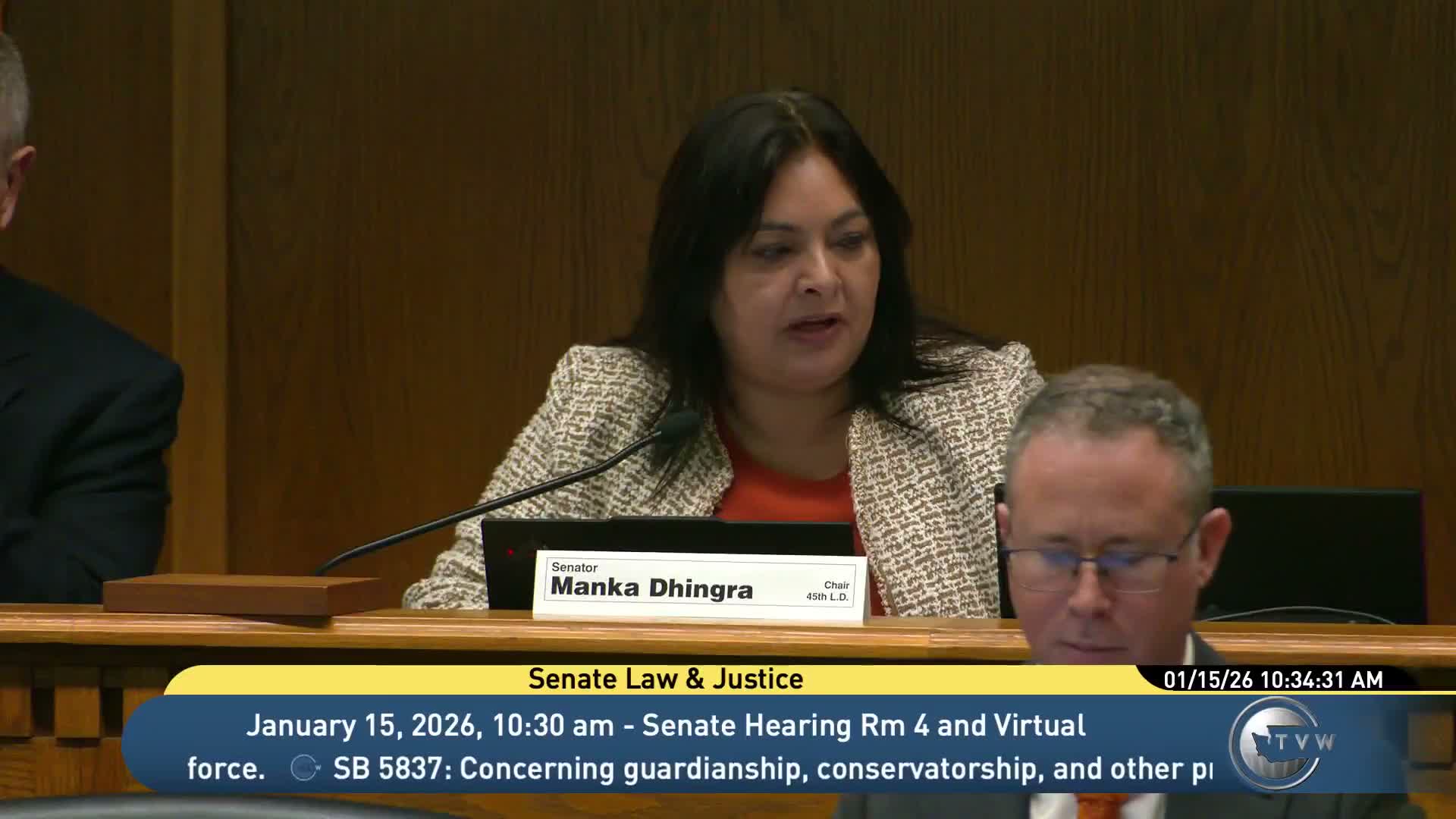
The Senate Law and Justice Committee on Jan. 15 voted to advance a proposed substitute to Senate Bill 5,855, a measure that would generally prohibit law‑enforcement officers in Washington from wearing masks except in defined circumstances and would allow civil suits by people detained by unlawfully masked federal officers.
Sen. Ashley Valdez, sponsor of the substitute, framed the proposal as a transparency and trust measure: “This is about trust and transparency,” Valdez said, noting more than 14,000 people signed in in favor at the committee hearing. The substitute retains exceptions aimed at protecting officers from hazardous environmental conditions and clarifies identification requirements for officers who are complying with state law.
Opponents and supporters sparred over several discrete amendments at the committee’s executive session. Sen. Fortunato offered Echo 1 (to separate medical N95/surgical masks from other environmental protective gear) and Echo 2 (to exclude riot gear from the facial‑covering definition); both amendments failed. Sen. Wagner proposed Echo 3 to explicitly allow weather‑protective coverings; that amendment also failed after members agreed the substitute’s language already includes protections for hazardous environmental conditions. Sen. Holy’s Echo 4 — replacing a private cause of action with disciplinary handling through the Criminal Justice Training Commission (CJTC) — was adopted by the committee; Fortunato’s Echo 5 (a compensation fund for officers allegedly harmed by the inability to wear facial coverings) was not adopted.
Throughout debate, members raised concerns about the bill’s interaction with federal agents. The chair and others said the private civil remedy in the substitute is principally aimed at situations involving federal officers who do not fall under state disciplinary jurisdiction. “These are individuals coming from out of our state under authority of a federal law that is not abiding by Washington state law,” the chair said during debate.
The committee voted to roll the adopted amendments into the substitute and recommended the bill be sent to the Rules Committee with a due‑pass recommendation. The committee did not take final floor action; the bill will proceed to Rules for scheduling.
What comes next: SB 5,855 will be considered in the Rules Committee and could be scheduled for floor action if Rules places it on the calendar.
Notes: The committee’s record shows a mix of stakeholder input received during the recent public hearing and numerous floor amendments aimed at clarifying exemptions and enforcement mechanisms. The substitute’s text preserves a contingency for discipline under CJTC in situations where state jurisdiction applies.