Get Full Government Meeting Transcripts, Videos, & Alerts Forever!
Get email alerts on the Childcare Audit topic
No spam. Unsubscribe anytime.
DCYF details audits and oversight of Working Connections childcare; agency says fraud referrals are rare
Summary
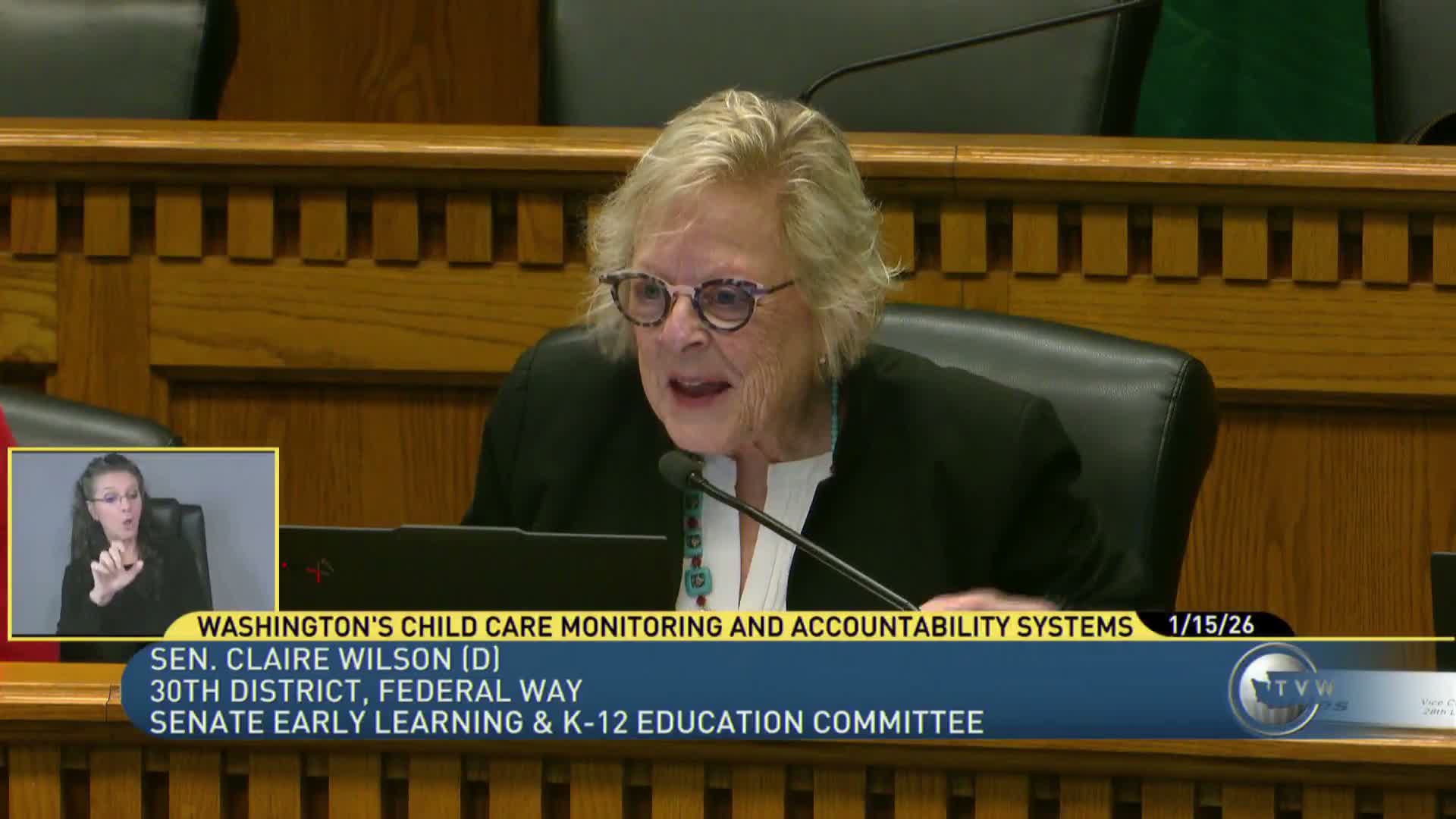
DCYF officials told the Senate Early Learning & K‑12 Education Committee that Washington audits roughly 23% of providers and families in its childcare subsidy program, that a centralized 12‑person audit team conducts provider and eligibility reviews, and that referrals to the Office of Fraud and Accountability remain a small fraction of cases.
Nicole Rose, Assistant Secretary of Early Learning with the Department of Children, Youth and Families, told the Senate Early Learning & K‑12 Education Committee that Washington’s Working Connections Childcare is a family benefit that pays licensed providers directly after verifying a family’s eligibility.
"In calendar year 2025, we had over 63,000 families that were determined to be eligible for Working Connections childcare," Rose said, and she added that the state has "over 6,600 licensed childcare providers." She described a three‑part flow: family eligibility verification, provider authorization, and service payment after care is provided.
Ruben Reeves, Assistant Secretary for Licensing, described annual in‑person, unannounced monitoring visits that licensors perform to check health and safety rules and said visits are counted only when a child is present. Reeves said licensors make three attempts and can take licensing action — including closure — if visits cannot be completed; he characterized such closures as rare.
Rose and Reeves outlined DCYF’s audit structure. Rose said DCYF maintains a centralized team of 12 auditors — six focused on family eligibility and six on provider billing — and performs both random audits (selected with a random‑number generator) and focused audits targeting application processing, payment, and billing accuracy. She said the centralized team conducts roughly 240 provider billing audits and about 620 eligibility audits per month.
"DCYF audits approximately 23% of all providers," Rose said, and she added that about 23% of eligible families are audited as well. Rose described the referral path for suspected fraud: DCYF refers potential fraud to the Department of Social and Health Services Office of Fraud and Accountability, and the Office of Financial Recovery handles collection of overpayments. She cautioned that overpayments are often administrative errors and not evidence of intentional fraud.
On enforcement, Rose said that referrals from provider audits for calendar year 2025 were about 0.1% and that, to date in that year, there were no prosecutions or convictions reported to the committee for provider referrals. She emphasized DCYF’s mix of monitoring, coaching and technical assistance as part of program integrity.
Committee members asked detailed procedural questions about how quickly licensors recheck providers when children are absent at an initial visit, which license‑exempt family, friend and neighbor providers receive unannounced monitoring (about 380 non‑relative providers), and whether Working Connections has a caseload cap (Rose said there is no cap and about 37,000 families were on the caseload at the time of the hearing).