Lifetime Citizen Portal Access — AI Briefings, Alerts & Unlimited Follows
Committee hears bill to preserve coverage of preventive services and allow state vaccine guidance
Loading...
Summary
SB 5967 would let the Washington Department of Health issue state immunization recommendations and require state-regulated plans issued after April 1, 2026 to cover preventive services as of June 30, 2025; agency officials and many clinicians supported the bill while some public commenters warned of politicization and asked for transparency and fiscal details.
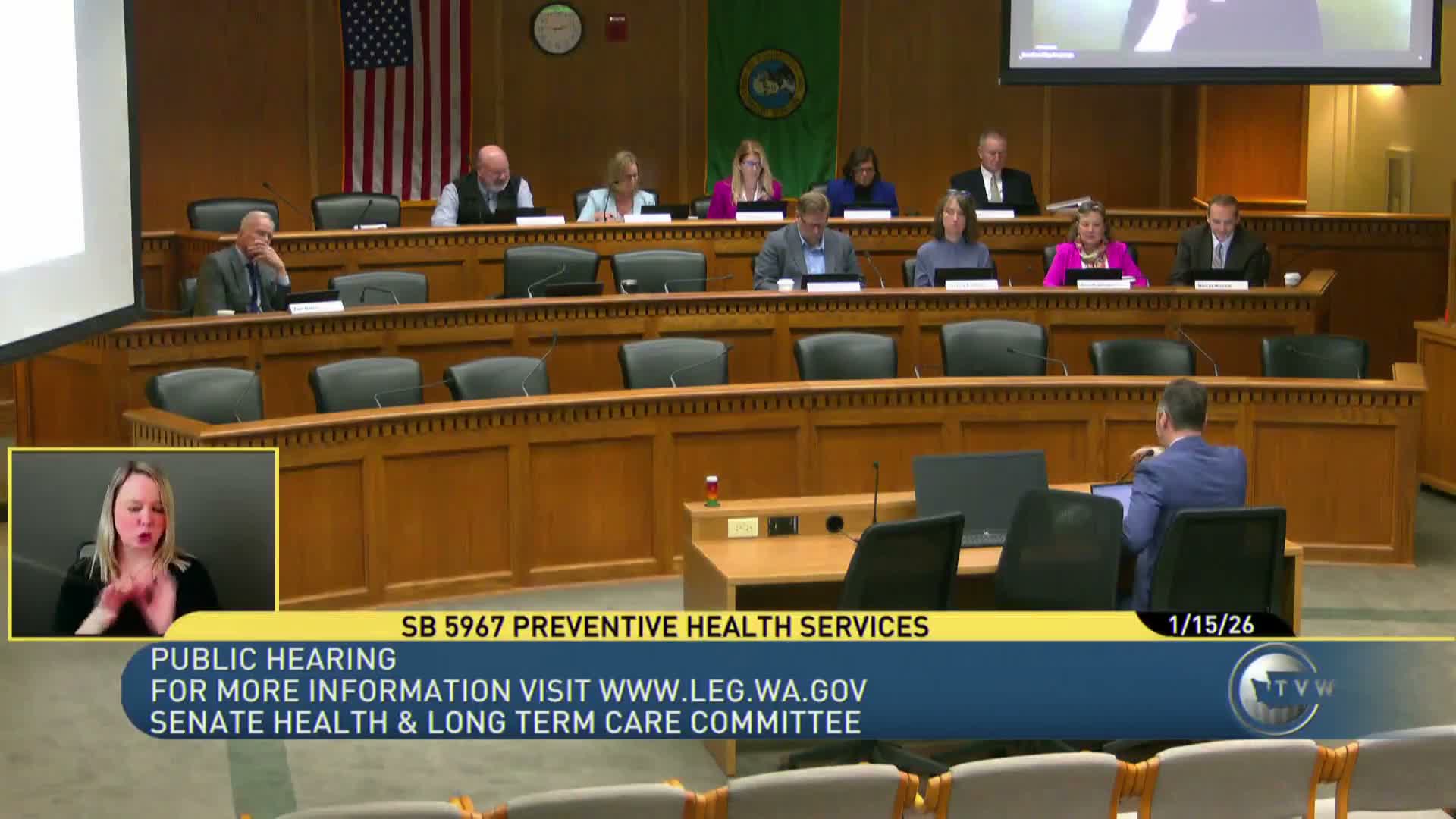
Senate Bill 5967 drew extended testimony in a packed public hearing before the Senate Health & Long Term Care Committee. Committee staff summarized the bill as creating statutory safeguards so that insurance coverage for evidence-based preventive services (including certain immunizations, USPSTF A/B services, and HRSA-recommended child and women’s screenings) remains in place at the state level even if federal guidance changes.
Greg Attanasio, committee staff, said the bill permits the Department of Health to issue immunization recommendations while directing the Office of the Insurance Commissioner to ensure coverage by state-regulated plans. "Plans must also cover the immunization recommendations that are issued by the Department of Health," he told members. The briefing noted two key dates in the bill: plans issued on or after 04/01/2026 must cover preventive services as those recommendations existed on 06/30/2025, and OIC may adopt rules as needed to keep coverage "as favorable or more favorable" to enrollees.
Caitlin Safford, the governor’s senior policy advisor on public health, emphasized the bill “does not mandate new vaccines or provide new mandates for current vaccines beyond those currently in state statute” and framed the proposal as preserving access and transparency. Insurance Commissioner Patty Kuderer said the statute’s protections are important to keep no-cost preventive services available and praised the bill’s reliance on evidence-based guidance. "No cost preventative services have a tremendous impact on the overall health of Washingtonians," Kuderer said.
Public health officials and clinicians — including Dr. Helen Chu (infectious disease specialist and former ACIP voting member), pediatricians representing the American Academy of Pediatrics’ Washington chapter, county health officers, and other primary care clinicians — testified in favor. Dr. Chu said federal advisory processes had recently become less predictable and that state authority would provide stability: "When vaccine recommendations become unstable or unpredictable, access suffers and public trust erodes," she said.
Opposition testimony came from Informed Choice Washington and several public commenters who urged transparency, questioned experts’ conflicts of interest, and argued the bill shifts vaccine decisionmaking to state officials without a funded process. Bob Runnels (Informed Choice Washington) said the bill "increases politicization of vaccines, reduces transparency...and doesn't include any resources required to replace the federal agency recommendations." Public commenters reported submitting far more con than pro written/testimony: committee staff posted sign-in tallies of approximately 595 pro, 1,792 con, and 3 other.
Committee members asked about fiscal implications and rulemaking; staff confirmed a fiscal note had been requested. No vote was recorded; the hearing record closed after all scheduled testimony. Any further committee consideration — including scheduling, amendments or fiscal review — was left to the committee’s subsequent process.
The hearing illustrated a clear split between medical and public health institutions arguing the bill is a necessary backstop to preserve access, and public commenters who urged caution on transparency, conflicts of interest and fiscal accountability.