Get Full Government Meeting Transcripts, Videos, & Alerts Forever!
Get email alerts on the Microfiber Filtration topic
No spam. Unsubscribe anytime.
Washington committee hears bill to require microfiber filters on commercial washers
Summary
A state committee heard testimony for HB 22-12, which would require microfiber-capturing filters on commercial and industrial washing machines and give Ecology limited authority to pursue residential standards if cost impacts are small. Scientists and student advocates urged action while appliance and laundromat groups warned of technical and safety challenges.
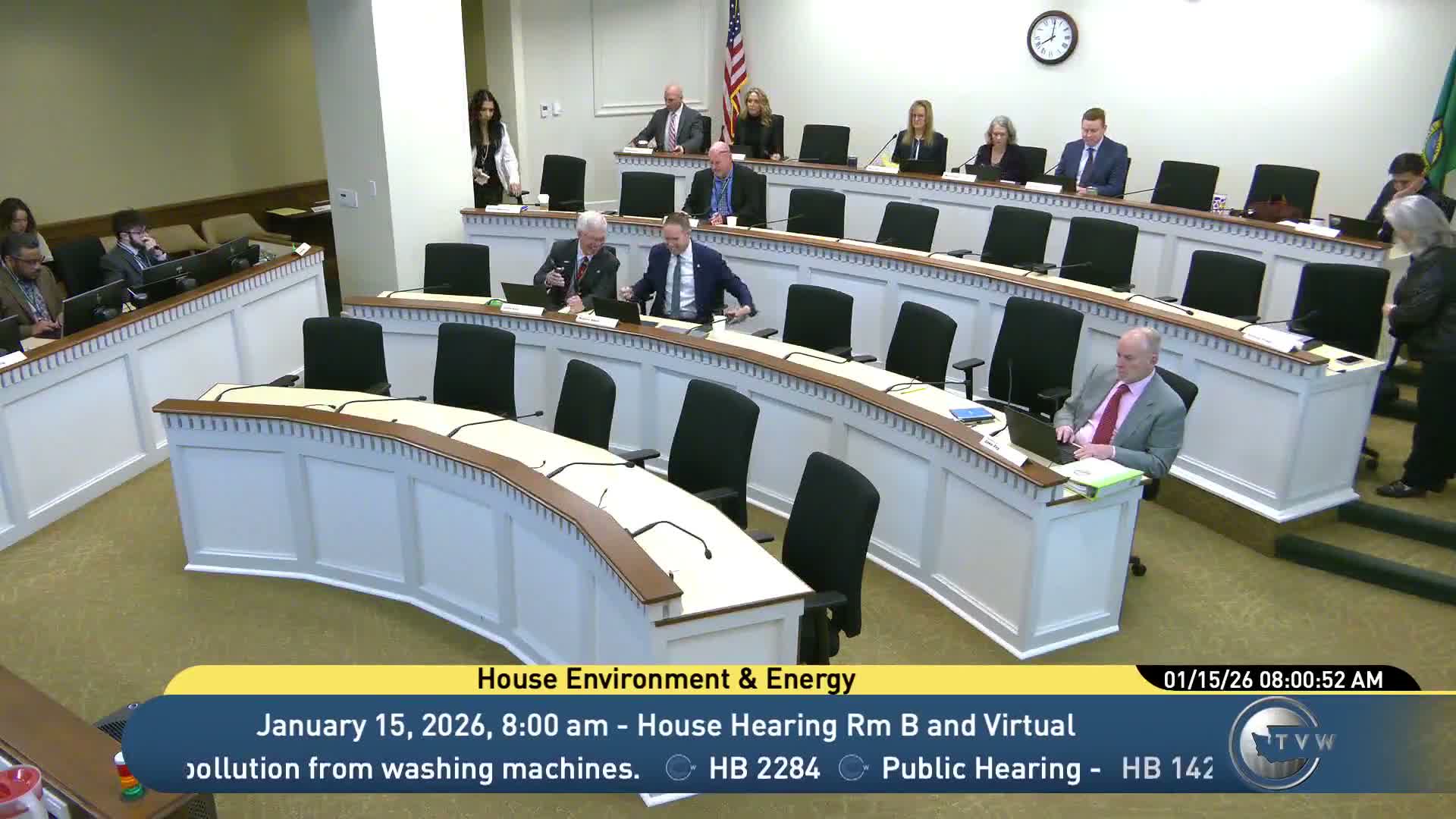
A Washington State Environment & Energy Committee hearing on HB 22-12 focused on requiring microfiber filtration on commercial and industrial washing machines and potential future residential rulemaking.
Jake Lipson, committee staff, told members the bill would mandate filters that capture about 87% of fibers for machines manufactured on or after July 1, 2028, require retrofits or equivalent functioning filtration on pre-2028 machines by 2034, and assign maintenance responsibilities to machine owners and operators. The Department of Ecology would implement the program and could adopt residential requirements only if it determines retail price impacts would be limited (no more than 10% or $70), Lipson said.
Sponsor testimony framed the measure as a source-focused approach. The sponsor argued commercial and industrial machines are the largest source of microfiber pollution and said the bill targets those sources first while residential rules would follow only when a larger market exists.
Student advocate Anupurni Lingaswaran, who brought the issue to lawmakers, told the committee that school water tests found microplastics and that pilot filtration reduced microplastics in wastewater by 41 percent. "We drink what's available at home, practice, and school," she said, urging lawmakers to "stop microplastics at the largest source, washing machines."
Scientists testifying for environmental groups and the Seattle Aquarium described microfibers as a dominant component of microplastic samples taken from local waters and said source reduction in laundry effluent would reduce pollutants entering streams and bays. Dr. Sean Larson of the Seattle Aquarium said his team consistently finds microplastics in Elliott Bay samples and that "the majority of these are microfibers, many of which come from clothing."
Industry and small-business witnesses urged caution. Jacob Cassidy of the Association of Home Appliance Manufacturers and the Coin Laundry Association raised technical and operational concerns, saying available aftermarket devices differ from mandating an in‑line filter for all machine cycles and warning of safety and feasibility challenges for high-capacity commercial laundries.
Testimony produced a mix of policy and technical questions: members asked about certification and third-party verification of filters, potential changes to machine operation if a filter clogs, workforce safety in handling lint removed from commercial systems, and agency costs to implement and enforce the program.
The committee did not take a vote. Chair suspended the hearing to proceed with other bills and indicated HB 22-12 may be resumed later in the session for further consideration.