Get Full Government Meeting Transcripts, Videos, & Alerts Forever!
Get email alerts on the Transportation Budget topic
No spam. Unsubscribe anytime.
Public hearing: stakeholders urge Legislature to fund preservation, ferries and paving in governor’s $16.8B transportation plan
Summary
Office of Financial Management staff outlined a $16.8 billion transportation supplemental that relies on targeted bonding; local governments, industry and ferry communities largely supported the plan and urged added preservation and vessel funding during public testimony.
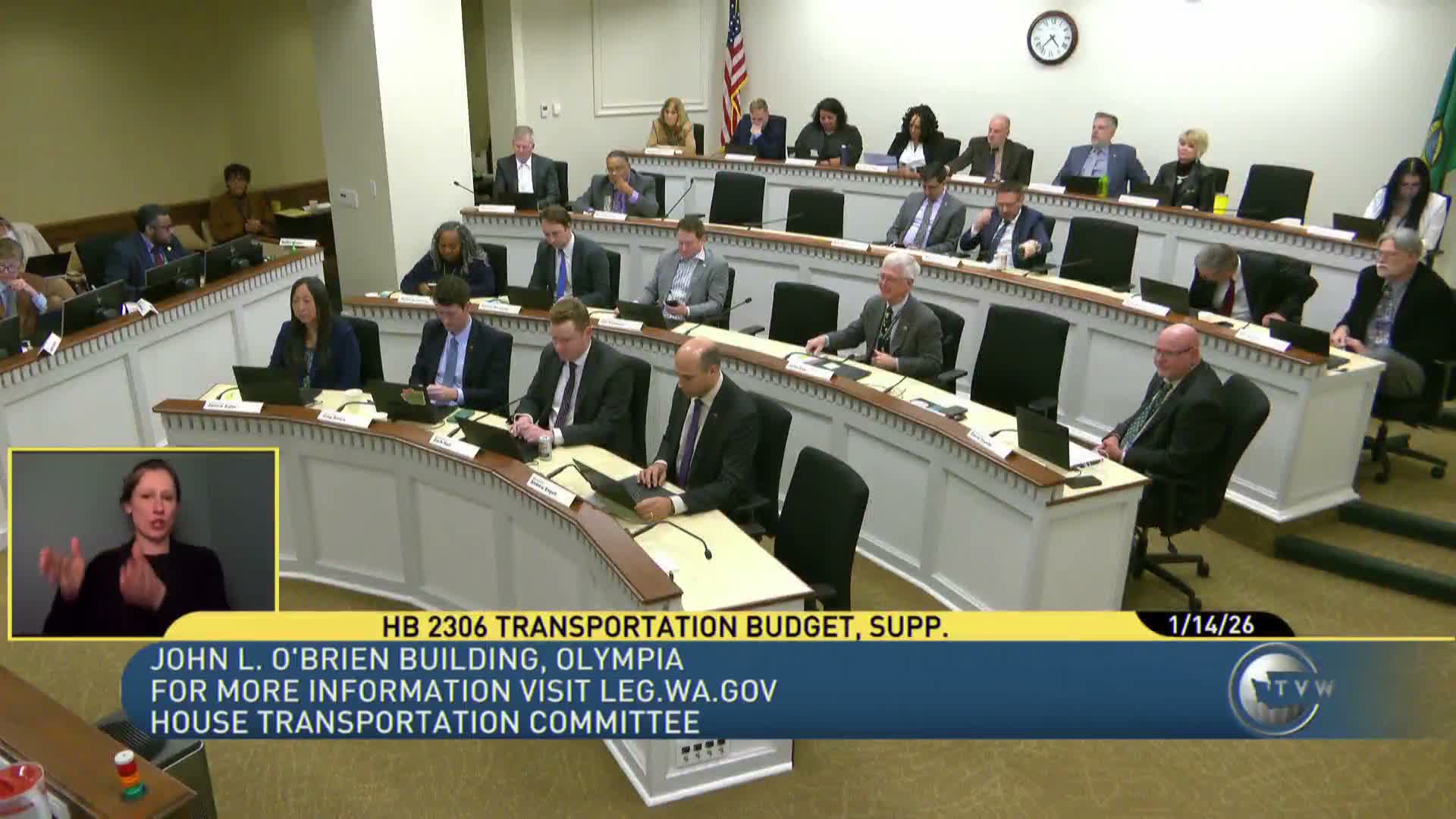
Megan Cotton and Eric Hansen of the governor’s Office of Financial Management briefed the House Transportation Committee on Jan. 30 about the governor’s supplemental transportation proposal and answered members’ questions as a large group of stakeholders testified in a public hearing.
The package: OFM described a $16.8 billion transportation package that focuses on preservation, maintenance and ferries. Hansen said the governor proposes bonding roughly $3.1 billion of transportation revenues (out of an estimated $5.3 billion capacity) rather than using the full available capacity. “We are not bonding paving, we are not bonding things that are not eligible for that type of financial instrument,” Hansen said.
Major allocations the presenters cited included $2 billion for preservation (about $1.1 billion of that to bridges), $164 million to pave an additional ~600 miles this coming summer, $756 million over 10 years to enable roughly 2,100 additional paved miles, $160 million for slope stabilization and failing culverts, $250 million for maintenance, and $1 billion to support the purchase of three new ferry vessels and preserve existing vessels.
Public testimony: Nineteen public commenters addressed the committee. Ashley Matthews, a Bainbridge Island City Council member, urged continued investments so routes can return to reliable two‑boat service and requested modest operational supports (for example, more law enforcement presence to reduce ferry line cutting). Industry groups widely supported the preservation emphasis: the asphalt industry, ports, associations of cities and counties, and the construction trades said additional, predictable funding for maintenance reduces future costs and protects economic activity.
Dredging and local grants: Port and shipping representatives requested $15 million to match federal funding for Lower Columbia River dredging, which OFM said is Washington’s share of a required non‑federal match; county and local representatives asked to stand up local road grant dollars earlier (a $2.2 million startup in 2026 ahead of a $23 million commitment in the next biennium).
Critical questions and data needs: Committee members asked OFM for more detail on debt‑service impacts if the legislature bonds; Rep. Lee asked for an estimate of how much additional debt service would consume future budgets over a 20‑ to 25‑year period. OFM said it would provide those figures to the committee. Several members also sought data comparing lifecycle costs for hybrid‑electric ferries; a member of the public (Pete Brady) shared a lifecycle cost model and asserted hybrid preservation costs could be much higher than diesel and agreed to provide his data to the committee.
What happens next: Committee staff summarized HB 2306 — the supplemental appropriations vehicle — and the committee will continue to consider amendments and additional information on debt service, lifecycle costs and funding tradeoffs as it prepares budget recommendations.