Get Full Government Meeting Transcripts, Videos, & Alerts Forever!
Get email alerts on the Budget topic
No spam. Unsubscribe anytime.
Appropriations committee hears broad public opposition to diverting $569M from Climate Commitment Act; providers warn Medicaid cuts risk closures
Summary
At a public hearing on House Bill 2289, dozens of one‑minute witnesses urged lawmakers to reject a proposal to repurpose $569 million in Climate Commitment Act funds and to preserve Medicaid, wildfire, housing, education and public defense funding. Providers warned reimbursement freezes and delayed rebasing threaten care access.
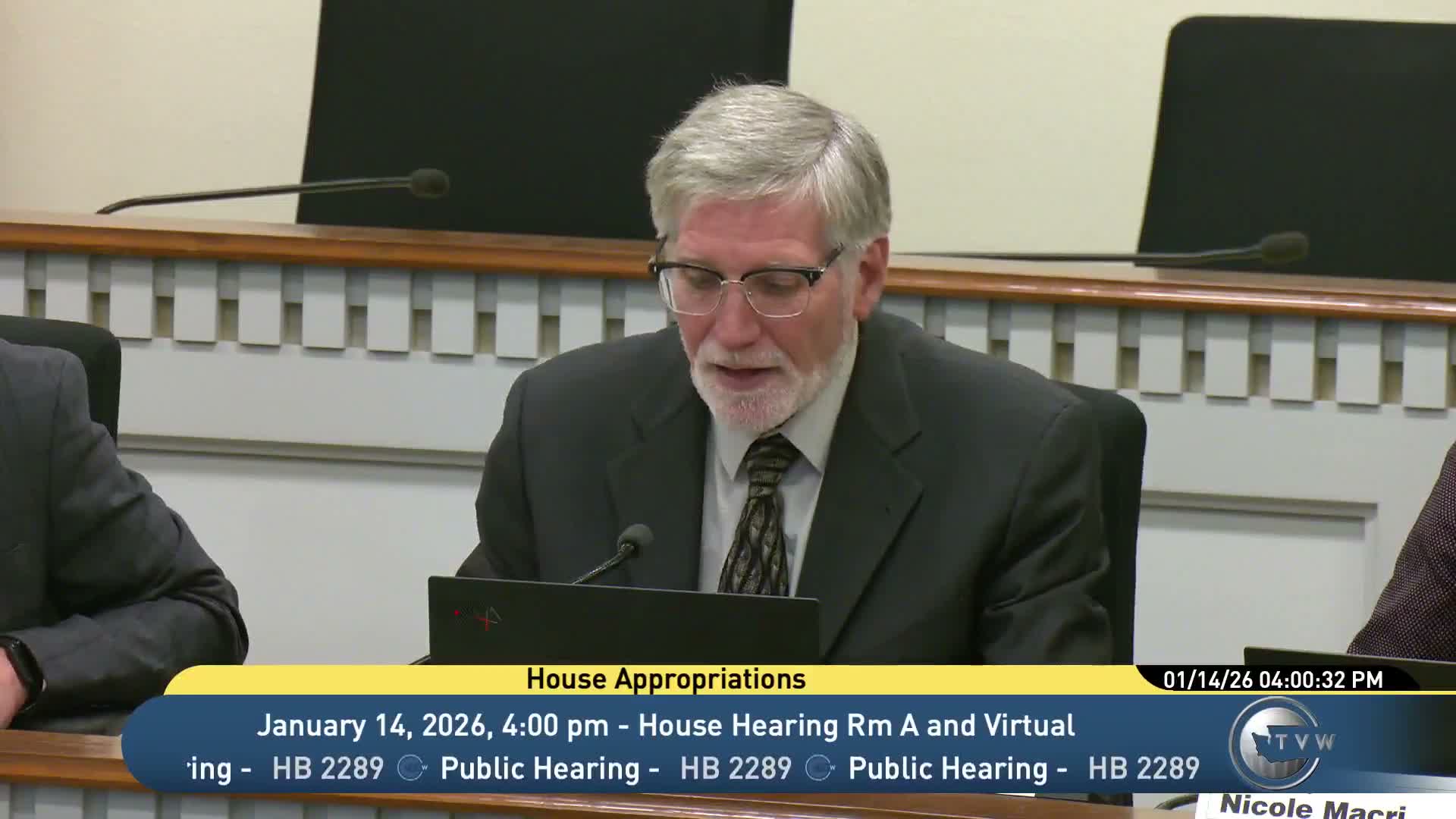
The House Appropriations Committee on Thursday held a lengthy public hearing on House Bill 2289, the governor's supplemental operating budget, drawing dozens of one‑minute testimonies that centered on a proposed $569,000,000 diversion from the Climate Commitment Act (CCA) and a suite of cuts and transfers that testimony said would weaken health care, housing and other frontline services.
Darcy Nonomaker, with Washington Conservation Action and the Environmental Priorities Coalition, told the committee: "We do not support Governor Ferguson's proposal to divert and supplant $569,000,000 from the Climate Commitment Act." Nonomaker said CCA revenue was designed to decline over time and "was never intended to supplant eligible program funding," and urged legislators to use CCA dollars for emissions reductions and community resilience.
Environmental and conservation witnesses echoed that message. David Medoza, director of policy and government relations for The Nature Conservancy, said redirecting roughly 80% of CCA funds would "undermine needed climate progress" and urged the Legislature to reject the proposal while restoring larger wildfire resilience funding than the governor proposed.
Health‑care providers and public clinics testified that budget changes to Medicaid would cause substantial harm. Rhonda Hoff, CEO of Yakima Neighborhood Health Services, said the governor's plan to move the Medicaid pharmacy benefit from managed care to fee‑for‑service would yield a projected $7,500,000 in state savings while imposing an estimated $100,000,000 cost to community health centers statewide by eliminating 340B savings; she said that loss would force cuts to mobile health and hygiene services used by unhoused residents.
Nursing homes and long‑term care operators warned that freezing Medicaid rates at 2022 levels and delaying the 2022 cost rebase until fiscal year 2027 (or later) would leave many providers operating below cost. Joe Rudd, administrator at Alderwood Park Health and Rehab, said his facility's Medicaid reimbursement covers "only 85% of the actual cost of care" and described rising wages and supply costs that make current rates unsustainable.
Speakers across sectors asked legislators to preserve or restore specific line items in the governor's proposal: requests included full restoration of a previously committed $125,000,000 per biennium for wildfire response (HB 1168), continued funding for the Ninth Grade Success initiative (cited by multiple principals and teachers for improving freshmen on‑track rates), protection of Foundation Public Health Services funding, and maintenance of the State Home Energy Assistance Program.
Advocates for justice system funding urged additional support for public defense and mandatory Blake implementation costs. Curtis Steinhauer of the Washington State Association of Counties described public defense as "the single, most pressing issue facing county public safety systems," while Ramona Brandes with the Washington Defender Association called reinstating part of an $8,000,000 reduction for Blake work a matter of legal obligation.
Housing and homelessness witnesses pressed for both preservation of existing supportive housing and a proposed $120,000,000 state contingency to prevent closures if federal funding is reduced. Sarah Dickmeyer of Plymouth Housing and Ash Jippens of the Washington Low Income Housing Alliance said program cuts would risk services for thousands, including veterans and people with disabilities.
Many testifiers also urged lawmakers to pursue additional revenue rather than cuts: higher education union leaders and student workers called for progressive tax options to avoid deeper program reductions that they said are already reducing teaching assistant positions and campus services.
The committee concluded the public hearing after hearing the scheduled sign‑ups and adjourned without taking final action on HB 2289. The transcript of the hearing records no committee votes during the public testimony portion.
What happens next: the committee will consider testimony and budget proposals as it continues deliberations on the supplemental operating budget; no further procedural steps or votes were recorded in the hearing transcript.