Get Full Government Meeting Transcripts, Videos, & Alerts Forever!
Get email alerts on the Higher Education Funding topic
No spam. Unsubscribe anytime.
OPR briefing: Washington higher‑education enrollments, tuition caps and financial aid shifts
Summary
OPR staff member Kate Henry briefed the committee on enrollment trends, tuition policy and financial aid, noting CTCs expect about 109,000 FTEs in 2025, a tuition cap tied to median wage growth of roughly 3.3%, and statutory and budget changes that will shift Washington College Grant awards across FY26–FY28.
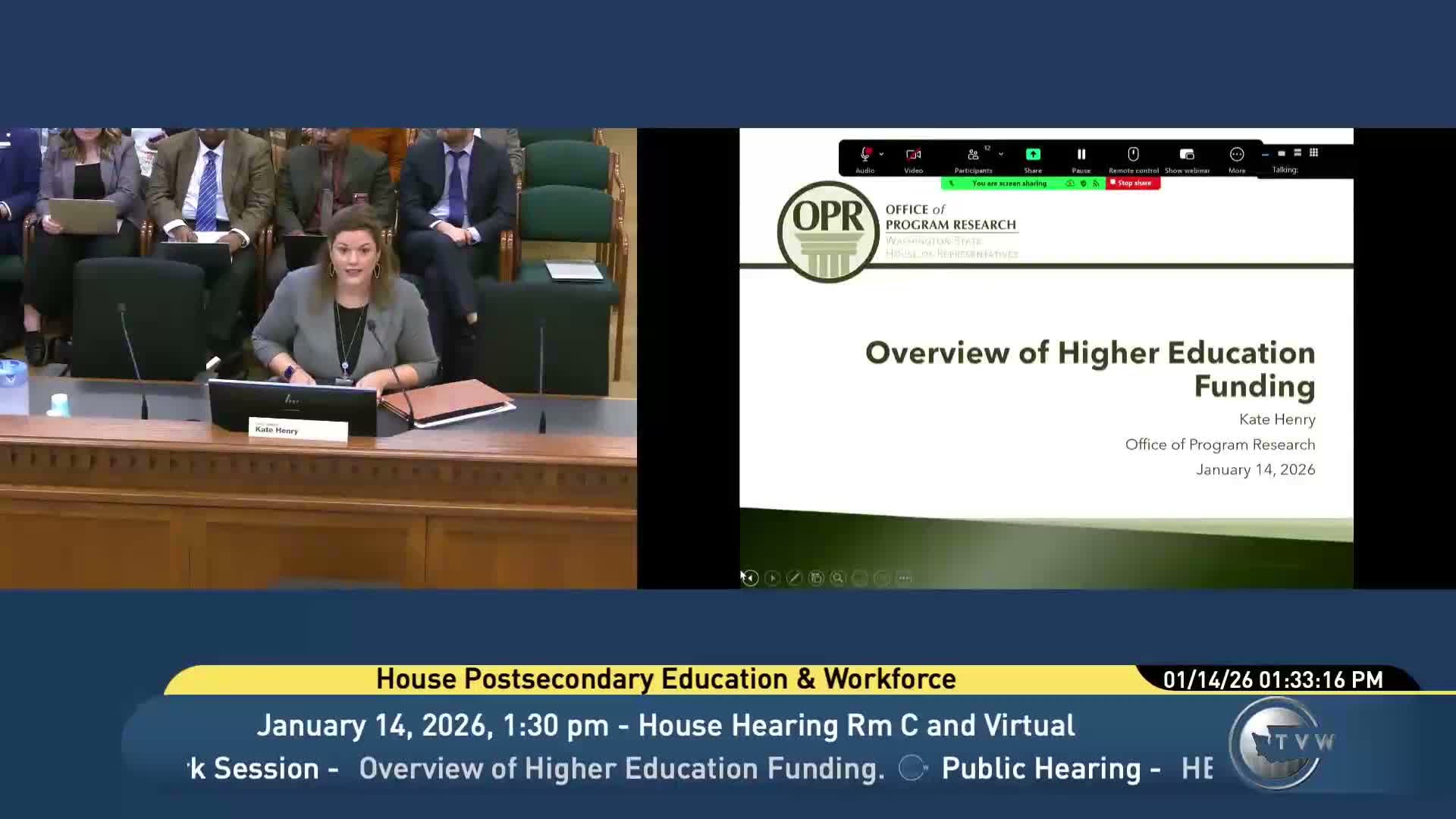
Kate Henry of the Office of Program Research briefed the Postsecondary Education & Workforce Committee on the state of higher education funding, laying out enrollment trends, tuition policy history and a detailed look at financial aid programs.
Henry told the committee that the community and technical colleges (CTCs) are expected to serve roughly 109,000 full‑time equivalent students and about 161,000 headcount in the 2025 academic year. She explained the difference between headcount (actual number of people) and FTE (an enrollment metric based on credit load) and showed year‑over‑year sector changes, including a roughly 100‑student drop at Central Washington University attributable to removal of its rugby program.
On tuition policy, Henry reviewed the post‑2015 framework that capped resident undergraduate tuition growth to no more than the average annual percentage growth of Washington’s median hourly wage over a 14‑year period. She said that cap currently equates to about 3.3% and that tuition remained largely flat after a freeze beginning in fiscal 2013 before stair‑step increases resumed under the 2015 policy.
Henry outlined major state financial aid programs and recent statutory changes. She said the state will provide just over $1 billion in financial aid during the current biennium and highlighted the Washington College Grant (formerly the State Need Grant), College Bound, Opportunity Scholarships and State Work Study among the largest programs. Citing Senate Bill 5785 and related budget actions, she said changes to the Washington College Grant’s award bands and eligibility phases will begin to take effect in fiscal year 2027, with some college‑bound changes phased into fiscal year 2028.
On funding flows, Henry said higher education accounts for roughly 8% of the state’s near general fund outlook (about $6.2 billion) and approximately 13% of total budgeted funds. She provided institution‑level comparisons of state funds per state‑funded FTE, noting differences among Evergreen State College, research universities and regionals, and observed that changes in enrollment can materially change per‑FTE funding without new appropriations.
Committee members asked for follow‑up materials — including student‑to‑staff ratios and institution‑level cost‑of‑attendance breakdowns — which Henry said she would provide. Chair Paul closed the work session and moved the body to the day’s public hearings.