Get Full Government Meeting Transcripts, Videos, & Alerts Forever!
Get email alerts on the Juvenile Rehabilitation topic
No spam. Unsubscribe anytime.
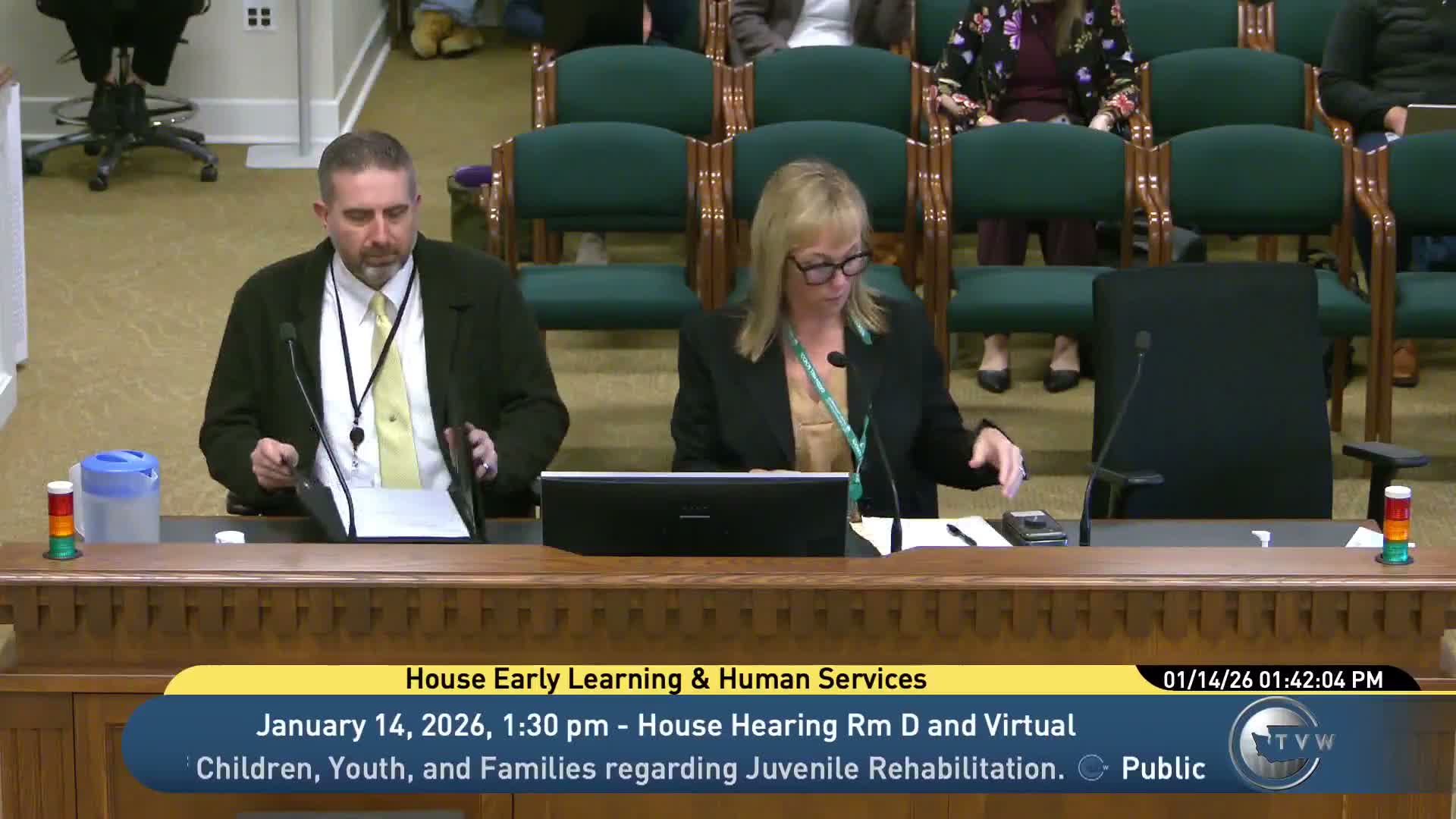
DCYF warns juvenile facilities face growing population, capacity and staffing shortfalls
Summary
DCYF officials told the Early Learning & Human Services Committee that juvenile rehabilitation (JR) populations are growing and aging, driven by adult‑sentenced youth and longer stays; the department urged more beds, targeted bed types, and staffing changes while highlighting community transition services (CTS) successes and data limitations.
The Department of Children, Youth and Families told the Early Learning & Human Services Committee that Washington’s juvenile rehabilitation population is increasing and getting older, driven largely by youth serving adult sentences and longer lengths of stay.
Jennifer Redmond, juvenile rehabilitation assistant secretary, said the department’s residential population was 400 across three secure facilities and eight community sites as of the previous day, and that Caseload Forecast Council modeling projects about 481 residents by 2031. “That particular population is where we’re seeing a bulk of our growth,” Redmond said, pointing to adult‑sentenced youth who can remain in JR until age 25 before transferring to the Department of Corrections.
The department outlined several drivers of crowding and program strain: intake rates exceed release rates, a small number of secure facilities limits flexibility, and a growing share of residents require higher security and specialized programming. Jeff Endermark, security classification administrator, described how intake classifications and statutory ruleouts limit placement options and said case managers reassess classifications every 30 days for most youth and every 90 days for those entering at maximum security.
DCYF emphasized efforts to expand less‑restrictive placements. The agency described Community Transition Services (CTS), an electronic home‑monitoring program launched in November 2023 that began placements in May 2024. Redmond said CTS has had 41 referrals, 39 screening approvals, 35 participants and a roughly 67 percent completion rate. She described both successful transitions (for example, a participant who obtained a commercial driver’s license and employment) and operational challenges such as after‑hours staffing and device troubleshooting.
On capacity, Redmond said Harbor Heights has opened one wing and the department expects a second wing to come online once a medical portable and IT upgrades are completed, adding roughly 22 beds. She said the Governor’s proposed budget included $15 million for predesign and construction and noted the Caseload Forecast Council projects a need for at least 50 more JR beds within five years.
Members pressed DCYF on safety and data limitations. Representative Penner asked whether the department can track safety‑plan failures; DCYF acknowledged its family case management system does not capture all outcome data and said some measures remain buried in case notes. On escapes, Endermark cited Office of Innovation, Alignment and Accountability data showing an escape rate of 1.78 per 100 youth in 2001 and 3.92 per 100 youth in 2025, “just a little bit over twice as much when compared.”
A committee member raised allegations of abuse and litigation involving the agency; DCYF acknowledged media and litigation impacts on staffing and public trust and said it would follow up with requested litigation details. Redmond also said work is underway to better match bed types to program needs, adopt trauma‑informed single‑bunk practices where appropriate, and align staffing models to complex population needs.
The department presented work on a master‑plan and capacity study, saying design teams are evaluating remodels, site readiness and programmatic needs and that medium‑security capacity appears to be the current priority. Redmond said the current relative stability could be lost if admission or release patterns change, and she urged continued attention to capacity, staffing and program design.
The committee requested follow‑up on data capabilities, litigation details and specifics about the department’s forecasting and classification tools. DCYF officials said they would provide additional materials and updates to members.