Get Full Government Meeting Transcripts, Videos, & Alerts Forever!
Get email alerts on the Tax Incentives topic
No spam. Unsubscribe anytime.
Committee considers expanding sales-tax deferral to more underutilized parcels to spur housing
Summary
SB 5884 would broaden a 2022 sales-and-use tax deferral program beyond parking-lot conversions to include vacant and underutilized land and allow cities to approve projects with 20%–50% affordable set-asides in designated areas; city officials and development authorities described ongoing projects and urged changes to broaden eligibility and clarity.
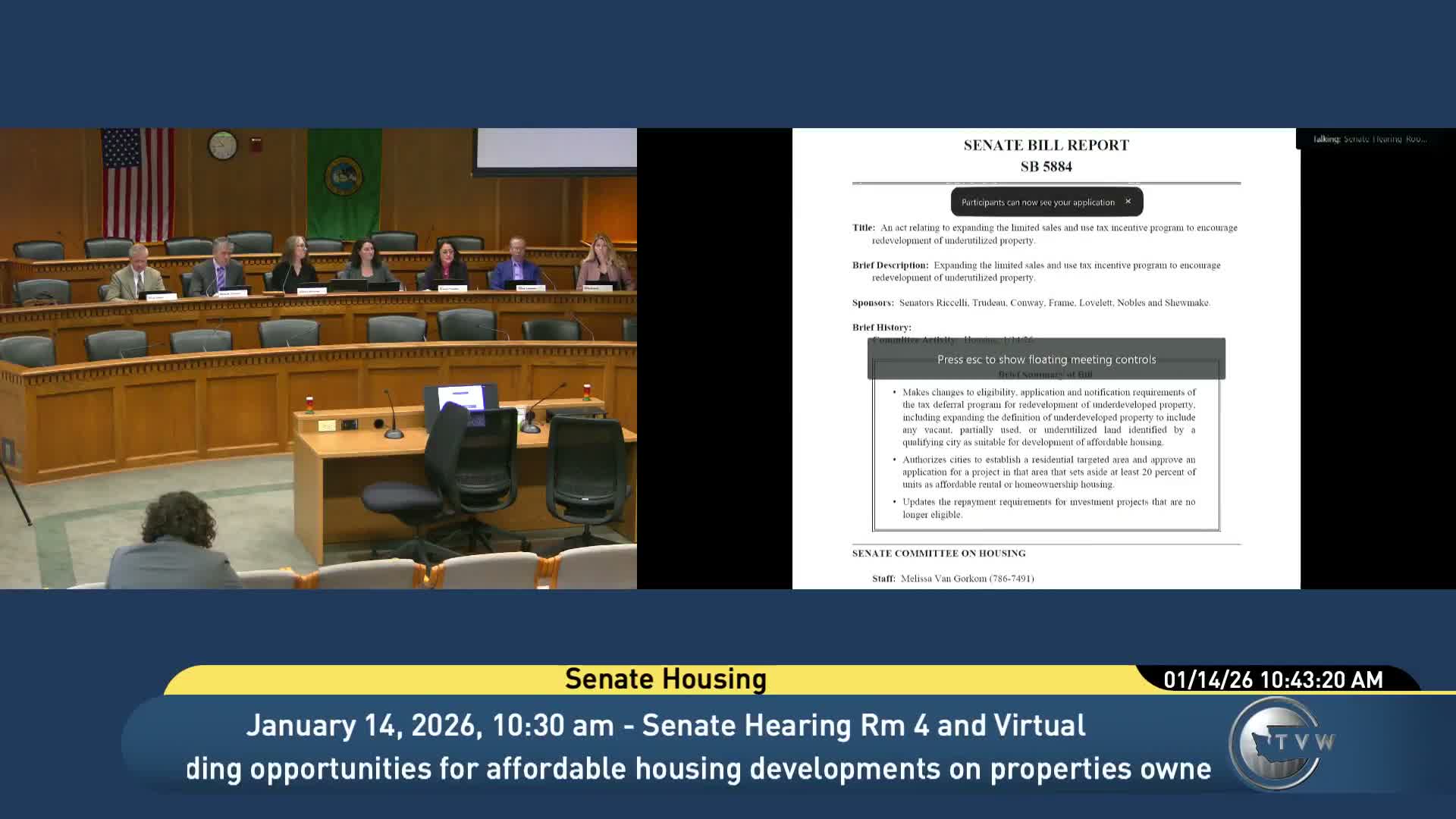
Committee staff told lawmakers on Jan. 14 that SB 5884 would expand a 2022 tax-deferral program so more underutilized urban parcels can be redeveloped for affordable and workforce housing.
Melissa Van Gorkum, committee staff, briefed members that the original 2022 program allowed cities between 135,000 and 250,000 population to authorize a deferral for investment projects on surface parking lots if the project set aside at least 50% of units as affordable and maintained that use for 10 years. The bill before the committee would expand the definition of eligible property to include vacant, partially used or underutilized land as identified by qualifying cities, permit cities to designate targeted residential areas with lower set‑aside requirements (as low as 20%), and change notification and eligibility rules related to Department of Revenue oversight.
Staff said the Department of Revenue estimates an administrative cost of about $20,000 and projected a $2.75 million state revenue decrease in the first full fiscal year of impacted collections, with an estimated $1.4 million local revenue decrease; local fiscal notes also noted potential indeterminate property-tax increases if parcels are redeveloped. Senator Marcus Richelli, the bill sponsor, said stakeholders in Spokane and other cities asked for the change to align the incentive with on-the-ground realities so more projects will proceed.
City officials and development practitioners described active or pending projects. Patrick Quinn (City of Vancouver) said Vancouver adopted the deferral last year and has three applications totaling over 500 units, 70% of which are expected to be affordable at 80% AMI or less; one project is under construction. Michael Lillequis (Bellingham Council) asked the legislature to lower the population threshold to around 95,000 to include Bellingham.
Support testimony also came from the Associated Builders and Contractors (which asked to remove certain apprenticeship/project-labor conditions), the Washington State Association of Counties (which asked for county eligibility for urban growth areas), and housing advocates who said the deferral meaningfully changes financing dynamics and can unlock projects that otherwise would not qualify for funding.
The committee closed public testimony without taking a final vote; multiple stakeholders asked for technical fixes (clarifying local/DOR roles, eligibility definitions and procurement/apprenticeship language) and, in some cases, for state support to cover planning‑department workload for implementation.