Get Full Government Meeting Transcripts, Videos, & Alerts Forever!
Get email alerts on the High Risk Ai topic
No spam. Unsubscribe anytime.
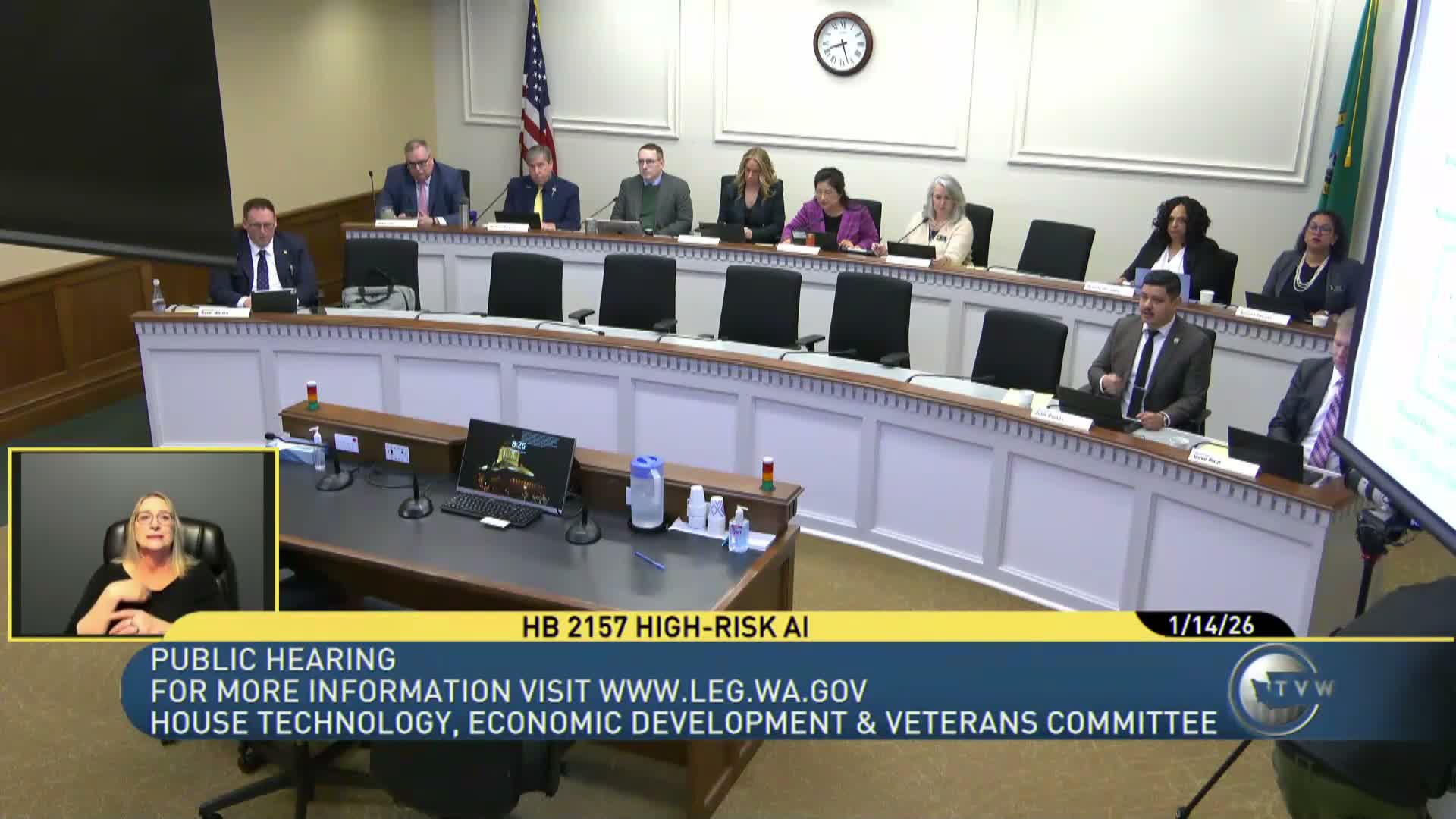
Committee hears debate over high‑risk AI bill that would impose duties and civil remedies (HB 2157)
Summary
HB 2157 would classify certain AI systems as 'high risk' when they substantially influence consequential decisions and would require developers and deployers to perform risk assessments, disclose limitations and adopt safeguards; witnesses split between civil‑rights and consumer advocates supporting the bill and industry and business groups warning of vagueness and litigation risk.
The committee reviewed House Bill 2157, a proposal to regulate “high‑risk” AI systems that autonomously make or substantially influence consequential decisions affecting employment, housing, health services and parole. Staff described core requirements for developers (risk‑management practices and transparency about system purpose and limitations) and deployers (impact assessments, monitoring, disclosure to consumers and limits on using a high‑risk system for consequential decisions without safeguards). The bill creates a private civil cause of action, allows injunctive relief and attorney fees, and includes a 45‑day cure period as an affirmative defense.
The prime sponsor framed the bill as necessary “in the absence of federal guidelines,” to protect consumers from real‑world harms ranging from manipulated content to discriminatory downstream effects of automated decisions. Supporters included technologists and privacy advocates who said the risk‑based approach and impact assessments reflect best practices; John Pincus, who served on the state automated decision systems work group, said the approach aligns with industry standards and recommended strengthening penalties for repeated violations.
Industry groups and business associations urged caution. The Taxpayers Protection Alliance, the Association of Washington Business, Chamber Progress and the Computer & Communications Industry Association warned that the bill’s definitions (developer vs. deployer, and what constitutes a consequential decision) are vague and could sweep routine business tools into coverage, creating compliance costs and litigation exposure that could discourage startups. Witnesses repeatedly raised concern about a $100,000 threshold cited in committee questions and asked for clearer, narrower applicability.
The attorney general’s office signaled conditional support but suggested more precise language for enforcement and recommended limiting or removing the right to cure to avoid undermining private enforcement. Health‑sector witnesses sought clarification about HIPAA and the bill’s interaction with healthcare operations. Several members asked for more detailed fiscal estimates and technical fixes; staff noted the underlying original bill has an available fiscal note from last year and said a fiscal note for any adopted substitute would be requested.
No vote took place in the hearing. Committee members asked sponsors to work with stakeholders on definitions, enforcement and fiscal impacts before further action.