Get Full Government Meeting Transcripts, Videos, & Alerts Forever!
Get email alerts on the AI Provenance topic
No spam. Unsubscribe anytime.
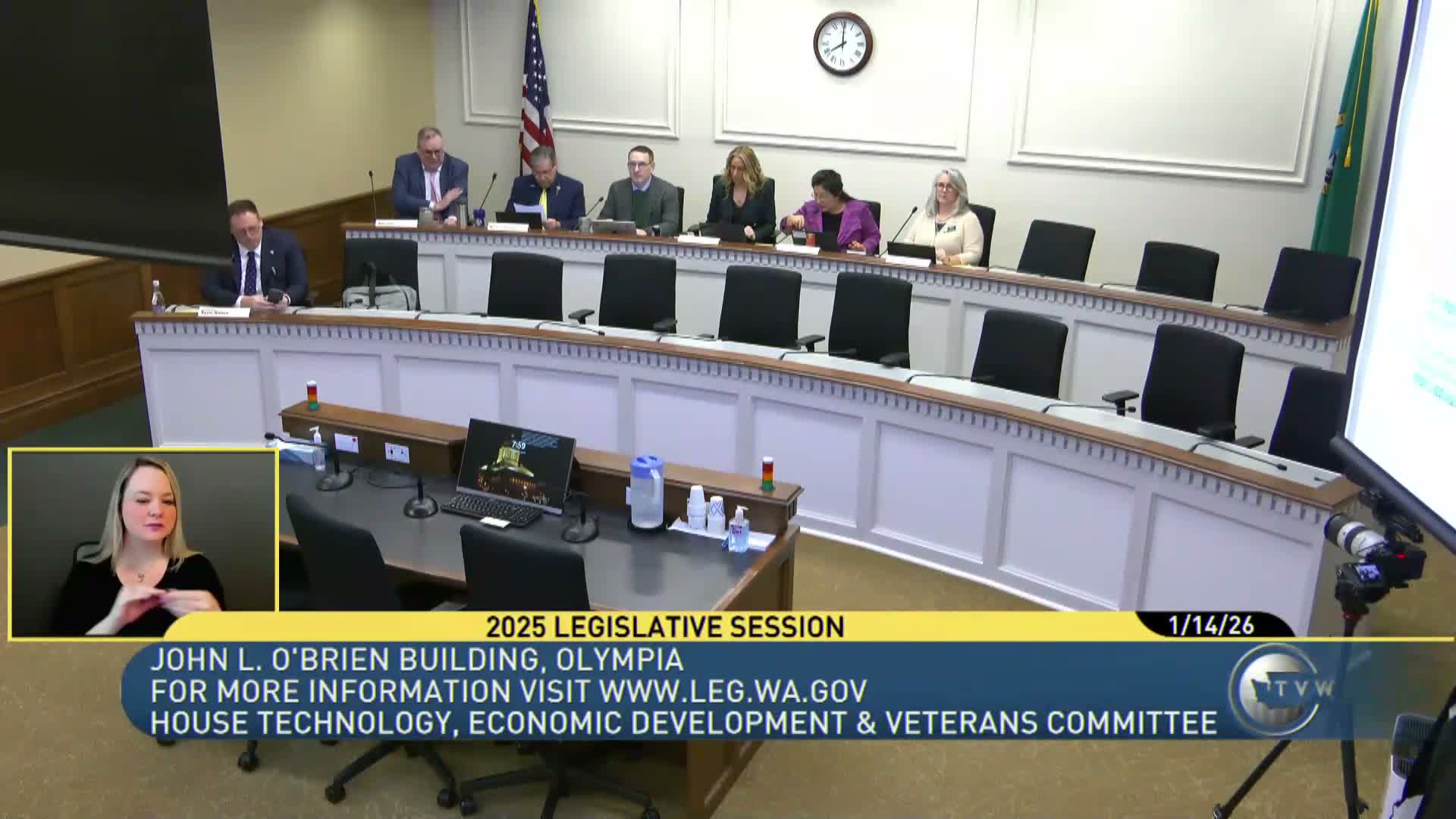
Committee hears mixed testimony on AI provenance bill requiring detection tools and disclosures (HB 1170)
Summary
The Technology, Economic Development, and Veterans Committee held a public hearing on HB 1170, which would require certain generative AI providers to offer provenance detection tools and include persistent disclosures in AI‑created content. Supporters cited risks from deepfakes; opponents raised First Amendment and technical feasibility concerns.
The Technology, Economic Development, and Veterans Committee on Jan. 30 held a public hearing on House Bill 1170, which would require certain large generative AI providers to make provenance‑detection tools available to users and to offer manifest and embedded “latent” disclosures in content created or modified by their systems. The staff briefing said the disclosures must, where technically feasible, be difficult to remove and include metadata such as the time and date the disclosure was added and the system version that produced the content.
Supporters told the committee that the bill addresses growing harms from realistic synthetic media. Jay Jessima of the Transparency Coalition said the state should act to curb disinformation and emotional harm caused by deepfakes, urging the committee to advance the bill “and send it to the House floor with a strong recommendation.” A Lake Washington High School senior, Yale Moon, said people need “a clear borderline” between AI and real images.
Opponents focused on legal and technical risks. John Coleman of the Foundation for Individual Rights and Expression said the measure “raises First Amendment concerns because it compels speech,” arguing that embedding government‑mandated provenance data in expressive content could burden anonymous speech, satire and journalism. Industry witnesses including the Washington Technology Industry Association and the Association of Washington Business warned that the bill’s technical approach mirrors a California model that has been delayed and reexamined; Amy Harrison of WTIA said watermarking can be removed and “give consumers a false sense of security while exposing compliant companies to liability.” Max Martin of AWB urged flexibility and expressed disappointment that a 45‑day right to cure had been removed from the substitute language.
Representatives of the attorney general’s office signed in as “other” but generally supportive of transparency tools, while cautioning that the bill’s definition of “covered provider” — tied to computing power and gross revenue thresholds — could make enforcement difficult and require outside technical expertise. A legislator noted a fiscal note from last year of about $1.2 million for the original bill; staff said the substitute before the committee does not yet have an updated fiscal note.
The substitute described in the staff briefing would require covered providers to output any detectible provenance data, collect user feedback on the detection tool, limit retention of personal information to specified circumstances, and require licensees to maintain latent‑disclosure capability. The bill exempts certain systems, including video games and interactive experiences, and would be enforced by the attorney general under the state Consumer Protection Act.
The committee closed the public hearing on HB 1170 after extended questioning and invited follow‑up from staff and stakeholders. No committee vote occurred during the hearing.