Get Full Government Meeting Transcripts, Videos, & Alerts Forever!
Get email alerts on the Yyhrt Ohy Hir topic
No spam. Unsubscribe anytime.
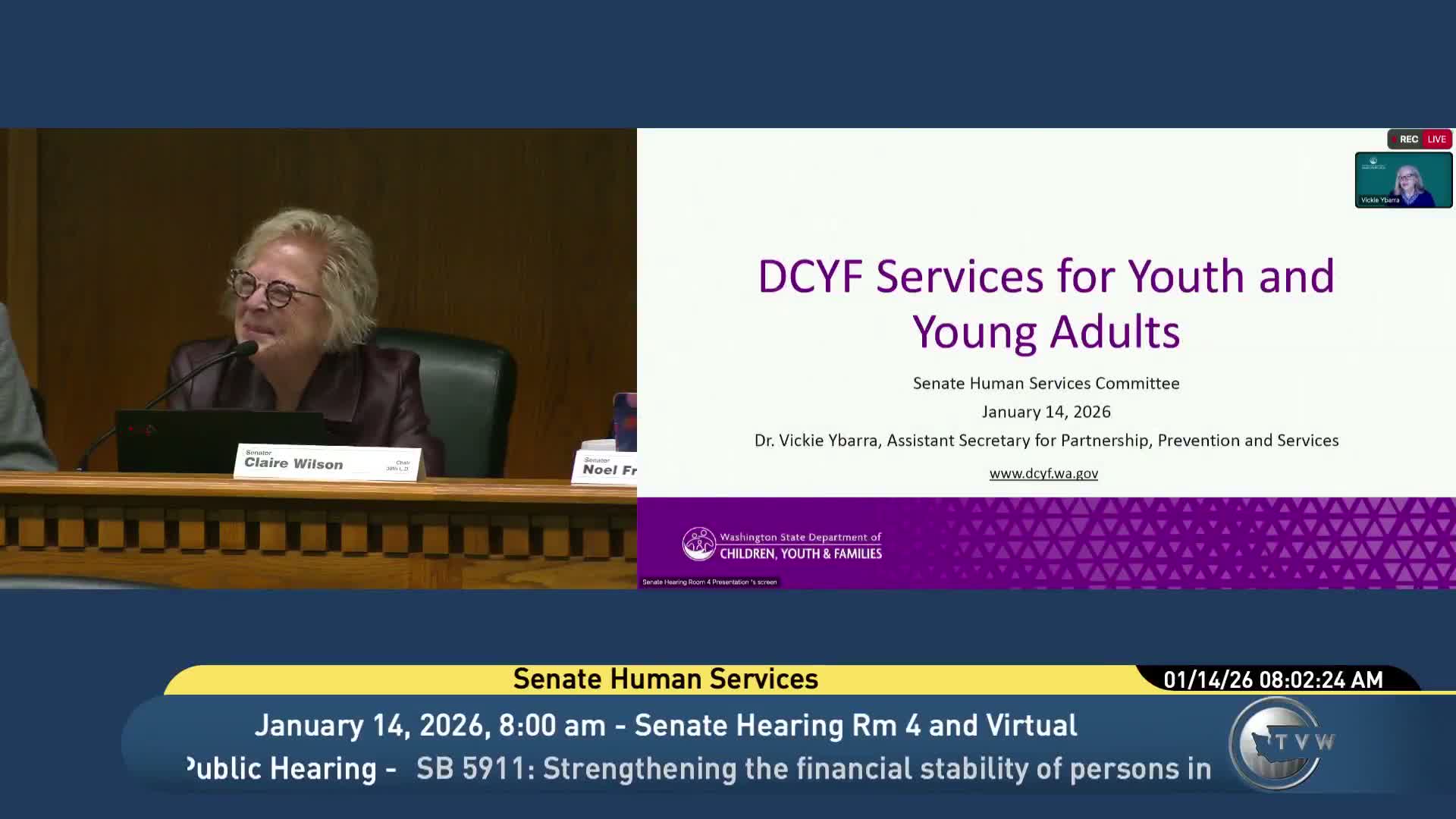
DCYF, Office of Homeless Youth and State Board of Health brief committee on youth homelessness response and health impact review
Summary
DCYF described the Youth & Young Adult Housing Response Team, caseloads and referral criteria; the Office of Homeless Youth highlighted state progress and 'functional zero' work. The State Board of Health presented a health impact review finding that housing assistance for EFC youth would likely improve housing stability and health outcomes.
The Senate Human Services Committee heard three briefings that framed the policy debate around several bills on its agenda.
Vicki Ybarra, Assistant Secretary for Partnership Prevention and Services at the Department of Children, Youth, and Families, described the Youth & Young Adult Housing Response Team (YYHRT), an interagency coordination group created by the legislature in 2022 to triage complex cases and connect eligible young people to existing housing programs. Ybarra said YYHRT accepts referrals for nondependent young people ages 12 through 24 exiting public systems of care (child welfare, juvenile justice, behavioral health) or who are homeless or at risk of homelessness; she said DCYF had 13 active YYHRT cases, 45 in monitoring and 58 total cases at the time of the briefing and that the team keeps cases open for up to a year with check-ins at 30, 90 and 180 days and again at 12 months after housing to monitor stability.
Casey Hanauer Sutton, Executive Director of the Office of Homeless Youth (OHY), described OHY’s statewide coordination role, said Washington has seen a 40% reduction in youth homelessness since 2016 (as stated in testimony) and highlighted OHY’s focus on prevention, data dashboards, procurement, and a community-based 'functional zero' approach aimed at reducing the length of time youth are homeless to under 90 days and eliminating unsheltered youth homelessness.
Miranda Comdroy and Caitlin Perez, health policy analysts with the Washington State Board of Health, described the health impact review (HIR) process and presented findings from the HIR of substitute Senate Bill 5,082 (a related Extended Foster Care housing assistance proposal). The HIR used 131 annotated references and interviews with 20 key informants and concluded that the substitute bill would likely result in DCYF contracting for an EFC housing program and that some eligible young adults would receive rental assistance and access to benefits, which would likely increase housing affordability and stability and improve health outcomes for some young adults in EFC. The analysts noted evidence was especially strong linking improved housing stability to better health outcomes and reducing inequities for certain populations (including Black, American Indian/Alaska Native youth, youth with disabilities and LGBTQIA2S+ youth). The HIR is a public document available on the State Board of Health website.
Committee members asked technical questions about data, eligibility windows and how federal and state rules interact; the presentors said HIRs are evidence-based, use key informants and are intended to inform legislators rather than issue recommendations.
The three briefings were used by members and advocates as context for the later bill hearings on SB 5911, SB 5940, SB 5942 and SB 5957.