Get Full Government Meeting Transcripts, Videos, & Alerts Forever!
Get email alerts on the Employee Monitoring topic
No spam. Unsubscribe anytime.
Bill would require written notice when employers use electronic monitoring for evaluations; businesses raise concerns
Summary
HB 2144 would require written notice before employers use electronic monitoring for employee performance evaluations; labor groups backed the transparency measure while business and industry witnesses urged narrower definitions and carveouts to avoid litigation and operational disruption.
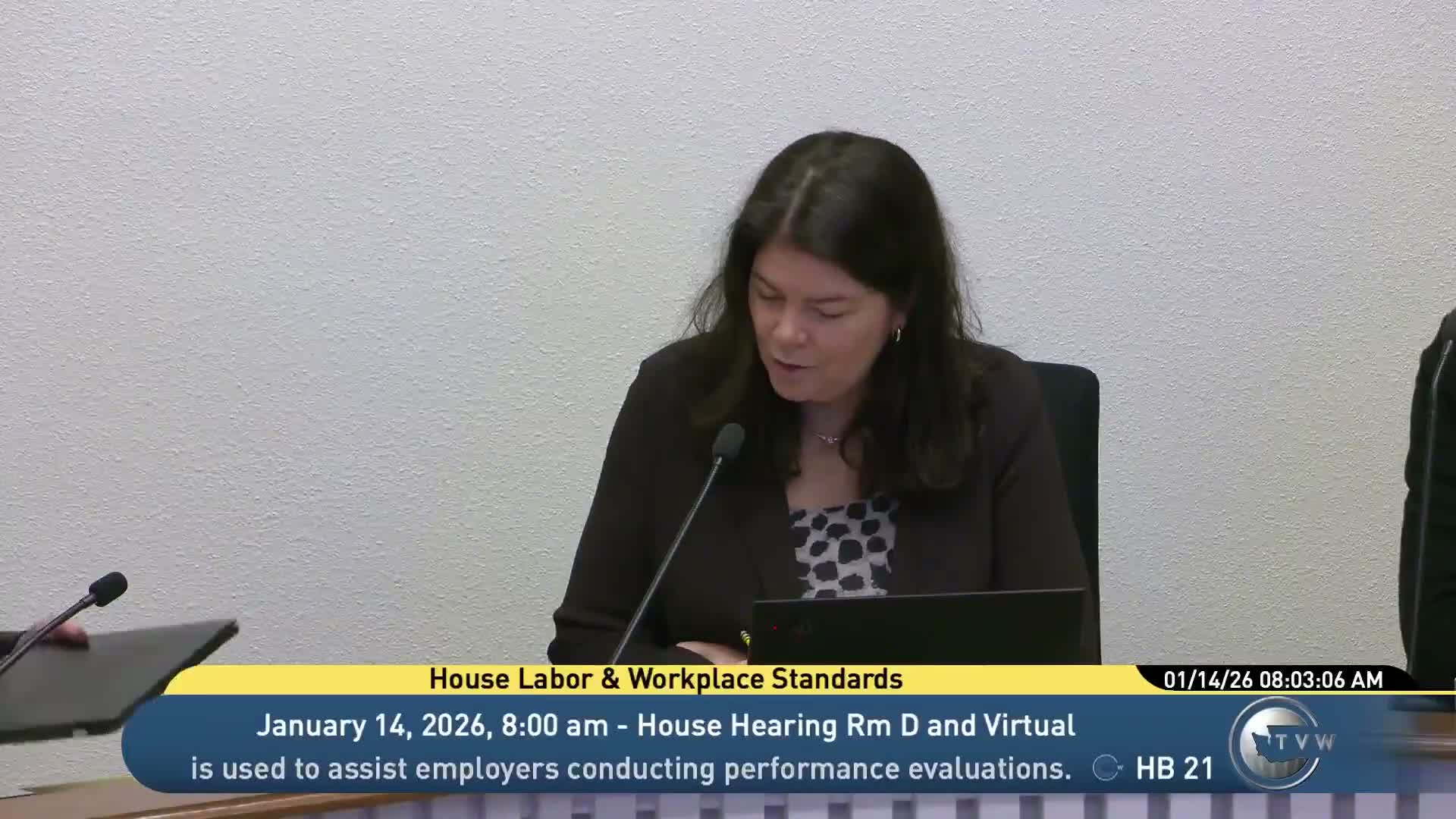
Committee members heard a staff briefing and extended testimony on House Bill 2144 on Jan. 14, which would require employers to provide written notice to employees when electronic monitoring is used to assist performance evaluations.
Staff defined electronic monitoring broadly, including AI, cameras, phones, telematics and other photo‑electronic systems, and described notice timing: existing systems require notice within 60 days of the bill's effective date; new systems require at least 30 days' notice before implementation. Staff said notice must describe how monitoring is used (for productivity tracking, summaries of performance, verification processes) and reiterated remedies: complaints to Department of Labor and Industries and civil penalties of $100 to $5,000 for willful violations and a minimum $5,000 for repeat willful violations; employees may also bring private causes of action and seek statutory damages and other relief.
Supporters told the committee notification is a matter of fairness and basic workplace transparency. John Treanor of the Washington State Labor Council said the bill "does not prohibit an employer from monitoring their workers. It simply requires them to inform workers of what they're doing." Samantha Grad of Teamsters 117 urged that collective bargaining representatives be notified as well at unionized worksites.
Business and industry witnesses pressed for narrower definitions and exceptions. James Crandall (Association of Washington Business) said the bill's definitions could sweep in routine technologies and prompt a quick wave of litigation under the bill's retroactive 60‑day look. Brad Tower (Community Bankers of Washington) and trade witnesses asked the committee to distinguish performance evaluations from security, fraud prevention and federally mandated devices (for example, electronic logging devices for trucking). The retail sector and construction representatives warned that broad notice timing could impede rapid deployment of safety technologies and impose burdens on small employers.
Law enforcement representatives noted their workplaces are atypical and that many monitoring tools (body‑worn cameras, recorded radio transmissions) are standard practice; they said the sponsor and stakeholders are discussing tailored language.
Committee members and witnesses indicated interest in drafting narrower substitute language to preserve transparency while addressing carve‑outs for safety and federally required systems.