Lifetime Citizen Portal Access — AI Briefings, Alerts & Unlimited Follows
Shining Mountain Montessori outlines plan for Carbonate Street childcare center, seeks county lodging-tax funds
Loading...
Summary
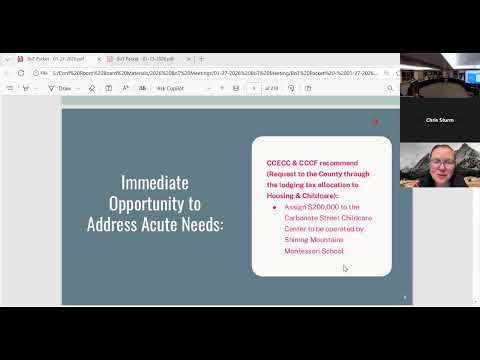
Shining Mountain Montessori presented a plan to operate a 4,600 sq ft Carbonate Street childcare center that would add 48 infant/toddler/preschool slots and about 12 staff; presenters asked the county for roughly $200,000 operating support and noted $1,286,000 in community project funding tied to the site.
Shining Mountain Montessori’s executive director, Emily Honey, told the Board of Trustees on Jan. 27 that the nonprofit would expand into the Carbonate Street space to add infant, toddler and preschool capacity and relieve a severe countywide childcare shortage.
Honey outlined a plan for a roughly 4,600-square-foot center with one infant classroom (8 infants), two toddler classrooms (10 each) and a children’s-house preschool room (20), producing 48 new slots. Combined with the school’s existing 20 full‑time spots, the expansion would represent a roughly 240% increase in the organization’s capacity, she said.
The presenters said staff estimates show payroll will be the largest single cost—about 82–83% of operating expenses—leaving narrow margins for other costs and financial aid. Start-up costs for materials and furniture were estimated at about $118,000 in year one, plus upfront leadership hires and training expenses to support a multi‑month ramp-up before tuition revenue stabilizes.
Megan Blaise, the school’s treasurer, described a tiered sliding-scale tuition model and a planned financial‑aid bucket intended to make spots available to families up to roughly 125% of Chaffee County area median income. The presenters gave example full‑price monthly tuitions of $1,800 for infants, $1,500 for toddlers and $1,350 for the children’s‑house program; before‑ and after‑care would be an additional fee ($5–$15/day depending on the model).
Town staff said a major portion of the project’s capital and completion funding is coming from community project funding (recorded in the presentation as $1,286,000 from Henderson’s office) and that the team plans to present to county commissioners on Feb. 9 to request lodging‑tax allocations set aside for housing, childcare and visitor experience enhancements. Staff asked the trustees for general support to proceed to the county presentation and to review a draft Memorandum of Understanding (MOU) at a future business meeting.
Trustees and several attendees pressed the presenters on staffing, licensing and the proposed schedule. Presenters explained multiple state certification pathways (college courses, workforce cohorts, on‑the‑job hours plus required CPR/first‑aid training) and said the program expects to hire about 12 employees to operate the expanded center. They also said workforce‑pipeline grants and partnerships will be used to recruit and train candidates.
A recurring point of concern from trustees and members of the public was the draft operating calendar: the MOU draft included a model with about 6 weeks of closure (holidays and staff training), which some trustees warned could create hardship for working families—particularly families with infants and toddlers who lack alternatives during school breaks. The presenters said the closure model is designed to balance staff retention and training needs and that they have explored multiple schedule scenarios.
The board did not vote on any funding for the Carbonate Street childcare center but agreed to let the team proceed with the county presentation and to return the MOU to the trustees as a future business item for more detailed review and any requested revisions.
The project’s next procedural step is the county commission presentation in early February and subsequent review of the MOU by the town board.