Get Full Government Meeting Transcripts, Videos, & Alerts Forever!
Get email alerts on the Medicare Data topic
No spam. Unsubscribe anytime.
CMS releases short‑term acute‑care PEPPER and a new portal; AO/AM accounts control initial access
Summary
CMS released the short‑term acute‑care PEPPER on Dec. 10, 2025 (covering Q3 FY2023–Q3 FY2025) and launched a new PEPR portal that currently allows only Authorized Officials (AO) and Access Managers (AM) to download reports; staff end‑user access is expected in spring 2026.
The Centers for Medicare & Medicaid Services released an updated short‑term acute‑care Program for Evaluating Payment Patterns Electronic Report (PEPPER) on Dec. 10, 2025, and launched a new portal to deliver the reports to hospitals and their authorized representatives.
Hannah Klein, a PEPR project team presenter for CMS, said, “A PEPPER is an electronic report that displays statistics on Medicare payments for discharges and services that are considered vulnerable to improper payments.” The release covers quarter 3 of fiscal year 2023 through quarter 3 of fiscal year 2025, and was provided to hospitals that had at least 11 claims in a target area during the most recent quarter.
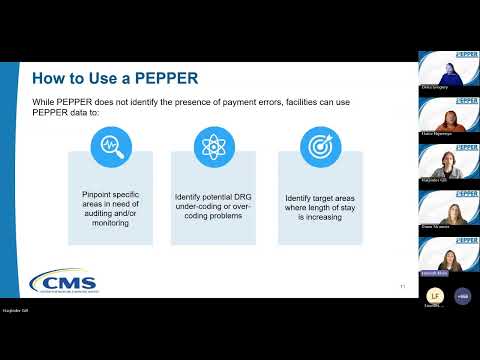
The report is intended as an educational tool. “PEPPER does not identify improper Medicare payments; it is an educational tool for providers to help identify payment patterns that indicate areas of risk for improper payments for further review,” Klein said. CMS emphasized hospitals should use PEPPER results to guide internal audits and monitoring rather than to presume wrongdoing.
CMS delivered the files as Excel workbooks. Dawn Strawser of the PEPR team described the workbook structure: separate tabs for the purpose and scope, target‑area definitions, a target‑area comparison report, national high‑outlier rankings and individual target‑area results. Outliers are visually flagged (high outliers in red bold; low outliers in green italics) and the workbook now places tables and corresponding graphs on the same tab for easier review.
The short‑term PEPPER includes 24 target areas. Some are coding‑focused target areas (the first 10 shown in the workbook) such as stroke intracranial hemorrhage and septicemia; others focus on admission necessity (for example, 1‑day stay DRGs and 30‑day readmissions). For admission‑necessity target areas the report displays only high outliers. Klein demonstrated how the metric is calculated with an example: a hospital with 24 numerator discharges and 27 denominator discharges would show an 88.9% target‑area percent and is compared to the national 20th and 80th percentiles to determine outlier status.
To access the portal, users must log in with a CMS Identity and Access Management (INA) account and be registered as an Authorized Official (AO) or Access Manager (AM) in PECOS. Klein said the portal will display a dropdown of CCNs (CMS Certification Numbers); an AO or AM must select a CCN and then click the file name to download that facility’s PEPPER workbook. “If you do not see your organization’s CCN listed, please check with your organization’s AO or AM or the EUS help desk to verify that you are listed as an AO or AM for that CCN,” Klein said.
During the question‑and‑answer session, Dina (Q&A facilitator) and others acknowledged initial access problems for some users and provided the PEPR help‑desk contact (cms_cbrpepper@cms.hhs.gov) and the public PEPR resources page (pepper.cbrpepper.org). Dina said, “At this time, only the AOs, the authorized officials, as well as the access managers, the AMs, have access to the portal to access and download the report.” CMS staff end‑user (SEU) roles are scheduled to be enabled in spring 2026; until then staff should request their AO or AM to download reports on their behalf.
Panelists also explained that the PEPR team cannot provide identifiable patient lists tied to PEPPER target areas; providers can attempt to replicate the counts using the inclusion/exclusion criteria in the user guide. For more detail on what changed in this release, the presenters directed attendees to page 3 of the PEPR user guide and to the posted slide deck and recording.
Closing the webinar, Jinder Gill urged participants to review their PEPR reports and use them for internal audits, and reiterated that slides, the recording and the transcript would be posted for later reference.