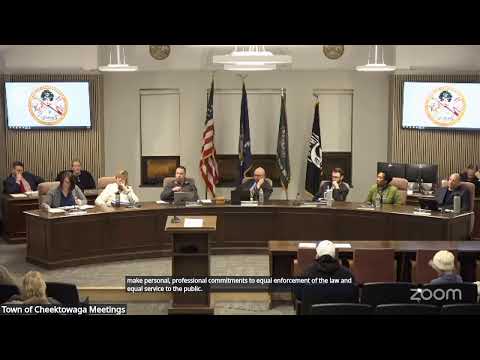
Residents urge Cheektowaga to end cooperation with ICE; board to review police policy
Loading...
Summary
Dozens of residents told the Town of Cheektowaga on Jan. 27 they want the town to end cooperation with federal immigration enforcement, citing recent deaths in custody and unclear local policy; board members said they will seek varied perspectives and consider a resolution to limit nonessential cooperation.
Dozens of residents used the town’s public‑comment period on Jan. 27 to press the Town of Cheektowaga to stop cooperating with U.S. Immigration and Customs Enforcement (ICE), while some residents and officials defended local police and urged civility in the discussion.
The public‑comment portion opened with several speakers asking the board to adopt a formal ban or resolution similar to actions taken by nearby jurisdictions. Holly Nowak, a longtime resident, said she was ‘‘imploring all of you to do what is right and to end cooperation with ICE now.’’ Other speakers, including Jessica Greenwald, a Cheektowaga firefighter, criticized town policy 414 as vague and said a one‑hour training module is insufficient to address alleged misconduct and reduce lawsuit risk.
Why it matters: The comments followed national coverage and videos of federal immigration actions and local reporting that residents said indicated regular contact between Cheektowaga officers and federal agents. Residents told the board that unclear local policy and inconsistent training could expose the town to legal liability and erode trust between police and immigrant community members.
Board response and next steps: Supervisor Brian Nowak acknowledged the strong feelings on both sides and said he would work with board members and local partners to gather ‘‘varying perspectives’’ on balancing public safety, legal limits and community trust. Councilman Vern Thompson said he will pursue a resolution limiting ‘‘nonessential cooperation’’ between the Cheektowaga Police Department and ICE and emphasized the goal of protecting constitutional limits and minimizing civil‑liability exposure. Thompson framed his proposal as aimed at ensuring local police focus on state and local public‑safety responsibilities, not federal immigration enforcement.
Competing claims at the podium: Several speakers defended CPD’s cooperation with federal agencies as necessary for investigations. Dennis Emery Hannon, who said he had worked as a confidential source for the FBI, argued that ‘‘tragedy happens when we stop communicating’’ and warned against impeding investigations. The exchange at times grew heated but the board repeatedly urged decorum and the protection of free speech.
Accusations and clarifications: Some public speakers alleged the town had routinely referred cases to federal agencies and cited a figure of ‘‘21 cases in Cheektowaga’’ as evidence of regular cooperation; others said those reports mischaracterized police practice. The town noted a recent retraining of officers and told the public it would review the CPD’s policy language (recorded in the meeting as policy 4 1 4 / 4014) and meet with the chief and stakeholders to clarify suspicious‑activity standards and communication protocols.
What’s next: The board did not adopt a formal ban during the meeting. Council members said they intend to develop language and work with the police chief, town counsel and community stakeholders to propose a resolution or policy clarifications at a future meeting. The meeting closed the public‑comment period and moved on to other agenda items before adjourning to executive session for litigation and personnel matters.