
Beloit board hears two providers propose one-school literacy pilot; district to decide next steps
Get AI-powered insights, summaries, and transcripts
Sign Up Free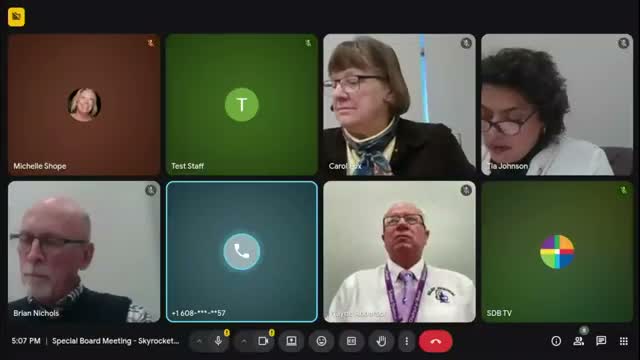
Summary
Skyrocket Education and Open Literacy presented a proposed three-year, one-school pilot to the Beloit School District board on Jan. 29, detailing a combined leadership-coaching and high-impact 1:1 tutoring model with 60 tutoring slots. Board members asked about alignment with district systems, student selection and long-term sustainability.
Beloit School District board members on Jan. 29 heard presentations from two education providers offering a proposed one-school pilot focused on leadership coaching and high-impact tutoring.
Michael, identified in the meeting as the "CEO and founder of Skyrocket Education," described Skyrocket’s hierarchical coaching frameworks, an initial audit process and intensive on-site support designed to help school leaders, instructional coaches and teachers align practice to measurable outcomes. "I am the CEO and founder of Skyrocket Education," he said, explaining the company starts work with an audit and then supports schools with frequent, site-based coaching and accountability measures. Michael said Skyrocket typically begins with an audit, provides on-site coaching and goal-setting, and expects high partner engagement, describing the arrangement as "high touch." He told the board Skyrocket currently maintains a small core staff and a network of consultants and can scale to work with multiple schools when needed.
Sarah Scott Frank, "the founder and CEO of Open Literacy," outlined Open Literacy’s virtual 1:1 tutoring model and the evidence base the organization cites from pilots in other districts. "I'm Sarah Scott Frank, the founder and CEO of Open Literacy," she said, and described work in Oakland and Milwaukee that started small and scaled based on data. She said Open Literacy aligns to the UFLI scope and sequence, employs certified teachers, maintains detailed substitute systems so sessions continue when tutors are absent, and is participating in a randomized-control evaluation that involves Johns Hopkins and aims toward ESSA Tier I evidence.
Together, the presenters and the foundation representative framed the proposal as a focused, three-year pilot intended to surface systems-level lessons for Beloit, not as a districtwide rollout. Sarah noted the proposal would provide "seats" rather than permanent spots tied to particular students: "Just 60 students," she said, clarifying seats can be reallocated when a student "graduates" from the program after meeting mastery benchmarks.
Board members pressed presenters on several operational and policy questions. Board member Megan Miller asked how the providers’ work would align with existing district initiatives, including the district’s "portrait of a graduate" work and MTSS structures; Michael said Skyrocket is curriculum-agnostic and focuses on how well existing programs are executed. Miller also raised concerns about the transferability of gains on benchmark measures to high-stakes state tests and about long-term sustainability; Sarah cautioned that some standardized tests are not sensitive to growth for students far behind grade level and urged a multi-year view of progress.
Megan and other board members also asked about legal compliance under Wisconsin’s Act 20, which had been raised in discussion of instructional approaches. One board member described limits in the state's law around certain cueing strategies; Sarah responded that Open Literacy emphasizes comprehension and phonics and said the organization seeks to avoid approaches that merely encourage guessing. The transcript indicates there was a back-and-forth on the topic but no formal legal determination.
On logistics, Dr. Anderson said the district and school principals would determine which students receive the 60 slots, with selection criteria likely to include attendance and fit within the district’s tiered supports. Sarah said Open Literacy is cautious about exiting students too quickly from tutoring and that exit decisions are made jointly with schools based on mastery and benchmark data.
No formal vote or contract action was taken at the meeting; the board instead heard the presentations and held a Q&A. Two procedural motions—approval of the meeting agenda at the start of the session and a motion to adjourn—were moved by Brian Nichols and seconded by Carol Fox and carried unanimously. The meeting adjourned at 6:31 p.m.
What happens next: presenters and district leaders did not complete a formal agreement at the meeting. Board members indicated interest in hearing further from principals and building leaders about readiness and conditions for success before any pilot contract is executed.