Residents urge Monroe County to plow private roads; highway officials say funds limited to maintained roads
Loading...
Summary
A resident appealed to Monroe County Council to plow private roads where neighbors and emergency responders were impeded after a 12–16 inch snowfall. Highway staff said county motor-vehicle-highway funds are restricted to county-maintained roads and outlined developers’ unresolved obligations; councilors urged commissioners and emergency management to explore short-term fixes.
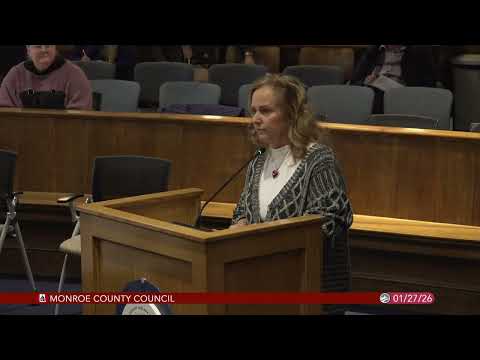
Skip Daly, a Monroe County resident, urged the council during public comment to intervene for neighborhoods that were left without plowing after last weekend’s storm.
“Plow them out. Find the money or the means to make it work today, tonight,” Daly told the council, naming Geranium Lane as an example of a street where residents were trapped and first responders could not easily reach homes.
Lisa Ridge of the Monroe County Highway Department told the council the department deployed about 45 employees who worked around the clock for roughly 48 hours to respond to the storm and that average snowfall in the county was 12 to 16 inches. Ridge said the direct cost for labor, equipment and materials for that event was $297,812.07.
Ridge explained a legal and fiscal constraint cited repeatedly in the meeting: the county’s motor-vehicle-highway funding is calculated in part from the mileage of roads the county formally accepts for maintenance, and private roads do not bring additional state funding. “We are very restricted on what our funds can be used for,” she said, adding the department cannot legally use those funds on private roads.
Council members pressed for emergency options. Several suggested the board of commissioners could declare an emergency or use rainy-day funds or coordinate with emergency management to contract a one-time contractor to free trapped residents. Councilor Wiltz and others framed the situation as both a public-safety and a planning issue: multiple councilors observed the problem stems from unfinished subdivisions where developers have walked away and bonds or HOA actions have been used sometimes to complete improvements.
Ridge said the county has over 60 subdivisions on a list being worked with planning and legal; she cited past examples where bond money or homeowner associations led to completion of streets and subsequent county acceptance. But she warned that unilateral county action to plow all private roads would create an incentive problem and could divert scarce gasoline-tax-derived funds away from county roads.
Councilors asked county legal and commissioners to provide clearer public information on which neighborhoods are affected, which legal processes are in litigation, and whether an emergency declaration—if issued—would open other funding or operational options. Several members urged prompt coordination with the commissioners’ office and emergency-management staff to identify immediate contractor options for the most acute, safety-critical sites.
The council did not adopt a formal emergency appropriation or vote on a procedural fix at the meeting; members repeatedly noted the ultimate authority on these operational and appropriation matters rests with the board of commissioners and county legal staff. The council concluded the item with direction to the county’s executive offices to pursue short-term options for sites posing immediate public-safety risks and to return with clearer cost estimates and legal pathways.